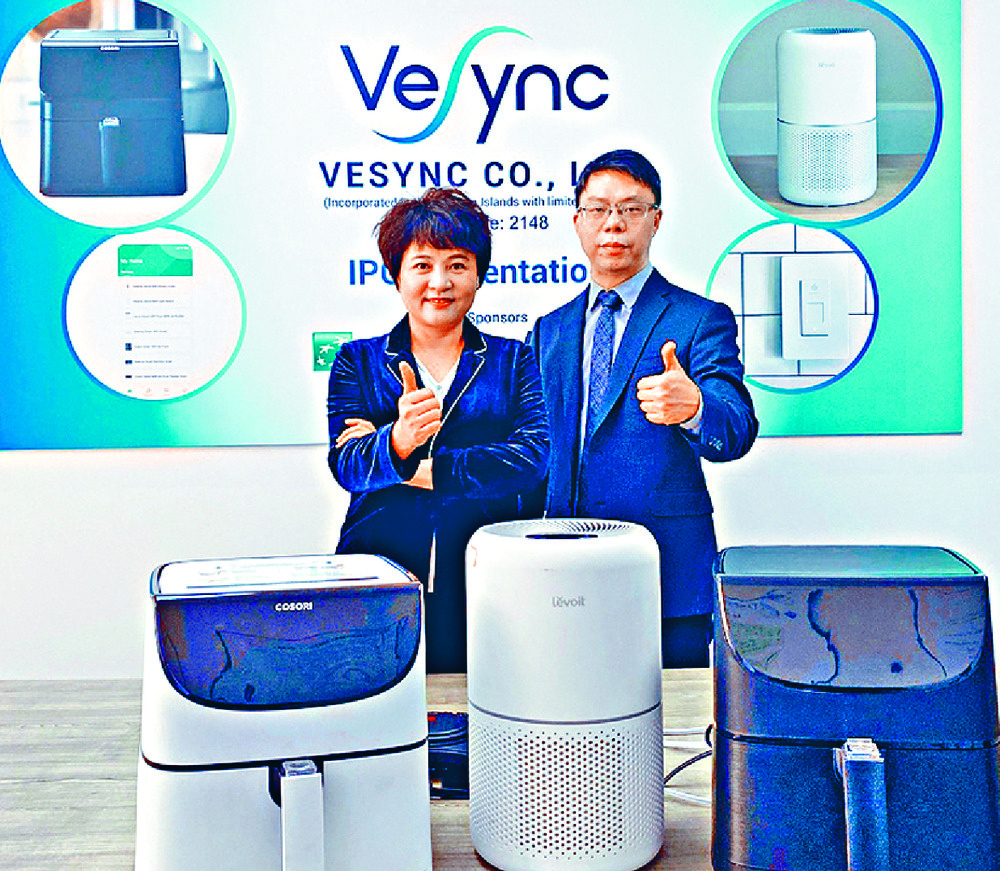
The photograph has the cheerful awkwardness of a business learning to introduce itself. Yang Lin stands beside her chief financial officer, surrounded by air fryers and an air purifier. Both give a thumbs-up. Behind them is the VeSync name. In front of them are the things that make the name matter: objects destined for somebody else’s kitchen counter or living room.
For a founder, it is a useful arrangement. The people are visible, but the appliances have taken the front row. Yang has built her career around products that enter a home, acquire a regular job and, if they do it properly, become unremarkable. An air fryer rarely gets thanked for an uneventful Tuesday.
By 2024, the group she founded was reporting annual revenue of $652.6 million. Its brands included Etekcity, Levoit, Cosori and the newer Pawsync. In May 2025, VeSync’s shares left the Hong Kong Stock Exchange, less than five years after their debut. Yang was also the sole director of Victory III, the offeror in the privatization. The founder who had accompanied the business into public ownership was involved in bringing it out again.
A different sort of apprenticeship
Yang’s route into appliances began at some distance from the factory floor. In December 2004, she completed a master’s degree in law at East China University of Political Science and Law. From January 2005 to March 2007, she worked at Community CPA & Associates Inc., where her last position was office manager.
The work included preparing financial statements and management reports, tax filings and business consultation for individual and business clients. It was an apprenticeship in the paperwork that accompanies other people’s ambitions. A business has to explain itself in numbers long before it gets to explain itself in an advertisement.
In October 2006, during that period of employment, she established L&H Y US in the United States and began trading small home appliances and electronic gadgets. The overlap is an interesting detail. Her early business history contains a gradual transition, with her trading venture beginning while she still held her accounting-firm job.
There are several dates to keep straight. The trading origin was 2006. Etekcity US began selling small appliances on Amazon in 2011. The Etekcity brand followed in 2012. Each date describes a different development: starting a business, finding a channel, then putting a recognizable name on what it sold.
A name on the box
A brand makes a particular demand of its owner. A trader can move on to the next item; a name on a box follows the product home. The customer remembers it when something works, when something disappoints, and when another purchase comes around. For Yang, the move into brands made the business more identifiable and its promises more durable.
The expansion acquired a geographic shape, too. A Shenzhen office was formed in 2013 to strengthen design and development. Etekcity entered the European Union market that year and Canada in 2014. The VeSync app was developed in 2015. Levoit and Cosori were launched in 2016. These milestones describe a company adding capabilities as well as destinations.
Cosori’s first air fryer arrived in 2018, followed by a smart air fryer in 2019. A cooking appliance could now belong to a software platform as well as a cupboard. There is a certain domestic comedy in that progression: the kitchen counter, already short of space, becoming another place where the digital world expects to be accommodated.
Yang’s English-language product announcements use the name Grace Yang. A signed company statement gives the fuller version, Grace Lin Yang. The names point to the same founder, appearing in different parts of an international business: Yang Lin in corporate biographies, Grace Yang beside announcements about the next appliance.
The founder in the drawings
There is another place where her name appears, and it is less conversational than a product launch: the inventor field of an appliance design patent. Lin Yang and Hai Yang are named together on US design records for a pressure cooker, a garment steamer, a sous vide cooking stick and an electric blender.
The distinction matters. A design patent concerns ornamental appearance. It does not establish that the named people invented every mechanism inside the appliance. It does place Yang’s name beside decisions about how household objects look. For a founder whose formal postgraduate education was in law, that is a striking addition to the career record.
The pressure-cooker design was published in October 2019. The garment-steamer design was published in March that year. Its drawings proceed through the object’s views: front, rear, sides, top and bottom. The familiar appliance becomes a carefully described form, examined from every direction. Even a steamer has to be ready for its close-up.
The sous vide cooking-stick design was published in June 2019; the electric-blender design followed in June 2021. Seen together, they offer a small catalogue of domestic tasks. Cooking, blending and getting the creases out of a shirt are hardly exotic ambitions. They are, however, activities customers repeat. That repetition gives apparently modest objects a substantial place in daily life.
Hai Yang is her brother. Before joining Etekcity Corporation in December 2011, he worked as a software engineer at AsiaInfo and Ericsson, on billing systems and gateway-server development. He later became VeSync’s vice president, with responsibility for sales, marketing and online operations. Their shared patent credits sit within an actual working relationship, with different professional histories behind it.
“All our efforts are for users.”
Yang Lin, chairperson’s statement, March 2022
What happens after the sale
The shared app added a different question to Yang’s business. Selling a device is one transaction. Connecting it to software creates an ongoing relationship, with settings, controls and the expectation that the product will remain useful after the packaging has been thrown away.
At CES 2022, Yang described an interest in extending that relationship beyond VeSync’s own brands: “We are open to partnering with other brands in expanding their smart home ecosystem.” The proposition was practical: other companies could use VeSync’s app and technology to expand the capabilities of their smart products.
The company’s exhibition invited visitors to test and connect devices in an interactive home setup. That is a revealing way to demonstrate the idea. A connected home has to survive an encounter with somebody who has other things to do. Convenience becomes easier to judge when a person can actually press the button.
Cosori’s Aeroblaze indoor grill, announced in November 2021, offered eight cooking functions, including grilling, roasting, baking and dehydrating. The app supplied remote controls, recipes and notifications. A single appliance thus carried two kinds of work: the physical business of cooking and the less visible business of helping somebody decide what to make.
In 2022, VeSync received German Brand Awards in two categories. Yang’s accompanying comments emphasized meaningful experiences and connected lifestyles. The language connects with the short sentence in her chairperson’s statement about users. The customer’s routine keeps returning as the organizing idea, whether the occasion is an award, an exhibition or an annual business review.
A bigger business, a smaller public footprint
On December 18, 2020, VeSync listed on Hong Kong’s Main Board. The offering issued 281 million shares, excluding the over-allotment, at HK$5.52 each, raising approximately HK$1.551 billion. For a business built around small purchases, the arithmetic had acquired a different scale.
By then, Etekcity, Levoit and Cosori were selling across markets including the United States, Canada, Britain, Germany, France, Spain, Italy and Japan. The listing put an international consumer business into a new public setting. The founder’s job now included the recurring scrutiny that comes with publicly traded shares.
Annual revenue at VeSync
Growth brought its own demands. In 2021, the product-development team grew to 502 employees, and the group recruited managers with experience at companies including Huawei, Tencent, Dyson and Microsoft. Its products had entered more than 7,649 North American stores. The operation required people who could organize a larger business as well as develop another product.
Yang’s account of the company emphasized combining capabilities across countries: creativity, design and service in the United States with China’s supply-chain system. It is a useful description of her role. The products may look self-contained on a shelf, but the business depends on coordination across borders, professions and retail channels.
For 2024, VeSync reported $93.0 million in profit attributable to owners of the parent. Sales outside Amazon accounted for 25.5% of revenue, up from 22.0% the year before. Yang’s March 2025 outlook emphasized improving products, building brands, widening channels and strengthening the organization, while acknowledging pressure from geopolitical tensions and tariff barriers.
Then came the change in ownership structure. VeSync’s shares were delisted on May 7, 2025, following privatization through a scheme of arrangement. Yang’s position at the offeror placed her directly in that transaction. The stock-market chapter had an opening date and a closing date; the work of running the business continued beyond both.
Tomorrow’s ordinary purchase
Yang’s career is easy to miss if the search begins with a single brand. Someone shopping for a Cosori air fryer may never look for the founder of VeSync. Someone buying a Levoit appliance may have no reason to connect it with Etekcity. The company’s names are distributed around the home; the person behind them is less immediately visible.
Put the record together and a particular career emerges: legal education, accounting-firm work, appliance trading, brands, design credits, software and decisions about ownership. The progression has required different kinds of competence. A financial statement and a blender drawing are unlikely companions, but both belong in Yang’s story.
Return to the photograph and the arrangement makes sense. Yang is standing behind the products, giving the camera a thumbs-up. Those objects will eventually leave the presentation and enter less ceremonial surroundings. A crowded counter. A hurried dinner. A shirt needed tomorrow morning. Her business has been built around earning a place there.