The first object Sunny Han had to market at Nanoleaf resisted the easy picture. It screwed into an ordinary socket, but it did not resemble the soft pear shape that has signaled “light bulb” for generations. Its twelve flat faces met at dark seams. Tiny LEDs dotted the planes. It looked a little like an engineering model and a little like something folded from card stock. In 2013, that strangeness helped the NanoLight travel: 5,746 Kickstarter backers pledged $273,278 to the campaign. But attention only opened the door. Someone still had to explain why this unfamiliar thing belonged in a familiar room.
Han joined Nanoleaf’s early marketing work around that crowdfunding period. Her career since then has been less a string of separate jobs than a long apprenticeship inside one changing idea. She moved from specialist to director, then vice president, and in July 2022 to chief marketing officer. Through those title changes, Nanoleaf moved from efficient bulbs to connected lighting, modular wall panels, and a wider smart-home portfolio. The objects changed. The core marketing problem did not: translate a new behavior without sanding away the detail that makes it credible.
The useful kind of strange
Early-stage hardware marketing has an odd burden. Software can hide complexity behind a rectangle of glass. Hardware sits on the table. People notice its seams, weight, heat, color, noise, and every compromise made on the way out of a factory. The marketer cannot invent distance from the product. Good copy has to live close to the object.
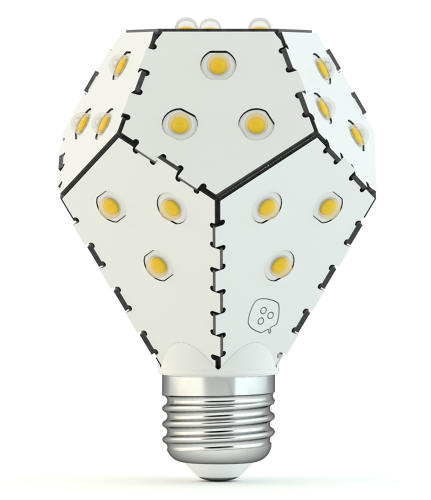
Han’s early public explanations show that closeness. When Nanoleaf introduced the Bloom in 2014, its trick sounded suspiciously like magic: it could dim through a conventional wall switch, without installing a dimmer. Han described the mechanism in concrete terms. A custom microprocessor watched for a break in AC power. If the interruption lasted less than half a second, the bulb read it as a command. A longer interruption simply turned it off. A novel feature became an action anyone could test with a finger.
“We’ve never stayed still.”Sunny Han, reflecting on Nanoleaf’s evolution
That half-second detail is a tiny masterclass. Start with the visible benefit: dim the bulb from the switch already on the wall. Keep the mechanism close enough to answer the obvious question: how? Then stop. The explanation is specific without becoming a circuit diagram. It respects both the engineer who built the behavior and the customer deciding whether to trust it.
Power break under 0.5 seconds
Flick the familiar switch
Dim light, no rewiring
The launch continues after launch day
The same 2014 moment contained a less comfortable lesson. Some early customers had complained that the first product cast an unwanted green hue and did not meet expectations. Han’s response was plain: the color issue had been fixed, and customers who contacted the company received replacements. There was no poetic frame for a color problem. The marketing job was to describe the correction.
That distinction matters in hardware. The launch video may end, but units remain in kitchens and bedrooms. Customers compare the promise with the physical thing every night. A team earns credibility by treating service, replacement, and explanation as part of the product story, not as an embarrassing appendix to it. Han’s early record shows a marketer willing to discuss the switch logic and the imperfect first impression in the same conversation.
Let the customer see what changes in a room before asking them to absorb the mechanism.
A precise technical detail can turn a surprising claim into something believable.
Corrections and replacements tell customers how the company behaves when the object disappoints.
Long-tenured operators remember which promises worked and which ones created avoidable confusion.
When the product becomes the room
Nanoleaf’s most important visual shift was from the bulb as an appliance to light as a composition. Its modular panels could be joined into larger patterns, controlled through an app, and synchronized with other experiences. The unit of the story changed. It was no longer merely watts and lumens. It was the wall, the desk, the atmosphere around a game, or the color of an evening.
For marketing, this was liberating and dangerous. A geometric panel photographed well. Customers could become demonstrators by posting their own layouts. Yet expressive products can drift into pure spectacle, admired in a feed and never pictured in an ordinary home. Han’s through-line has been to close that distance. In her recent account of Nanoleaf’s evolution, she described the goal as taking emerging technology and making it intuitive, well designed, and usable in everyday life. The brand wants the demo to become a habit.
Her own path mirrors that broadening canvas. Public career records place her at Nanoleaf from its early marketing-specialist stage, through global planning as a director, to vice president in 2021 and CMO the following year. Today she sits on the leadership team and oversees a marketing organization that includes brand, creative, public relations, regional marketing, and ecommerce functions. The person who once explained a single switch gesture now has to make many products and channels sound like one company.
One company, a widening brief
Institutional memory as an operating edge
Thirteen years at a consumer-hardware company is unusual because hardware companies contain so many clocks. A campaign can change this afternoon. A product roadmap may stretch across years. Manufacturing decisions lock in earlier than customers realize. Retail calendars introduce another rhythm. Standards, apps, and home platforms create dependencies outside the company’s control. In that environment, memory is not nostalgia. It is a map of prior promises.
Han can remember when the pitch centered on efficiency, when a bulb’s unusual geometry itself created attention, when customers needed a replacement, and when modular panels opened a different emotional territory. That memory lets a marketer ask better questions of the next idea. Is this genuinely new, or simply new language? Does it extend the reason people already care? Can a customer explain it without repeating the press release?
Her 2026 reflection on the company’s brand work is revealing because it emphasizes revision. She described “thinking, rethinking, and challenging ourselves” over what Nanoleaf should become. The phrase feels like the workbench version of strategy: place the idea down, turn it around, argue with it, and see whether it still connects to the object people know.
A durable brand is not a slogan preserved in glass. It is a translation system that remembers what customers already understand.The operating lesson in Han’s tenure
A practical playbook for unfamiliar products
The most stealable lesson from Han’s career is sequence. First, find the product’s useful strangeness. The faceted bulb looked different and consumed less energy. The Bloom behaved differently but used the switch people already had. Modular panels changed the wall itself. Each story began with a contrast a customer could notice.
Second, make the demo legible. A beautiful video can create desire, but a repeatable action creates understanding. Flick the switch. Join the panels. Choose the scene. If someone can imagine doing it, the product has crossed part of the distance from novelty to possession.
Third, answer friction with the same specificity used to sell the feature. Hardware customers remember whether a company acknowledges the unit in their hands. The reply to a green hue is not an aspiration. It is a fix and, when needed, a replacement.
Finally, let the brand move without pretending it has no past. Nanoleaf no longer needs to introduce itself as a crowdfunded light-bulb experiment. Still, the early discipline remains relevant: modern technology must be translated into a thing someone can use in a room they know. Han’s long tenure gives that ambition continuity. She has watched the company enlarge the canvas while keeping the customer’s home as the final test.
That is also why her career resists the usual founder-centered account of a young technology company. Nanoleaf was started by three engineers, but products do not enter culture through engineering alone. They need a vocabulary, a demonstration, an answer when the demonstration meets reality, and a team that can repeat the idea across markets without flattening it. Han’s progression records that less visible layer of company building. The work accumulates in launch pages, retail displays, interviews, support responses, and the internal arguments that precede a new identity. None is the whole brand. Together they determine whether an unusual object remains a curiosity or becomes a category people recognize.
A light is easy to notice and hard to describe. It changes a room while disappearing into the experience of the room. Han’s work has lived inside that paradox for more than a decade. The products became more connected, colorful, and programmable. Her essential task stayed modest and difficult: make the new thing clear enough that it can stop feeling new.