Consider the difference between sending money and receiving it. A sender sees a screen, an amount and a confirmation. A recipient needs something rather more practical: cash for groceries, a usable bank balance, credit on a phone. Between those two experiences sits Xoom. Its business becomes easier to understand when you stop looking at the button and start looking at the person waiting at the other end.
- Xoom moves personal money across borders through several receiving methods.
- Its reach depends on local banks, wallets and cash partners.
- Compare the final payout, including the exchange rate, before sending.
The recipient is the design brief
Founded in 2001 by Kevin Hartz and Alan Braverman, Xoom grew around a recurring consumer task: supporting people abroad. Hartz was its early CEO; John Kunze became CEO in 2006. PayPal bought the company in 2015. The founding story belongs to the early internet, but the underlying problem is older: how to help someone far away without making distance their problem, too.
Today, Xoom describes coverage in over 150 countries, with particular attention to corridors including India, Mexico and the Philippines. Customers can arrange bank deposits, eligible debit-card deposits, mobile-wallet transfers, cash pickup and home delivery in selected markets. Phone reloads and supported bill payments extend the same idea: sometimes the useful thing to send is the payment for a particular need.
The workflow is straightforward. Select the destination, enter an amount, choose an available receiving method, provide the recipient’s details and review the quote. Eligible customers can use funding sources connected to PayPal. Receiving options vary by country. A person collecting cash need not acquire the sender’s banking setup or become an enthusiastic app user. That asymmetry is part of the appeal.
“Be there, even if you can’t be there.”Xoom’s website
Sender→02
Xoom + partner→03
Spendable money
The number PayPal was buying
When PayPal announced the acquisition in July 2015, it put the enterprise value at approximately $890 million, with a cash price of $25 per share. Buying Xoom offered a faster entrance into international remittances. The purchase was also a bet on established relationships at both ends of a transfer, rather than on a useful interface alone.
At the November closing, PayPal reported 1.5 million active U.S. customers and approximately $7.1 billion sent during the preceding twelve months. Then came the revealing detail: 97% of payment volume came from repeat users. That is payment volume, not a customer-retention percentage. Still, it suggests the service had found a place in routines people returned to.
of payment volume came from repeat users.
Historical snapshot · acquisition closing, November 2015
A family payment is rarely a one-off novelty. Bills return. So do school costs and everyday expenses. For a product team, the interesting question is what makes the next transfer easier. Familiar recipient details, recognizable delivery options and a process already used successfully can matter more than another reason to download an app. That is an interpretation of the repeat-volume figure, not a claim that every customer stayed.
Read the second price tag
Xoom’s economics are less mysterious than its network. It charges transaction fees where applicable and earns money through currency conversion. Its fee guidance says the price varies with the transaction, payment method, amount, destination and receiving currency. The exchange rate includes a spread. A credit-card issuer may add a cash-advance fee of its own.
For a sender, the sensible comparison is the amount the recipient receives for the same total outlay, using the same delivery method. A bank deposit and a cash collection are different services. Compare Xoom with alternatives such as Remitly, Wise or Western Union on the route you actually need. A country count cannot tell you which counter is convenient for your mother.
The funding method can affect timing, too. Xoom’s payment-method guidance says some larger bank-funded transfers may wait up to three business days for payment to arrive. A service advertising speed still has to accommodate bank clearance and review. For an urgent bill, check the displayed delivery estimate before treating the transfer as money already available.
The $30.8 million weak point
There is a less comfortable chapter. In December 2014, employee impersonation and fraudulent requests aimed at Xoom’s finance department led to $30.8 million of corporate cash being sent overseas. Its annual filing said the investigation found no evidence of system penetration or harm to customer funds or data. Xoom strengthened internal controls following the incident.
The lesson concerns the institution behind the screen. A company moving money needs dependable approval procedures inside its own office as well as safeguards around customer transactions. Here, the documented failure involved requests to the finance team. The disclosed response was procedural change. There is no need to invent a dramatic founder conversion to see what the loss forced management to address.
New rails, familiar destinations
Recent product changes keep returning to the receiving end. In 2023, Xoom expanded Visa Direct-enabled debit-card deposits across borders, launching in 25 markets. Funds could become available within minutes, although the receiving institution and region affect actual availability. The card already in someone’s pocket became another destination for a family transfer.
In April 2024, eligible U.S. customers gained PYUSD-funded transfers without a Xoom transaction fee. The stablecoin is converted to dollars for funding; recipients receive the selected fiat currency. A currency-conversion spread can still apply. November brought announced plans for PYUSD settlement with Cebuana Lhuillier and Yellow Card, aimed at improving the machinery between partners.
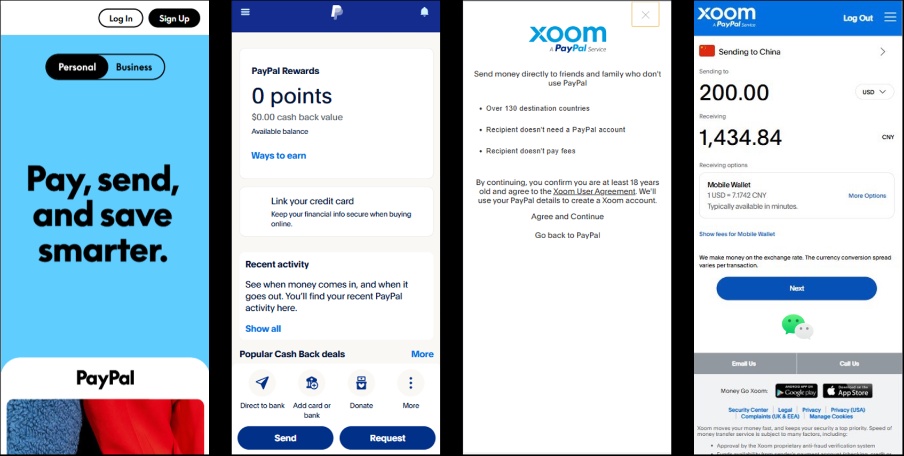
In April 2025, Tenpay Global connected Xoom to Weixin Pay. The launch let users in the United States, Canada and Europe send to Weixin Pay Wallet Balance or linked bank accounts in China. For recipients, the useful change was access inside an existing payment environment. The transfer arrived closer to where daily spending already happened.
Build backward from the kitchen table
The transferable idea is modest: begin with the recipient’s next action. Can they collect the cash, access the account or use the wallet? The approach depends on partner coverage, opening hours, verification and a competitive final quote. Where those conditions do not fit, another service may suit the job better. Xoom’s story makes the endpoint tangible. A transfer succeeds when someone can finally do something with it.