Before Xiaoxi Wei had a company to explain, she made a living explaining other people’s business. For two years after university, she worked as a business translator. Then she went to Buffalo to study chemistry. In October 2014, the newly minted PhD co-founded X-Therma in the San Francisco Bay Area. Translation would remain a useful occupation: she now had to make a molecular idea intelligible to the people who might help build a business around it.
Her career has moved between those two demands ever since. There is the exacting work of understanding how molecules behave. Then there is the work of persuading an institution, a collaborator, or an investor that the behavior deserves further investigation. A useful experiment and a convincing explanation have different requirements. Wei has spent more than a decade dealing with both.
A childhood with permission to dismantle things
Wei grew up in Dongying, China. Her father was a petrochemical engineer with a business involving heat-transfer technology. At home, he encouraged her to take things apart and work out how they functioned. Scientific curiosity had an unusually practical welcome: the machinery could be opened, and the child doing the opening was encouraged.
In 2003, her performance on China’s college entrance examinations disappointed her. Her parents treated the result as a beginning with room for improvement. She entered Ningbo University, studied biotechnology, and graduated with highest honors in 2007. The sequence is a useful corrective to a tidy résumé. The achievement came after a result she had found discouraging.
The two years of translation followed. In 2009, she moved to the United States for graduate study, changing her academic focus to chemistry. It was a decision to spend several more years learning a different set of tools before setting up her own venture. Ambition, in this instance, included returning to the classroom.
Buffalo, and the people in the small print
At the University at Buffalo, Wei studied with Bing Gong, whose work concerns supramolecular chemistry: how molecules organize into larger structures. This was the research setting in which she developed her scientific training. Her doctorate was completed in 2014, the same year as that of Mark Kline, the fellow student who became her husband and co-founder.
Look at the papers and the connection becomes more tangible. Wei and Kline appear together among the authors of research on synthetic nanopores. A 2012 Nature Communications paper investigated self-assembling structures with selective transport properties. A 2016 paper, “Persistent Organic Nanopores Amenable to Structural and Functional Tuning,” again lists both researchers alongside Gong and other collaborators.
Those titles offer a less glamorous, more useful view of a founder’s preparation. Before the financing announcement comes a particular scientific question, a set of methods, and a long author list. Wei’s later company grew from someone trained to care about molecular structure in detail. The professional partnership with Kline also had an academic history before it had a corporate one.
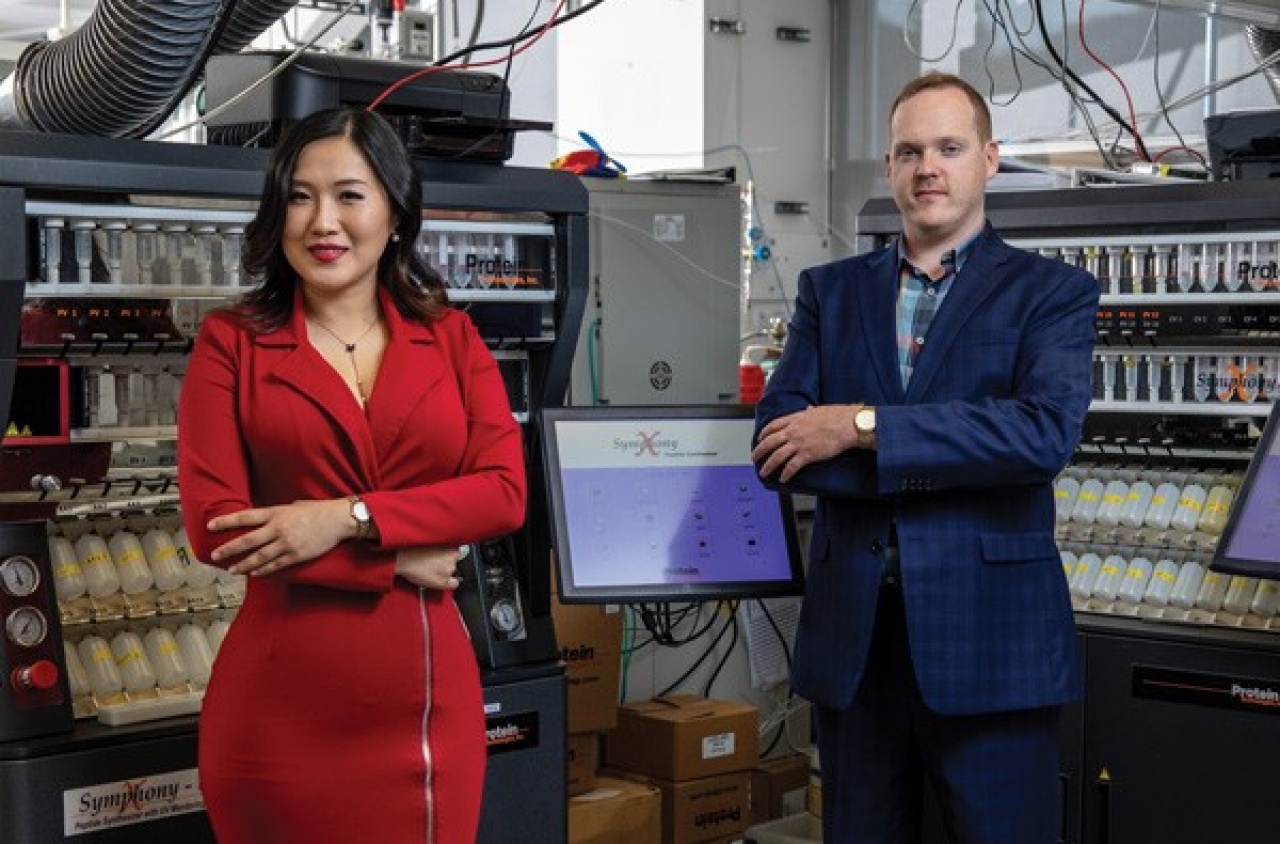
The laboratory with more than one front door
X-Therma began in 2014. The following year, Wei started the company’s research work at Lawrence Berkeley National Laboratory’s Molecular Foundry. The company’s history records a first grant and a provisional patent filing in 2015. These are compact entries on a timeline; each represents a different piece of the enterprise taking shape.
The Foundry matters to the story because it is a shared research facility. An industrial user can work in proximity to specialized instrumentation and researchers whose knowledge would be difficult for a young company to assemble alone. Wei’s company entered that environment early, rather than waiting until it could reproduce an entire research institution inside its own walls.
In a 2025 account of peptoid research, the Foundry recalled Wei and Kline as early industrial users. Their work involved molecules that interact with ice as it forms. The account describes experiments examining ice structure using X-rays, a reminder that the attractive shorthand “inspired by nature” still has to survive a meeting with an instrument.
Biomimetic chemistry takes a function observed in nature and asks how a synthetic material might reproduce it. For Wei, that has meant working with peptoids, protein-like synthetic molecules. Nature supplies a question worth pursuing. The chemist must decide what to make, how to make it, and how to find out whether it behaves as intended.
“You have time.”
Xiaoxi Wei, closing X-Therma’s March 2024 financing announcement
When ice entered an art competition
In October 2019, Wei’s research acquired an unexpected audience. The Molecular Foundry held its NanoArt Image Contest, drawing 33 entries from its community. Her submission placed second in both the Foundry’s Choice and People’s Choice voting. The same subject that occupied the laboratory had become something people wanted to look at.
The image showed different forms of ice crystals under polarized light. Large hexagonal structures appeared alongside forms altered by a natural antifreeze protein and by a synthetic peptoid. Wei made the image at the Foundry’s Biological Nanostructures Facility, with assistance from Kline, Adam Childs, Mussie Gide, and Andrea Callegari.
It is a pleasing interruption to the usual inventory of founder accomplishments. A patent has its own audience. So does a funding announcement. A field of colored crystals can recruit someone who would never voluntarily open either document. Ice, having caused so much experimental trouble, was at least prepared to sit for a picture.
The contest also makes the collaboration visible. Wei submitted the image, but the accompanying credit names the people who helped produce it. That small list belongs beside the larger institutional names in her career. Scientific work happens at both scales: an organization makes the equipment available, and particular people help get the experiment done.
The work between the rounds
For a scientist running a company, money arrives with a second vocabulary. Grants, contracts, angel investment, and venture rounds have distinct purposes and expectations. Wei’s public career includes all of them. Her task has involved explaining research to people who evaluate its scientific promise and to people deciding whether to invest in a business.
In December 2021, X-Therma announced a $13 million Series A led by LOREA AG. Participants included Zen11 Holdings, Graphene Ventures, VU Venture Partners, 2b AHEAD Ventures, Methuselah Foundation, and Catalytic Impact Foundation, alongside returning angels. The investor list put a growing network around a company that had already spent years developing its research.
March 2024 brought a $22.4 million Series B. Starling Locke Capital joined LOREA AG in leading the round, with participation from new and existing investors. The company described the money as support for expanding commercial operations globally. Nearly ten years separated the founding from that announcement. The interval is part of the achievement.
Financing figures can make progress look abrupt: one number replaces another, and the chart rises. Wei’s chronology is slower and more interesting. Between those announcements came the work of building a team, maintaining research relationships, and preparing for commercial production. The round provides a date and an amount. The company has to supply everything that happens between them.
From the bench to the production line
In May 2024, X-Therma announced commercial manufacturing readiness for XT-Thrive. The business described an independent quality organization, a quality management system, and a Hercules, California, facility equipped with an automatic aseptic fill-and-finish line. For a founder whose earlier work concerned structures far too small to see, these are conspicuously physical additions to the story.
Manufacturing introduces a practical test of scientific ambition. A material has to be made repeatedly, with consistent specifications and the records to demonstrate them. Equipment, procedures, and quality oversight become part of the product’s existence. The idea now occupies a production facility as well as a research notebook.
Wei’s business has also acquired a wider geography. X-Therma lists its North American base in Hercules and a European operation in Innsbruck, Austria. Its collaborators and investors extend beyond one campus or one country. That international network reflects the distance between founding a company and organizing the people, capital, and facilities needed to keep developing it.
A larger table, with more chairs
As the company developed, its leadership gained people with different kinds of experience. Johannes Weggemann, a board member from 2021, joined the executive team as chief financial officer in August 2024. In June 2025, Neil Warma joined the board. Wei welcomed his experience in scaling international operations as the company entered its next stage.
These appointments mark a change in the founder’s surroundings. Wei still brings the perspective of an inventor. Around her sit people whose responsibilities concern finance, production, business development, and organizational growth. A company built around scientific work needs enough expertise to keep the science moving while other people solve the problems gathering around it.
Wei has continued explaining the venture in public, including podcast appearances in August and October 2026. The audiences and formats have changed since the days of business translation. The underlying task remains recognizable: understand something precisely, carry it across a boundary, and give another person a reason to pay attention.
Her career began with permission to take things apart. It has become a prolonged exercise in putting things together: molecules, research partnerships, an international business, a team. The translator and the chemist have both stayed employed.