In 2010, Alex M. Chen visited Suzhou with a business idea small enough to require a chemist’s explanation. He wanted to build a company around pharmaceutical crystallization research. He had a doctorate from Rutgers, eight years at Merck behind him, and an interest in the physical details that can make an otherwise promising piece of science difficult to turn into a product.
Within a week of that visit, he had secured venture backing. Crystal Pharmatech began that year in BioBAY, in Suzhou Industrial Park, with Chen, Yanfeng Zhang and Robert Wenslow as co-founders. The company’s initial territory was solid-state research and preformulation. The initial service depended on deep expertise within a narrow field. Its expansion would bring that original specialty into contact with formulation development, manufacturing and analytical work in other scientific fields.
Today he leads Crystal Bio Solutions as well as the wider organization that grew from Crystal Pharmatech. His career stretches between chemistry and management, between a laboratory’s exacting questions and a business’s rather untidy collection of people, premises, partnerships and deadlines. The connection between those worlds gives his story its shape.
A week in Suzhou
Chen’s education took him from a bachelor’s degree in chemistry at Peking University to a doctorate in chemistry at Rutgers University. His subsequent work included eight years at Merck Research Laboratories and Merck Manufacturing Division. Research and manufacturing appear together in that background, a useful pairing for someone who would later build a business connecting scientific investigation with practical development work.
He returned to China in 2010 with entrepreneurship in mind. Suzhou offered more than available laboratory space. Its industrial park had specialist services, financial backing and a support organization that understood the needs of technology businesses. Chen spoke appreciatively about that setting and the confidence it gave prospective customers.
“The area looks and feels right for high-tech start-ups.”
Alex M. Chen, on Suzhou Industrial Park
The location mattered to recruitment, too. Chen pointed to the area’s setting and its lower property prices compared with neighboring Shanghai as reasons people might join and stay. For a research business, that is an operational consideration. Expensive equipment needs skilled colleagues around it; skilled colleagues need somewhere they are willing to live.
At first, almost all the company’s business came from large American pharmaceutical companies. By the time Chen discussed its progress in 2015, the United States accounted for 65 percent of revenue and China for 35 percent. The company had started in China while serving an overwhelmingly American customer base. Its commercial geography was becoming more balanced.
Crystal Pharmatech’s revenue mix as described in 2015.
Trust needs a floor plan
By its third anniversary, Crystal Pharmatech needed different premises. In 2013 it moved into a freestanding building in BioBAY, expanding its research space and giving itself more control over the security of customers’ work. The reason Chen gave for the move was unusually revealing: intellectual property deserved attention alongside research capacity.
A contract laboratory handles work that belongs to someone else. A customer is buying scientific judgment while entrusting valuable information and materials to another organization. The building, access arrangements and operating procedures become part of the service. In this business, trust comes with doors.
That practical concern sits beside the company’s early growth. Research operations expanded in Suzhou and New Jersey, placing the business closer to customers on both sides of the Pacific. A scientist starting a company soon acquires a second curriculum: real estate, security, recruitment and the difficult art of making an organization dependable.
The financing milestones followed. Crystal Pharmatech raised $10 million in Series A funding in 2015 and $14.5 million in Series B funding in 2018. These were company fundraising rounds, money intended for a business and its expansion. Behind the figures lay the less photogenic work of adding capabilities that customers could actually use.
The company between the companies
Chen also built through partnerships. In 2013, Crystal Pharmatech joined forces with Particle Sciences, bringing solid-state research together with formulation expertise. The collaboration addressed a problem familiar to specialists: a decision that makes sense within one discipline can create trouble for the people doing the next stage of the work.
A material may look suitable from one angle and prove awkward when another team has to work with it. Connecting those perspectives earlier gives a customer a better chance of choosing a workable route. Chen’s company occupied the space where the separate pieces needed to meet.
A partnership with Xceleron pursued a related logic, combining early analytical information with solid-form and formulation expertise. The commercial proposition depended on the interaction of the partners’ knowledge. Each organization brought a different way of examining the same development problem.
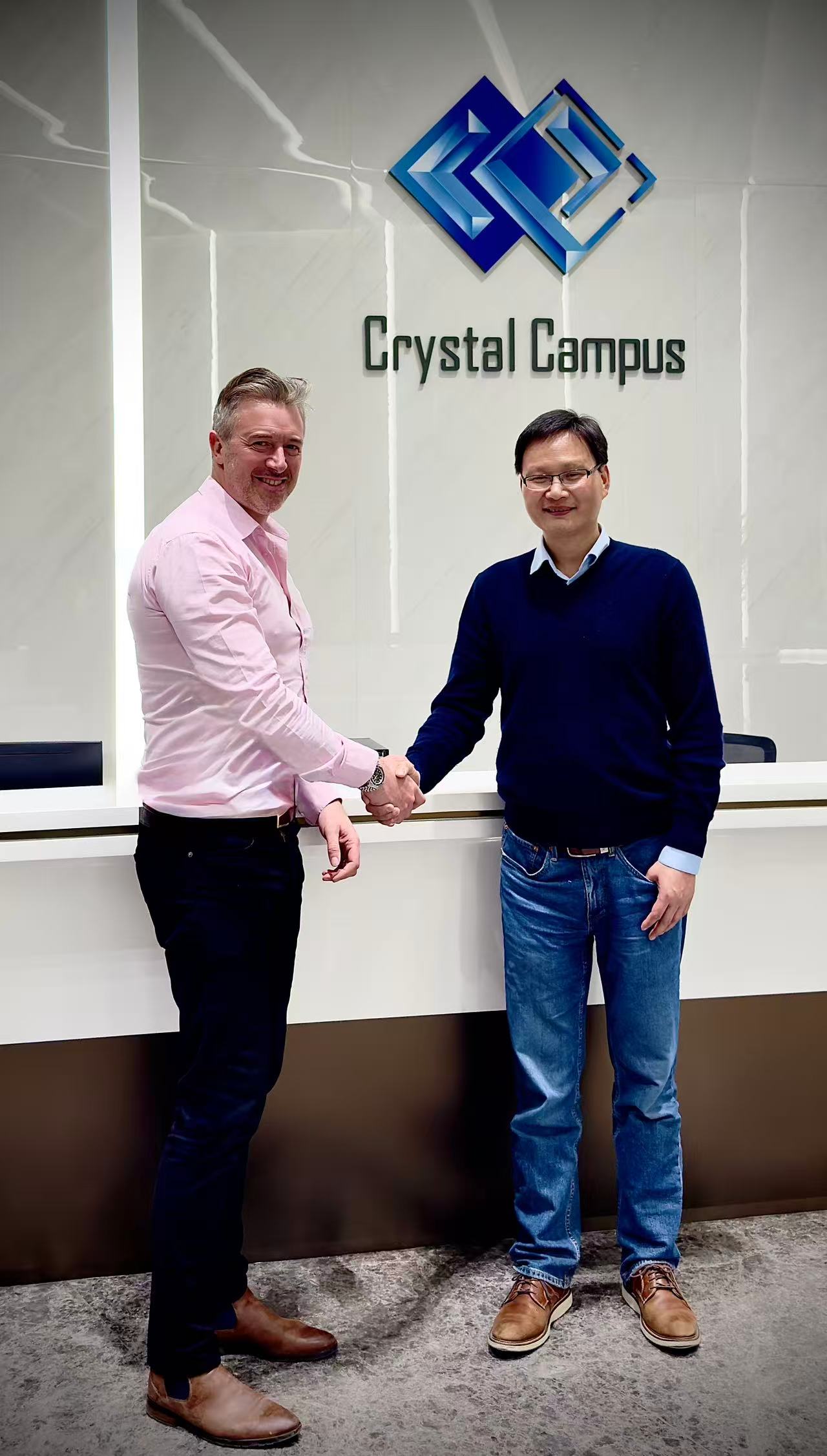
The company was building scientific connections in public as well. It organized a solid-state research symposium in China, bringing researchers and equipment companies into the conversation. Chen later chaired a session on polymorph, salt and co-crystal screening at the 2013 Pharmaceutical Powder X-ray Diffraction symposium in Beijing. Even after taking the chief executive’s title, he had a place on the technical program.
A wider circle of specialists
The organization’s scope widened over the following decade. A formulation laboratory in Toronto extended its capabilities through Candoo Pharmatech in 2018. Crystal Formulation Services, founded in 2021, added another base for formulation development and manufacturing. In 2022, the group established a biologics analytical laboratory in New Jersey; the company history records its spinout as Crystal Bio in 2024.
Those additions changed what Chen had to coordinate. A company founded around a narrow research specialty was developing several centers of expertise. Each needed capable scientific leadership. Each also needed a useful relationship with the rest of the organization.
There is a telling detail in Chen’s welcome to chief scientist Lianfeng Huang: he said he had often studied her published work. An executive introducing a senior hire could have stayed with credentials and titles. Chen described reading. It gives a brief glimpse of a chemist still taking a professional interest in another scientist’s reasoning.
At Crystal Bio Solutions, the leadership structure makes specialization visible. Meina Liang leads bioanalysis and biomarkers; Shiaw-Lin “Billy” Wu leads CMC analytical work; Lorin Roskos leads quantitative clinical pharmacology. Ye Gu serves as chief technology officer and head of business development. Chen’s task sits across these distinct responsibilities.
Roskos’s appointment in September 2025 accompanied the launch of quantitative clinical pharmacology services. In January 2026, Allan Cortes joined to lead West Coast business development. One appointment added scientific breadth; the other strengthened the organization’s connections with customers in the western United States. Building the team meant attending to both.
- 2010Solid-state research begins in Suzhou
- 2018Formulation laboratory in Toronto
- 2022Biologics analytical laboratory in New Jersey
- 2026Three businesses share the Crystal Group identity
Back to the very small
For all that expansion, Chen’s interest in crystal structures remains close to the center of the story. In April 2026, Crystal Pharmatech announced an expanded collaboration with the Swiss instrumentation company ELDICO Scientific. It planned to bring an ELDICO ED-1 electron diffractometer to its Suzhou research site.
The instrument is designed to determine structures from crystalline powders at a scale below a micron. The ambition was to make the technique part of routine research workflows, allowing more structural questions to be answered within the regular course of the team’s work.
Chen described a longstanding scientific goal: understanding the structure of every polymorph. Polymorphs are different crystal arrangements of the same compound. His stated aim was to integrate the equipment into screening work and determine the structure of every form the team identified. It is a specific aspiration, attached to a particular instrument and a practical process.
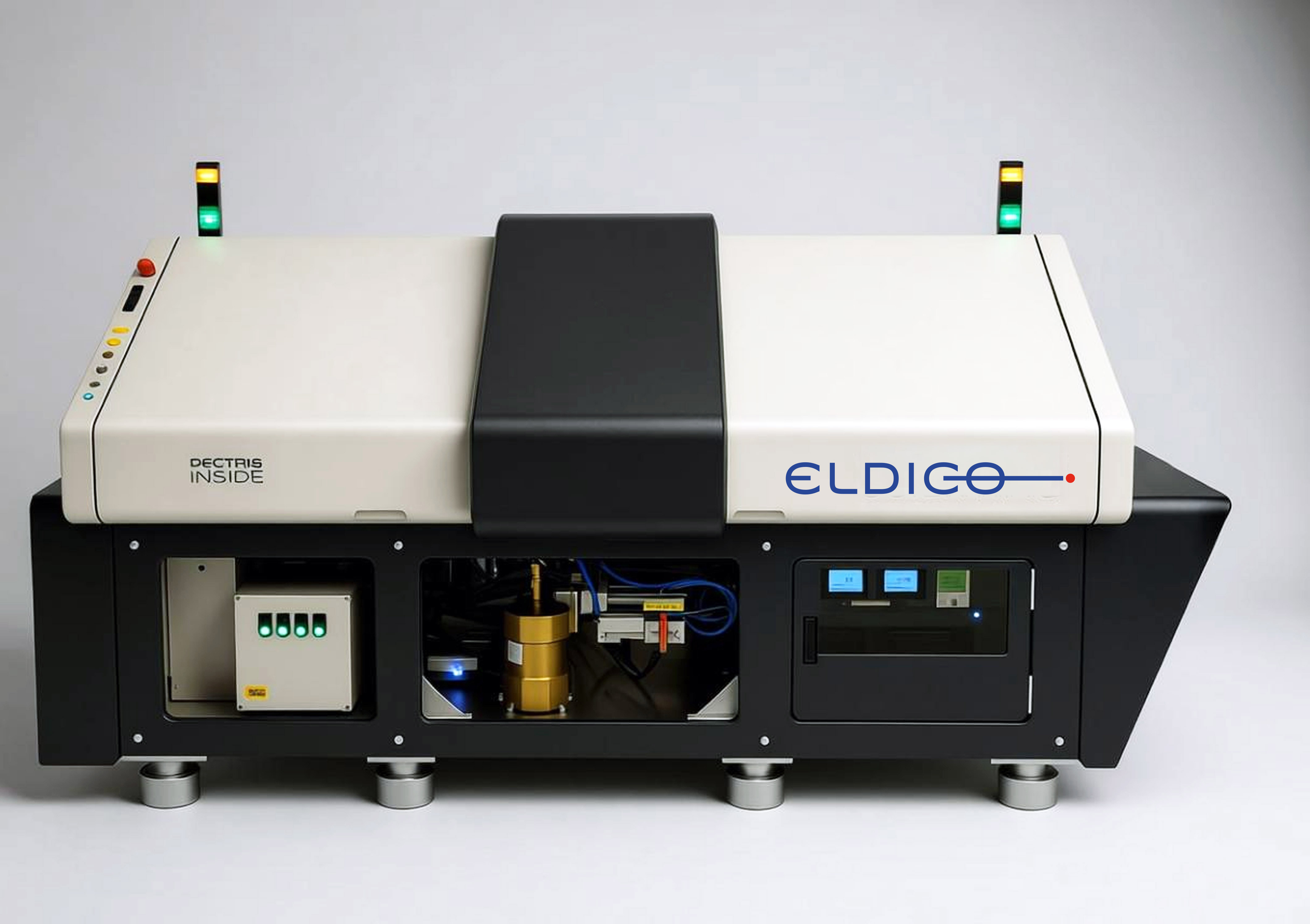
The two sides of the April announcement are worth holding together. There is a piece of equipment intended for a laboratory, and there is an organizational decision to make a specialized method easier to use repeatedly. The latter is part of the chief executive’s job: choosing where to invest, finding a partner and giving a scientific team a practical route to work with a technique.
Three businesses, one name
In June 2026, the organization introduced a shared Crystal Group identity. Crystal Pharmatech, Crystal Bio Solutions and Crystal NAX would retain their individual scientific specialties while making their common affiliation clearer. Small molecules, biologics and nucleic acid technologies now sat under one group name.
“This brand alignment reflects the way our businesses operate today.”
Alex M. Chen, June 2026
For Chen, the announcement put a name around years of expansion. The original company had grown by adding capabilities and connecting teams. The group identity acknowledged the resulting organization, with Chen identified as its co-founder, chairman and chief executive.
In 2024, Chen and Wenslow were listed together for the Controlled & Modified Drug Release Summit in Princeton. In 2025, both appeared on the leadership team attending DCAT Week in New York. Those appearances provide a small continuity across the changing company structure: two of the original founders still representing the business together, meeting the people whose projects give the laboratories their work.
There is a certain advantage to a founder story with this many ordinary working details. An industrial park. A secure building. A colleague’s papers. A conference appointment. Each makes the enterprise easier to picture, and each shows a different part of the job Chen took on when he left Merck.
His career offers an unusually concrete view of the scientist-founder’s changing job. First comes a research specialty. Then come colleagues, customers, buildings and partnerships. Eventually there are several businesses to connect. The questions get larger, but the early habit of examining how the parts fit together remains useful. Sixteen years after Suzhou, Chen is still working on the arrangement.