In January 2024, Young Whan Park acquired something a founder might be expected to regard with suspicion: another chief executive. Soongyu Choi, Avelos Therapeutics’ chief technology officer and one of its co-founders, became co-CEO. Park continued as CEO and president; Choi combined the executive role with his technical responsibilities. A company founded less than three years earlier now had two people sharing its highest executive title.
There is a pleasing lack of theatre in that arrangement. The founding team was already working together. The change gave Choi a larger formal role rather than supplying a stranger with an impressive business card. For a profile of Park, it is a place to begin. His career has passed through research, corporate management, public programmes, and entrepreneurship. At Avelos, authority has room for a colleague.
The company was established on September 1, 2021, by Park, Choi, and Kangsik Yun, its head of business development. Those three responsibilities put a particular kind of experience around the table: company leadership, scientific leadership, and the work of forming commercial relationships. Avelos began with a team of founders whose careers preceded the company by many years. The incorporation date marked a new organisation, rather than the beginning of their working lives.
That distinction matters when considering Park’s move. He had already worked inside institutions with existing departments, established procedures, and substantial research responsibilities. Avelos required an organisation to be assembled around the work. The challenge was partly one of scale: what to build internally, what to obtain through collaboration, and how to give a small team enough support to function beyond its own walls.
New Jersey before Seoul
Park’s education began with a bachelor’s degree in chemistry at Kyung Hee University and continued with a chemistry master’s at the University of Wisconsin-Milwaukee. He earned his doctorate at Rutgers University, followed by postdoctoral research at the University of California, Berkeley. His public LinkedIn profile dates the Berkeley period to 1992–1994. The route took him between Korean and American institutions before the executive titles arrived.
Merck’s research operations in Rahway, New Jersey, became a substantial part of his professional life. His career record places him there from 1994 to 2008. Avelos describes his tenure as 15 years and identifies him as a programme leader. The two descriptions give the same broad picture: a lengthy period inside a large research organisation, followed by a return to Korea.
The record also contains the smaller signatures of a scientific career. Park appears among the four authors of a 2003 paper whose title includes the phrase “mix and read.” A laboratory method has acquired a name that sounds faintly like instructions for a cake. The paper belongs to his Merck years and puts him alongside Jeffrey H. Toney, Aimie Ogawa, and Megan Blair. An executive biography compresses that period; an author list restores some of the colleagues.
Back in Korea, he led research at Daewoong Pharmaceuticals from 2009 to 2011. His positions included senior vice president and chief scientific officer. Avelos puts the research organisation he managed at about 200 members. That is a considerable change in the unit of work: a programme leader becomes responsible for a research workforce. Later, as a founder, he would face the question of what a much smaller organisation should try to keep for itself.
- 1994–2008Merck · Rahway
- 2009–2011Daewoong · Research leadership
- 2011–2021Public programme · Business development, then president
- 2021 onwardAvelos · Co-founder and CEO
A professional life with other people in it
Alongside the employment history sits another chronology. Park served as the second president of the Korean American Society in Biotech and Pharmaceuticals, or KASBP, in 2005–2006. The society had been established in 2001. His presidency therefore came during its early years, while he was still working in the United States. Professional association work was already part of his career well before Avelos existed.
KASBP brings together Korean and Korean American scientists working across industry. Its activities include scientific exchange, collaborations with Korean organisations, and information about employment opportunities. Park’s place in that organisation adds an institutional connection between his American research career and his later Korean leadership roles. It also gives his biography something that a list of employers alone would miss: a period of service to a professional community.
In 2007, KASBP listed him as the recipient of its Daewoong Scholar Award, with Merck as his affiliation. The distinction has its own modestly revealing context. The recipient was working at an American company; the award carried the name of a Korean company he would subsequently join. Careers cross organisational boundaries long before the next job appears on a résumé.
The following year, he spoke at the society’s symposium in New Jersey. Friday’s programme began with registration and a reception, proceeded through opening remarks and dinner, and reached its technical lectures in the evening. Park’s slot ran from 8:40 to 9:20 p.m. The Saturday programme moved to Rutgers’ Busch Campus. The sequence is refreshingly ordinary: even an international scientific network needs a registration desk, a dinner schedule, and someone willing to speak after dessert.
Learning to work across a boundary
From 2011 to 2017, Park headed business development at the organisation that became National OncoVenture. From 2017 to 2021, he served as its president. Those dates place a decade of public-programme work between Daewoong and the founding of Avelos. They also show that commercial relationships were an explicit responsibility in his career before he became a company founder.
In 2018, he described a working arrangement built around joint committees. Each project’s committee met monthly and divided its membership equally between his organisation and the originating team. Decisions were made together, including how results should be evaluated and whether work should proceed. The interesting managerial detail is the balance of representation. Collaboration had a calendar and an agreed place where decisions could be taken.
His argument about the distance between academic research and commercial development was practical. He favoured mentorship from people with industry experience and discussed Stanford’s SPARK programme as an example of a bridge between the two. For Park, the transition required people familiar with development, alongside financial support. That concern makes a useful precursor to Avelos: how do different kinds of expertise stay involved after an idea leaves its original setting?
A committee is unlikely to win a place on a motivational poster. Yet the monthly meetings and equal membership tell us more about this part of Park’s work than a heroic founder anecdote would. They describe a mechanism for cooperation. Years before the shared CEO arrangement at Avelos, he was explaining how separate organisations could share decisions without pretending they had become the same organisation.
A company with neighbours
Avelos’ early milestones came in a compact sequence. A collaboration and licensing agreement with a research institute in the United Kingdom followed in December 2021. In February 2022, the company moved to Magok-dong in Seoul and completed seed investment from Myriad Lifesciences and Infobank. Its research centre opened in March. A KRW 10 billion Series A followed in July. The first year involved premises, partners, research operations, and financing.
The choice of Magok had an everyday logic. Park described access to shared facilities and nearby companies as reasons for locating there. A young company could use facilities at a reasonable cost and find opportunities for collaboration in the neighbourhood. Geography became part of the operating plan. An address could give the founders access to resources that would otherwise have to be assembled independently.
Park also spoke about the kind of employer he wanted to build. In 2023, he described an employer that people would want to join and discussed transparency, fairness, and communication. Avelos’ stated company values include transparent communication. These are expressed commitments, rather than a verdict on employees’ experience, but they establish what Park chose to emphasise when asked about his organisation.
“The company should be a place employees want to go.”
Young Whan Park · 2023 · translated from Korean
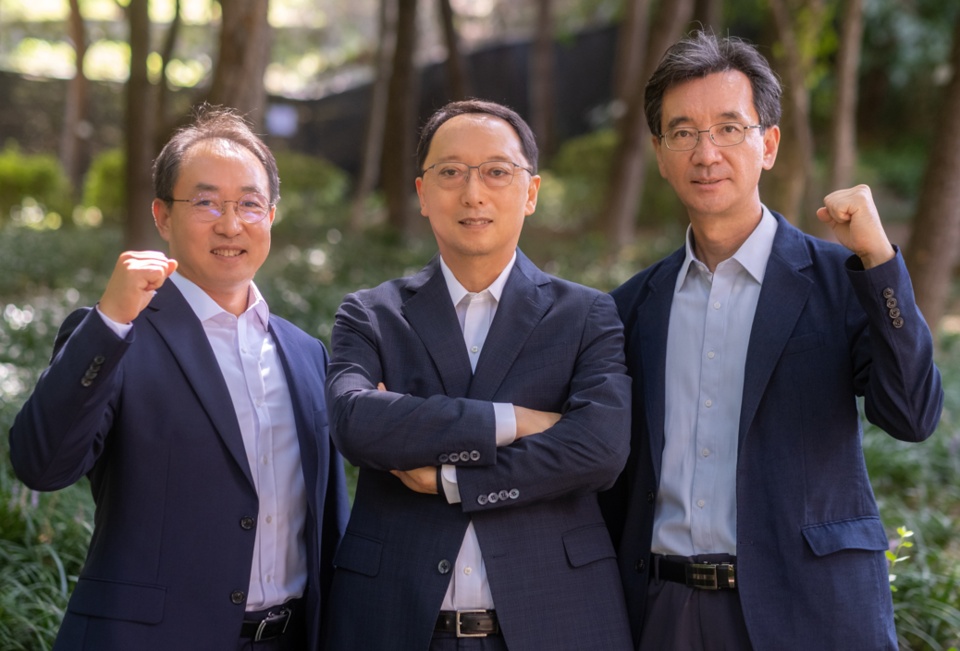
The founders’ group photograph gives that organisation a human scale. Choi stands on the left, Park in the centre, Yun on the right. Park has folded his arms; his colleagues have raised their fists for the camera. It is a company photograph with a little choreography. All three fit in one frame, which is also a useful reminder of how closely the founding responsibilities began.
Thirty-five meetings, and work still to do
By April 30, 2024, Avelos had closed a KRW 17 billion Series B. Stassets Investment led the round, with new and returning investors participating. In May, the company reported that total financing had surpassed KRW 30 billion. Park pointed to the founders’ experience and the company’s potential when discussing a raise completed during a difficult investment period. The money was company financing; it says nothing about his personal wealth.
A further relationship followed with Hyundai Pharm. A strategic investment and joint research agreement was announced in March 2025, following an agreement reached in February. The company’s partners now included both financial investors and another operating business. For Park’s story, the significance is the continuing movement between an internal team and external organisations. Avelos was adding relationships as well as resources.
In June 2025, Choi described the first three and a half years as a period spent building the research organisation alongside Park. He also outlined plans for a technology evaluation by the end of 2026 and a possible KOSDAQ listing after 2027. Those were plans. They gave the company a proposed sequence of commercial milestones without turning a future stock-market event into an accomplished fact.
A year later, Park was in San Diego for BIO USA. In June 2026, he reported about 35 business meetings during the event, with four or five companies already engaged under confidentiality agreements. He expected tangible progress before year-end, potentially through due diligence or a term sheet, while acknowledging that a final licensing contract could take longer. His update distinguished conversations, intermediate steps, and a completed agreement.
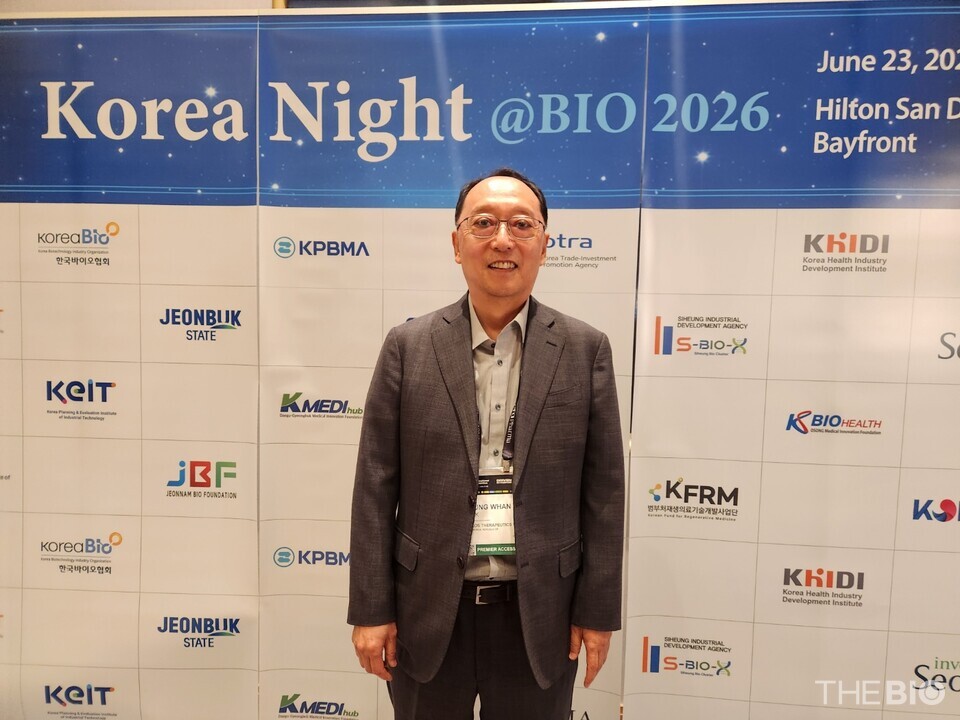
That distinction is a fitting place to leave him. The work has moved from Rahway to Seoul and back into international meeting rooms. Park now shares executive responsibility with a founding colleague while seeking partners beyond the company. His next chapter will be measured in decisions and agreements, each requiring someone else at the table. The smaller room has acquired quite a few doors.