A software feature can arrive fully formed and still go nowhere. Someone has to assess the change, run the tests, gather the evidence and obtain the approvals. In a regulated business, that work travels with the software. Leave enough of it unfinished and a useful improvement becomes another item everyone would rather postpone. Bryan Ennis has built much of his career around this peculiar bottleneck: companies buy technology to move faster, then struggle to keep up with the work required to use it.
The absurdity has a distinctly office-bound flavour. A cloud application gets an update; the organisation reaches for a spreadsheet. A new capability promises efficiency; introducing it creates another documentation project. Somewhere in the middle sits a person who knows which file is current. It is an arrangement that works rather well until that person goes on holiday.
Ennis, Sware's co-founder and chief quality officer, has worked on both sides of this problem. At Genzyme, he managed regulatory systems. At Veeva, he helped customers adopt software and developed compliance programmes. At Sware, where he previously served as CEO, he has worked to turn the supporting routines into software themselves. His story follows the unglamorous distance between having a tool and being able to put it to work.
The customer after the sale
His earlier work at Genzyme involved selecting, implementing, integrating and validating regulatory content management applications. That combination matters. Selection is the appealing part of a technology purchase: demonstrations, possibilities, plans. Integration introduces the neighbours. Validation asks whether the resulting system does what the organisation needs it to do. A career spanning all three provides plenty of opportunities to discover where the promises meet the plumbing.
At Veeva, Ennis founded the R&D Customer Success programme. He led retention efforts during a period in which the customer base grew from three to more than 300. The numbers describe the business around him, rather than a feat he performed alone. His responsibility was the continuing relationship: helping customers get value from regulated software as the product and its community expanded.
Veeva customers during the growth period in which Ennis led R&D customer retention. A historical company figure, not Sware's current customer count.
Customer success offers a particular education. A sales conversation ends with a decision. A customer relationship has to survive what happens next. Features need to be introduced, questions answered and changes absorbed into working routines. Ennis's remit also included developing Veeva's compliance programmes. He was close to both the people asking for new capabilities and the conditions that governed their use.
The experience gives his later work a practical centre. The interesting question becomes how much of a software investment an organisation can actually use. A feature left switched off may look tidy on a validation schedule, but it contributes very little to the job it was bought to improve. Ennis keeps returning to that gap between purchasing capability and putting it into service.
Kosal Keo, a release calendar and a different business
By 2019, Ennis was CEO of Boston Technology Research, working alongside founder Kosal Keo. The business helped Veeva customers manage implementations, releases and changes. Its approach combined services with a software suite called Res_Q, covering electronic change management and validation work. The later Sware story already had its central ingredients: repeated customer problems, a partner with quality expertise and a product built around the repetition.
Keo and Ennis brought different experience to the same table. Keo's background was in compliance and quality systems; Ennis had built Veeva's R&D customer success practice. The partnership put the rules of introducing a change alongside the experience of helping customers live with one. Their work concerned the part of a software release that remains after the release notes have been published.
The company was developing a hybrid of consulting and software. That is a revealing stage in the story. Consulting can resolve a particular customer's difficulty. Software can carry a repeatable method to the next customer. Res_Q offered a way to preserve useful work and organise the sequence around it, rather than recreate every task as a fresh exercise.
- 01 / GENZYMEMake systems workRegulatory content and integration
- 02 / VEEVAHelp customers use themR&D customer success and compliance
- 03 / BTRKeep up with changeRelease management and Res_Q
- 04 / SWAREBuild the process into softwareValidation workflows and quality strategy
The work that follows you home
Ennis uses the idea of validation debt to describe accumulated obligations around releases, testing, requirements and compliance. It is a useful phrase because it names work that can be deferred without disappearing. A backlog may stay out of sight for a while. It still belongs to somebody, and the next release adds another demand.
In 2023, he described a familiar working mixture of email, paper documents and spreadsheets. His diagnosis concerned volume: teams knew how to validate systems, but adding more systems increased the work they had to maintain. Competence could coexist with exhaustion. The difficulty was organising a growing obligation with tools that scattered its pieces.
“a lot of white knuckling by individuals.”
Bryan Ennis, describing manual validation work, 2023
Res_Q's answer was to bring documents, tests, evidence, reviews and signatures into a shared workflow. For Ennis, the attraction was continuity. Teams could carry out the work according to their own procedures and risk assessments while keeping its components connected. An update would arrive inside a process, with somewhere for the evidence and the decisions to go.
There is a human dimension to that ambition, even when the language is full of systems. A process distributed across inboxes depends on memory, persistence and people chasing other people. A well-organised workflow can make the next step visible. The reward is modest enough to be convincing: fewer mysteries about the status of a task and less dependence on the colleague who remembers everything.
A founder takes the quality seat
On October 9, 2024, Sware appointed Ennis chief quality officer. He reported to CEO Ellen Reilly, with responsibility for quality strategy, audits, compliance and improvements to the company's systems. The appointment also placed him close to innovation in Res_Q. The former CEO's next title put a specific part of the business at the centre of his work.
That role gathers together several strands of his career. He had managed systems, supported customers and helped develop the routines around software releases. Now the remit included the quality of Sware's own operation and the product through which it proposed to improve other organisations' work. The company would have to practise the discipline it was selling.
“we have a unique opportunity to lead by example.”
Bryan Ennis, on becoming chief quality officer, 2024
The appointment came alongside additions to Res_Q's dashboards, reporting and AI capabilities. Ennis's public work subsequently moved further into AI governance. The shift expanded the question he had been pursuing for years: how do organisations bring changing technology into a working system that they can understand, monitor and trust?
The enthusiast who wants the evidence
In a January 2026 conversation with Michelle Vuolo and Martin Heitmann on Augmented Ops, Ennis described himself as an active AI user. He also explained that AI had advanced faster than he expected when the company set out to digitise validation. He had deliberately moved towards work focused on innovation and responsible adoption. Even the person building the plan had needed to revise it.
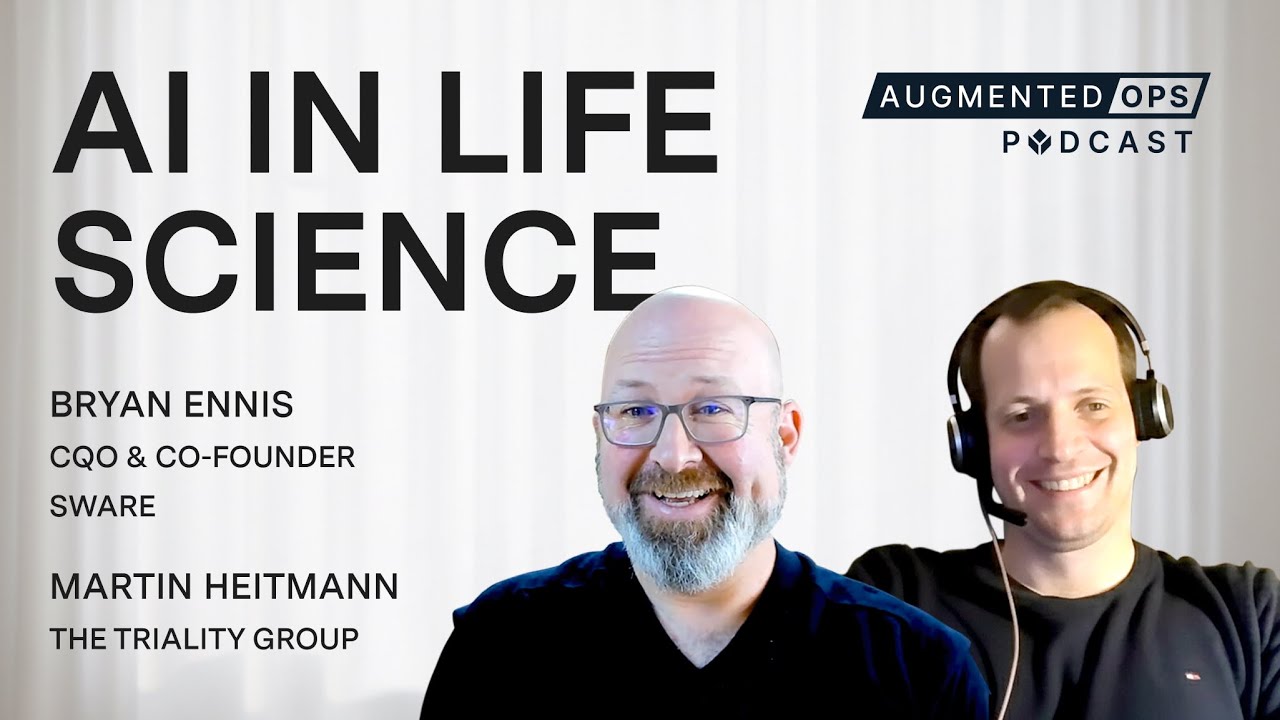
His enthusiasm comes with questions. In that conversation, he stressed the value of carefully defined applications and good data. He treated learning to question providers as part of adopting the technology. Where is the information? How is it protected? What evidence supports the result? These are questions a quality leader can take into a meeting without requiring everyone else to become an AI researcher.
By July 2026, his writing was examining the responsibilities attached to building an internal AI validation application. Generating a document, he argued, leaves plenty of engineering unfinished. Permissions, record versions, approvals and the history of changes still need to be maintained. The prototype's first successful demonstration is only one moment in the life of a system.
There is a business interest in that argument: Sware sells validation software. There is also a consistent career interest. Ennis has spent years dealing with what happens after a system is introduced. His concern with maintenance and accountability fits the customer success work that preceded his founder role. A convincing demonstration has to become an operation that colleagues can rely on.
His August writing turned to the connections between AI agents and existing enterprise applications. He explored Model Context Protocol as a way to make approved capabilities available across systems, with governance around the resulting work. The vocabulary had changed. The underlying preoccupation remained recognisable: help useful tools work together without losing track of who did what.
Jazz cello, mountain paths and the last day of August
Away from product vocabulary, Ennis's background has a few welcome surprises. His University of Hartford years, from 1998 to 2001, included a jazz cello performance minor. He also co-founded the university's Environmental Action Team. A speaker biography describes him as an avid back-country hiker. Those details give the person in the conference programme a little more room to breathe.
He brings some of that informality into his public writing. His monthly LinkedIn newsletter is called Quality at the Edge of AI. Opening the August 2026 edition on August 31, he joked about his commitment to just-in-time publishing. It is a pleasingly small admission from someone whose professional life concerns keeping work current. Even a quality officer has a calendar.
His recent speaking programme has included sessions about piloting AI and defining a minimum viable product in regulated environments. The scale of the question is practical: decide what a first application should do, establish how to evaluate it and learn from the result. Ennis's public ambitions sit at that junction of experimentation and discipline, where a promising tool starts acquiring responsibilities.
The thread through his career is the customer trying to use what they have bought. At Genzyme, that meant making systems fit together. At Veeva, it meant helping customers keep getting value. At Sware, it means organising the evidence and approvals that accompany change. The next feature will arrive soon enough. Ennis is concerned with whether the people receiving it can put it to work.