In a photograph taken after the Mighty Merrimack Swim in Lowell, Massachusetts, Maria Beconi stands at the far right of a group of swimmers, wearing a medal, a white T-shirt and purple shorts. The occasion was a two-mile swim on August 6, 2017. She had finished first in her age group. It is a pleasantly uncomplicated entry in a career otherwise thick with abbreviations: a distance, a finish, a place.
Her professional life is harder to fit on a results sheet. There is agricultural engineering, then animal science and statistics, then a doctorate in biochemistry. There are large research organizations and small companies; an independent consultancy and executive appointments; work as a scientist and work putting scientific teams together. The organizations change size. The responsibility keeps returning to the awkward stretch between an idea and something an organization can actually do.
Beconi is based in Bedford, Massachusetts. Her career has taken her through established companies including Merck and Abbott, through the CHDI Foundation, and into the leadership teams of Retrophin, Goldfinch Bio and Disc Medicine. More recently, her professional profile lists Neli Therapeutics, formerly Kolm Therapeutics. FireWheel Bio lists her as its Chief Scientific Officer Advisor. Beginning again, in her case, comes with a considerable amount of prior practice.
Three degrees, three ways of looking
Beconi is a native of Argentina. Her education began with a Bachelor of Science in agricultural engineering at the University of Buenos Aires. At the University of Kentucky, she earned a master's degree in animal science and statistics. Michigan State University followed, with doctoral study in biochemistry and chemistry. The sequence crosses disciplines as well as countries. It also resists the tidy retrospective story in which every credential appears to point directly toward a future executive title.
Engineering, statistics and chemistry ask different kinds of questions. What can be built? What does the evidence support? What is happening at the molecular level? Those are useful distinctions when reading her later career. The degrees establish the breadth of her training; they do not need to be pressed into service as proof that she had a master plan. A biography can allow its subject to acquire experience without pretending the destination was printed on the first ticket.
engineeringUniversity of Buenos Aires · BS
& statisticsUniversity of Kentucky · Master's
& chemistryMichigan State University · PhD
Later appointments included group leader at Upjohn/Pharmacia/Monsanto, research fellow and principal investigator at Merck Research Labs, a management and US site leadership role at GlaxoSmithKline, and director of drug metabolism at Abbott Laboratories. These are jobs close to the machinery of research. They require attention to the experiment, but also to the people, resources and decisions that surround it. A laboratory has an organization chart even when the discovery story leaves it out.
The useful inconvenience of a question
One of Beconi's specialties is abbreviated DMPK: drug metabolism and pharmacokinetics. The letters describe a field concerned with measuring what happens to compounds over time. For a general reader, the important word is measuring. A proposed explanation and an observed result may be excellent company for one another. They may also disagree. The work is to establish which relationship you actually have.
In 2012, Beconi was the first named author of a paper examining a compound called JM6. Its title stated a direct conclusion: JM6 was not a prodrug for Ro-61-8048. A prodrug is a compound intended to be converted into another compound. Here, the investigators tested that proposed relationship and reported evidence against it. There is nothing coy about the wording. The title tells a reader, before the abstract begins, that an assumption has been examined and has failed the examination.
That is a revealing item in a scientific career. Company biographies tend to favor additions: another program, another appointment, another accomplishment. A paper can make its contribution by subtraction, removing an explanation that does not stand up. The value is in making the next decision better informed. An elegant theory has no entitlement to survive an experiment merely because it arrived elegantly dressed.
“I am honored to join the impressive and passionate ZielBio team”
Maria Beconi, on her January 2022 appointment
The JM6 paper brought together a substantial author group, including Dawn Yates, Kathryn Lyons, Leticia Toledo-Sherman, Ignacio Munoz-Sanjuan and Celia Dominguez. Beconi's work appears in the same space as her management career: among collaborators. Authorship makes those connections visible. It puts names beside the collective work, rather than compressing the whole enterprise into a single person's moment of inspiration.
A company needs more than a clever idea
Before joining Retrophin, Beconi founded KAB DMPK Strategies, LLC, an independent consultancy in nonclinical sciences. Its clients included Lundbeck, TB Alliance and Boehringer Ingelheim Vet Med. Consulting added another organizational setting to her experience. The scientist could bring specialist knowledge to different clients without occupying the same permanent seat at each organization. The founder, meanwhile, had a business of her own to run.
Retrophin announced her appointment as vice president of preclinical development in November 2013. She joined during an expansion that also brought in executives responsible for regulatory affairs, operations and manufacturing. The company was assembling several different capabilities at once. Read together, the appointments describe the practical problem facing a growing scientific business: every additional ambition creates more work that someone must be equipped to handle.
She later became Retrophin's chief scientific officer. Her responsibilities included building its discovery research and early development team, infrastructure and portfolio. The team belongs in the sentence. So does the infrastructure. Both are easy to overlook when the interesting noun is “discovery.” But an organization has to make discovery repeatable enough to support a program of work. That involves hiring, assigning responsibility and providing the conditions in which several people can produce evidence together.
- 2013Retrophin
Vice President of Preclinical Development - 2017Goldfinch Bio
Vice President of Pharmacology and Non-clinical Development - 2020Disc Medicine
SVP of Translational Research and Development - 2022ZielBio
Chief Science Officer
Goldfinch Bio appointed Beconi vice president of pharmacology and non-clinical development in September 2017. By December 2020, Disc Medicine was identifying her as senior vice president of translational research and development and naming her as a presenter at a virtual scientific meeting. In January 2022, ZielBio announced her appointment as chief science officer. The titles changed, but each placed her inside the research organization rather than at a ceremonial distance from it.
The word “translational” is particularly apt in a career like this. It describes movement between stages of research, and it has a useful everyday echo: people with different specialties have to understand one another. A company can employ excellent individuals and still have difficulty deciding what their combined findings mean. The organizational challenge is to give that evidence a route into the next decision.
Thirty-plus, with the credit kept intact
FireWheel Bio credits Beconi with supporting more than 30 successful international regulatory submissions and registrations. “Supporting” is the right word to preserve. The number belongs to a career involving teams and institutions, and it does not imply that she accomplished every task herself. It describes repeated participation in work that must be assembled, checked and presented beyond the research organization.
There is a difference between describing a result and understanding the work needed to make it reviewable. A submission gathers evidence into a form that other people can examine. The scientific question acquires an administrative life: records, explanations, responsibilities. This is where an experienced research leader's career starts to look less like a string of discoveries and more like a succession of completed obligations.
Her present advisory listing at FireWheel fits that background. The company groups shared functions in a central hub and places individual programs in separate operating companies. Beconi sits among its management team and advisors, alongside people responsible for operations, commercial strategy and intellectual property. It is an arrangement that makes the division of labor visible. Scientific judgment has a place at the table; so do the other kinds of work needed to keep a company moving.
Pizza, then a river
A smaller scene supplies a different view. In May 2011, writer Gene Veritas described attending an informal brainstorming session at Beconi's home with a CHDI team. There was pizza, soft drinks, brownies and cupcakes. Beconi introduced the visitor after the food. The account has the ordinary particulars that appointment announcements tend to lose: a host, a room, something to eat, an introduction that lets a conversation begin.
No elaborate interpretation is necessary. The meeting happened, and she helped convene it. A scientific workplace can sometimes extend to a table with cupcakes on it. The invitation and introduction are modest acts, but they make room for another person's perspective. They also produce a more recognizable picture of collaboration than a diagram of departments does. Someone has to welcome the guest.
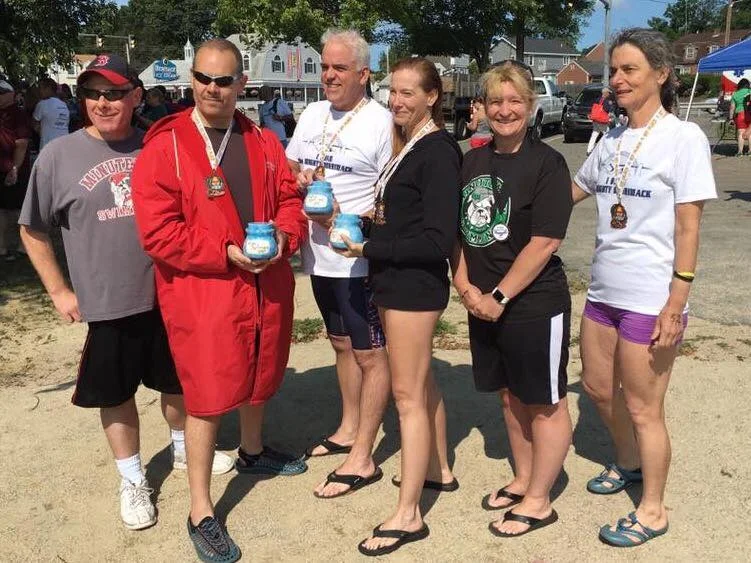
Six years later comes the river photograph. The Minuteman Masters had turned out for the Mighty Merrimack event in Lowell. Beconi's age-group win appears among the club's results, alongside the achievements of other swimmers. The photograph is a group portrait, which seems appropriate. Even the most individual result has a social setting: people beside you, a club report, a shared occasion worth recording.
Two miles is an unusually legible accomplishment beside a résumé of specialized roles. It also deserves to remain a swim, rather than being conscripted into a theory about executive performance. There is pleasure in allowing a person more than one arena. Beconi can be a research leader, a consultant, an advisor, a host and a swimmer. The medal adds a detail; it need not explain the doctorate.
Her career has repeatedly returned her to the early work of an organization: setting up research, building a team, advising a program, starting a consultancy. Those beginnings rest on experience accumulated elsewhere. The distinctive feature is the combination of specialist science and the willingness to take on its practical organization. A beginning may sound like a clean slate. Beconi's comes with several degrees, a long list of colleagues, and quite a few things already learned.
Continue the conversation
PROFILES, WORK & FURTHER READING