A kidney has no use for an itinerary. Once removed from its donor, it begins a journey whose difficulty is measured in biology as much as distance. A commercial flight can cross an ocean in an afternoon. Keeping an organ useful through collection, packing, travel and assessment is a rather less accommodating business.
- The experiment: five reported transatlantic journeys with pig kidneys, preserved for 48-72 hours.
- The invention: synthetic molecules inspired by natural antifreeze proteins, paired with temperature-controlled transport.
- The business: preservation products for cell manufacturers today; a longer road toward human organ banking.
In October 2024, X-Therma described just such a test. Researchers at Johns Hopkins in Baltimore sent pig kidneys to the Medical University of Innsbruck on commercial aircraft. At the destination, the organs were assessed on a clinical-grade perfusion machine. The company reported that they remained viable and functional. The repetition matters: a transport system has to survive the world outside the laboratory.
A kidney with an itinerary
The team was led by transplant researcher Gerald Brandacher. Alongside the shipping experiments, X-Therma reported a separate life-supporting pig transplant: a kidney preserved for 72 hours maintained normal renal function throughout a 200-day observation period. These were animal experiments. Their importance lies in making a specific proposition testable: can preservation chemistry buy enough time for an organ to take a much longer journey?
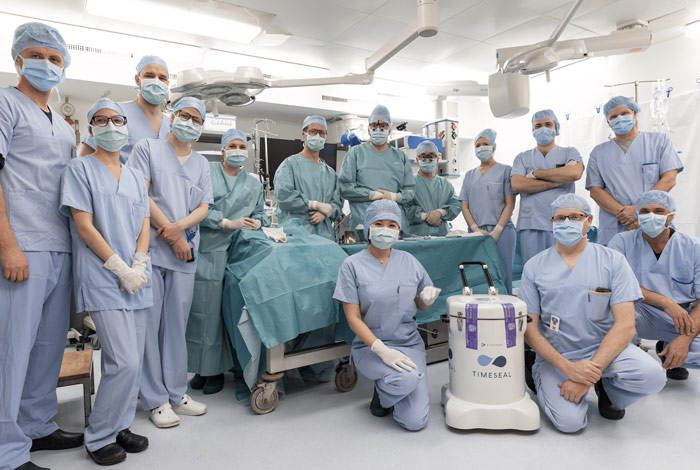
X-Therma attacks a familiar transplant constraint from an unusual direction. Cooling slows biological activity. Go too far, however, and ice becomes destructive. Conventional cold storage and machine perfusion approach that problem differently. X-Therma’s wager is that better control of ice can make colder, non-frozen preservation practical, while a portable device keeps the conditions steady.
The useful outcome would be more choice: a wider search for an appropriate recipient, more room for assessment, and less frantic scheduling. Those are potential consequences of a longer preservation window, rather than benefits already established for every human transplant. Extra time has value only if the organ still works when the journey ends.
Borrow the trick, build the molecule
The ambition began before the company. Xiaoxi Wei was eight when her grandfather died. X-Therma’s account connects that loss to his need for a donor liver and to her determination to increase organ availability. In 2014, the year she completed a medicinal chemistry doctorate at SUNY Buffalo, she established the company with Mark Kline.

They brought complementary chemistry expertise. Wei’s work concerned biomimetic nanoscience; Kline’s included supramolecular systems and peptidomimetic polymer synthesis. Their research used the Molecular Foundry at Lawrence Berkeley National Laboratory, where X-Therma became an industrial user. The company’s first cell-line preservation proof of concept followed in 2016.
The scientific inspiration comes from antifreeze proteins found in nature. X-Therma uses synthetic peptoids to reproduce useful ice-control behavior. That distinction is central: the product borrows a biological function while avoiding natural proteins in the formulation. A Molecular Foundry interview explains how the researchers found peptoids that disrupted ordered ice formation and changed crystal shape.
Think of the task as managing water’s manners. Lowering temperature is straightforward; persuading water not to organize itself into damaging ice is the harder trick. Chemistry supplies that intervention. Engineering supplies the controlled journey. Neither can substitute for the other when the cargo is alive.
“No additional steps or equipment were needed.”
Gerald Brandacher, on the transplant workflow described by X-Therma
Three products, two kinds of cold
The product names are similar enough to demand a moment’s attention. XT-Thrive is a medium for deep-cold cryopreservation of mammalian cells and tissues. X-Therma specifies a range from -70°C to -196°C. It is chemically defined and free of DMSO, serum and proteins. Its intended users include teams working with stem cells, immune cells and other biological materials.
XT-NoVo serves a different job. Commercially launched with TimeSeal in June 2026, it is designed for ice-free preservation around -5°C. The company describes storage and transport of cells, tissues and engineered constructs for up to five days. This is a claim about a defined platform and its applications, not permission to assume every living material can spend five days in transit.
These are different use cases, not results from a head-to-head trial.
XT-ViVo is the organ-preservation formulation paired with TimeSeal. In 2022, the combination received FDA Breakthrough Device designation for an intended kidney-preservation period of up to 120 hours. Designation supports development and review. Marketing authorization remains a separate regulatory decision, requiring the relevant evidence of safety and effectiveness.
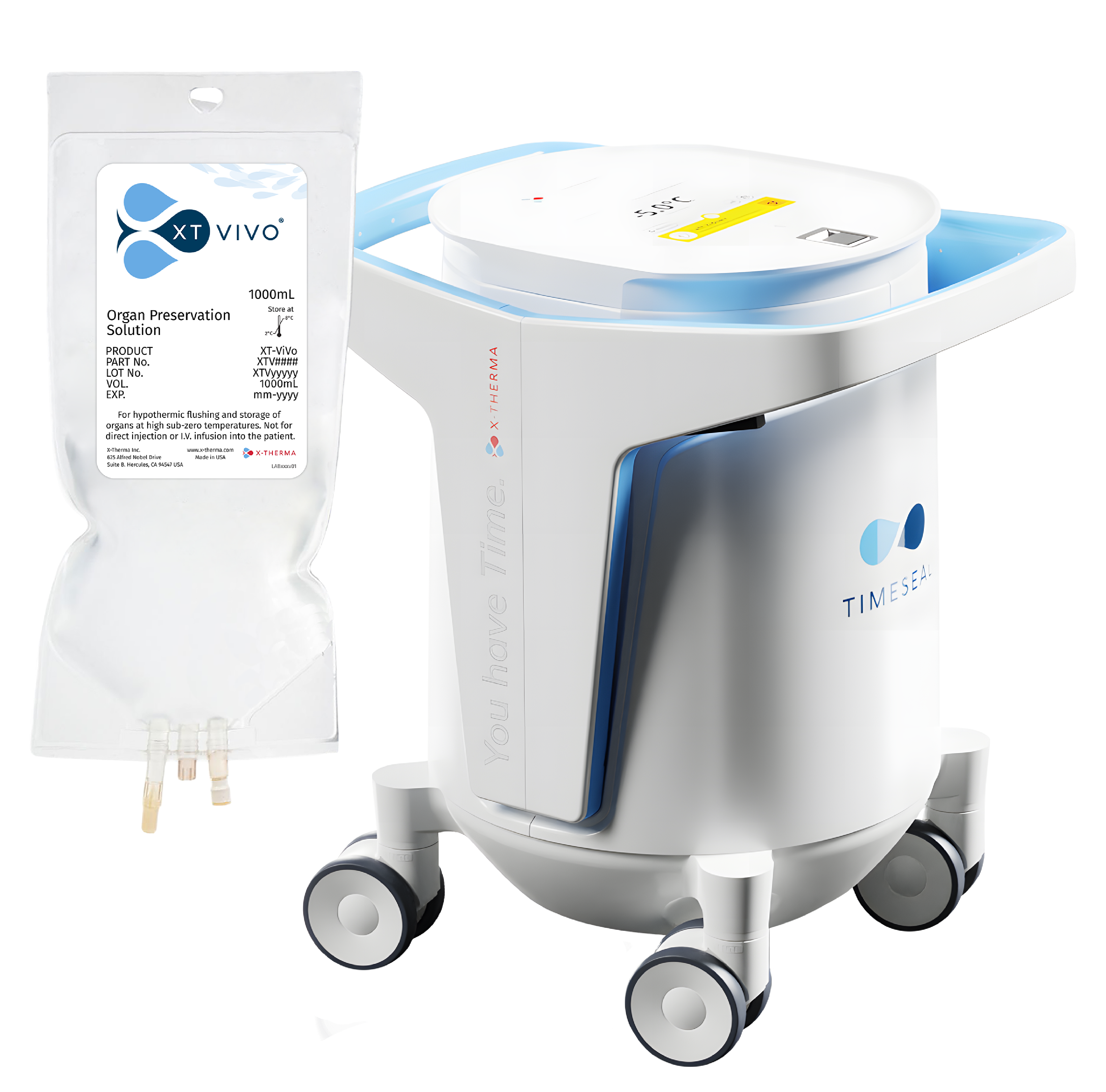
TimeSeal is designed to maintain that environment without external power, blood, oxygen or perfusion during transport. Sensors supply tracking and temperature information. This does not make perfusion irrelevant: the shipped kidneys were assessed using a perfusion device after arrival. Preservation on the way and assessment at the destination can be complementary jobs.
The bottle needs a business behind it
X-Therma sits in the infrastructure of regenerative medicine. It supplies tools for other organizations’ research, manufacturing and delivery. The commercial proposition is B2B: proprietary media and transport hardware, offered through product inquiries and quote requests. A cell-therapy manufacturer needs a dependable ingredient, consistent production and documentation it can carry into its own development program.
Here the comparison becomes more precise than “better freezing.” Established media such as CryoStor CS10 already offer serum-free formulations; CS10 contains 10% DMSO. X-Therma’s DMSO-free approach is a meaningful distinction. Whether it is the better choice for a particular process depends on recovery, function, handling and validation. A preserved cell that survives but loses the desired function is a poor bargain.
For organs, the alternatives include conventional static cold storage and machine-perfusion approaches such as OrganOx’s technology. They have different workflows and clinical histories. X-Therma emphasizes colder storage and portable transport with few supporting requirements. That positioning is clear; comparative superiority would require appropriately designed studies.
Combined: $35.4 million in these two rounds. Financing measures capital raised, not product price or development spending.
LOREA led the Series A. Starling Locke Capital co-led the Series B with support from LOREA and other investors. The later financing was intended to advance commercial operations and clinical development. Research grants and contracts also supported the science. That combination helps explain how a company can pursue a difficult organ-banking ambition while developing products for cell-manufacturing users.
Manufacturing became a visible milestone in 2024. X-Therma announced acceptance of XT-Thrive’s Drug Master File and, subsequently, GMP commercial readiness. A DMF lets customers reference confidential manufacturing information in their own regulatory submissions. It is useful supplier infrastructure; FDA neither approves nor disapproves the file itself.
A longer journey still needs a destination
The practical lesson is to test the whole trip. X-Therma worked with surgeons and research institutions, then put preserved organs on aircraft. Other builders can copy that habit without copying the molecule: identify the stressful handoff, involve the people responsible for it, and measure performance after the handoff rather than congratulating the ingredient beforehand.
The same discipline applies to buyers. The sensible evaluation asks whether the actual cell type or tissue retains its required function under the proposed protocol. Temperature control, packaging, preparation and assessment still matter. Results in pig kidneys do not establish outcomes in human kidneys, let alone every organ. Longer storage also cannot supply a missing donor or settle immune incompatibility.
X-Therma’s ambition is to make living medicines available on demand. The appealing detail is how ordinary part of that future could look: a scheduled flight, a manageable delivery window, a team able to plan. The extraordinary work sits inside the container, where a little synthetic chemistry is trying to persuade biology to wait.