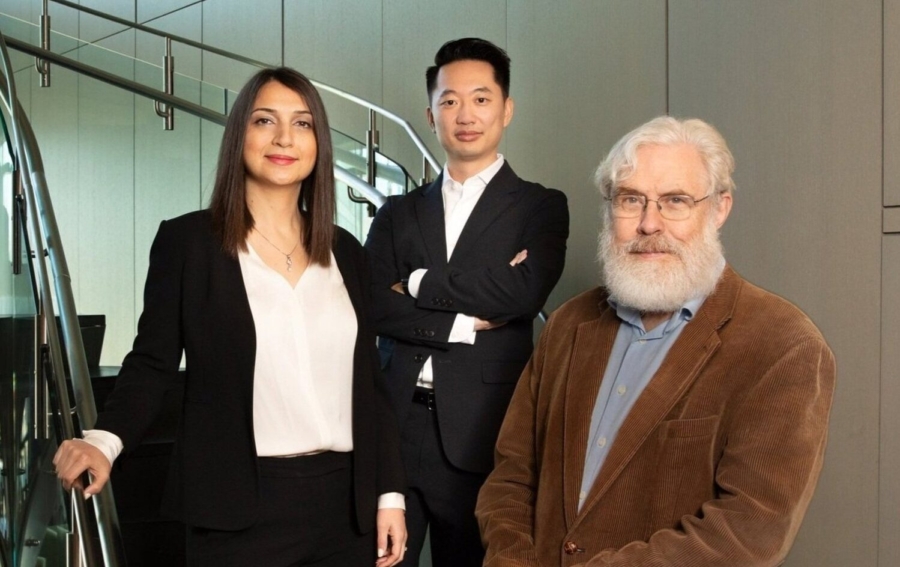
The cell that launched GC Therapeutics came with an excellent punch line: it was made from George Church. Parastoo Khoshakhlagh and Alex Ng were working in the Harvard geneticist's lab, trying to turn induced pluripotent stem cells into oligodendrocytes, the cells that wrap nerve fibers in protective myelin. The source cells had been reprogrammed from Church's skin. Four days after applying their transcription-factor recipe, Khoshakhlagh saw myelin forming on screen and hurried over with her laptop. "George, look at your myelin!" she told him. The science had acquired a protagonist - and Church, as Ng later joked, had literal skin in the game.
The episode explains both the charm and the tension of the Cambridge company. GC Therapeutics, or GCTx, says it can make specialized human cells in days, not the weeks or months often required by conventional differentiation protocols. It has raised $75 million, assembled roughly 45 employees and mapped more than two million combinations of genetic switches. Yet its public programs are still preclinical. The first four days may be fast; the years of safety testing, manufacturing work and clinical proof remain stubbornly pharmaceutical.
01 / The trickStop coaxing. Start programming.
Stem cells are wonderfully promiscuous raw material. Induced pluripotent stem cells, or iPSCs, can renew themselves and become nearly any specialized cell in the body. The usual method is closer to elaborate cooking than software: expose cells to timed sequences of growth factors and media, imitate developmental signals, adjust the microenvironment, wait, measure and try again. A protocol for one cell type may share little with the next. It can take 60 to 180 days, and yields can be low.
GCTx goes closer to the control panel. Transcription factors are proteins that switch gene programs on and off. They help determine whether a cell behaves like a neuron, a blood-vessel cell or an immune cell. Khoshakhlagh, Ng and colleagues built a library of 1,732 human transcription factors and variants, then screened them to find the combinations that push iPSCs directly toward a chosen identity. Their line is memorable because it is also technically descriptive: "We do not coax cells - we code them."
How much time leaves the recipe?
Illustrative scale based on company-reported comparisons. A shorter differentiation step does not shorten toxicology studies, regulatory review or clinical trials.
The platform is called TFome, pronounced "tee-eff-ome." It combines the physical library, pooled and multidimensional screening, gene editing and machine learning. The company says demonstrated protocols can produce cells in one step, in four days, at greater than 90 percent efficiency, without tuning a unique soup of microenvironmental factors for every target. In a 2025 paper, researchers used iterative screening to identify six transcription factors that rapidly produced microglia-like cells, the brain's resident immune cells, without neuronal co-culture.
02 / The productA platform with a pipeline attached
GCTx is not a contract manufacturer selling bags of generic cells. It is a venture-backed biopharmaceutical company building proprietary medicines. TFome is the discovery and production engine. The Cell State Cookbook is its growing empirical map of how transcription-factor combinations move cells between states. Predictive models learn from those physical experiments. "SuperCells" is the company's name for resulting cells that are further engineered for properties such as potency, engraftment or immune compatibility.
The commercial theory is platform leverage. Start from a renewable iPSC line. Reuse a similar screening and manufacturing strategy. Let each experiment enrich the dataset that guides the next program. If that works, GCTx can develop several products without rebuilding the factory every time. It may eventually commercialize its own medicines and license programs or technology to drug companies, although no therapeutic licensing deal or paying customer has been publicly announced. Today, its capital comes from investors, not product revenue.
Demyelinating disease
A first-in-class neurology effort that includes multiple sclerosis. GCTx said it remained on track to name a development candidate in 2026.
Type 1 diabetes
A regenerative cell-therapy approach aimed at replacing lost function in metabolic disease. The company calls the goal best-in-class.
This is also a strategic narrowing. At its 2024 public launch, the company described gastrointestinal, neurological and immunological priorities. In January 2026, it put two sharper stakes in the ground: demyelinating disorders and type 1 diabetes. It also started speaking more explicitly about in vivo reprogramming and rejuvenation - using the cookbook to change cell state inside the body rather than manufacturing every therapy outside it. That extension is ambitious and earlier than the disclosed cell-therapy pipeline.
03 / The moatEvery failed combination can still pay rent
The most defensible part may not be a single four-day recipe. It may be the map built while finding it. Conventional discovery often produces isolated protocols and discarded failures. GCTx's combinatorial screens create structured observations across a large design space. A combination that does not make microglia can still teach a model something about cell-state control. The company says its completed cookbook covers more than 300 states and feeds predictive foundation models validated in closed-loop biology.
A cartoon of the cookbook, not the actual data
no shift
partial shift
target state
off target
potent
unstable
precursor
repeatable
That makes GCTx different from competitors focused on a narrower stable of immune cells or a single disease. Fate Therapeutics and Century Therapeutics also use iPSCs to build off-the-shelf therapies, especially engineered immune products. BlueRock Therapeutics has clinical experience with iPSC-derived neurons. Sana Biotechnology and others pursue immune-evasive replacement cells. GCTx's claim is broader: a genome-scale, transcription-factor-first system that can search across many cell identities and use a modular production approach.
Breadth is not automatically an advantage. A company can drown in possibility. The pipeline choices matter because a platform becomes valuable when one product works, not when a slide shows many arrows. Demyelination is a logical proof: oligodendrocytes supplied the founding experiment, and successful cells would need to make durable, functional myelin. Type 1 diabetes offers a crowded but legible test of replacement-cell manufacturing and immune protection.
“The clever part is making a cell in four days. The valuable part is making the same cell safely, repeatedly and at scale.”YesPress analysis
04 / The bill$75 million buys the right to attempt the hard part
Harvard's Blavatnik Biomedical Accelerator funded early platform work and helped the team build a second version of the transcription-factor library. Awards and Golden Tickets from Amgen and Biogen supplied recognition, LabCentral space and drug-development access. Harvard protected the foundational intellectual property and licensed it exclusively to GCTx. Then, in September 2024, Cormorant Asset Management led a $65 million Series A with Mubadala Capital, Andreessen Horowitz Bio + Health, Medical Excellence Capital, Cercano Management and Pear VC. The round brought total financing to $75 million.
That is what it cost to launch the clinical push, not what a finished medicine costs. GCTx has not published per-dose manufacturing economics, pricing or revenue. The money funds safety and efficacy studies, process development, regulatory work, hiring and the slow accumulation of evidence. In 2025 it recruited leaders from Editas Medicine and AVROBIO for drug development and technical operations. In 2026 it hired former BlueRock chief scientific officer Stefan Irion, who helped move an iPSC-derived Parkinson's therapy into the clinic, while Ng shifted to chief innovation officer.
The personnel change reveals what changed the company's mind about what it needed next. The platform had enough experimental depth to become a cookbook; the bottleneck moved from inventing the engine to driving a candidate through development. Kate Haviland, formerly CEO of Blueprint Medicines, became board chair. GCTx also reported productive discussions with the FDA and EMA around a streamlined platform model. Regulatory encouragement is useful. It is not an approval, and the details of those private interactions are not public.
Where the four-day thesis breaks
- If rapid differentiation produces cells that look right but lack durable function.
- If gene editing or expansion creates genomic instability, impurities or tumor risk.
- If cells fail to engraft, are rejected by the immune system or behave unpredictably in tissue.
- If a shared process cannot satisfy product-specific manufacturing and regulatory controls.
- If clinical benefit does not beat existing drugs, devices or rival cell therapies at a viable cost.
05 / The stealA practical playbook hiding inside the petri dish
Most readers cannot assemble a library of human transcription factors. They can copy the operating logic. GCTx began with the control point, not the visible workflow. Instead of optimizing every step in a months-long protocol, the founders asked which master switches could remove steps. They turned experiments into a reusable asset and chose a first therapeutic area connected to the strongest founding evidence.
Find the variable that governs the process. A direct instruction can be worth more than a faster version of a bad sequence.
Structure experiments so unsuccessful combinations improve the map instead of disappearing into a lab notebook.
A renewable starting point and shared workflow create leverage only when quality controls travel with them.
The first program should expose the platform's weak spots. Myelin formation, durability and function are harder to hand-wave than a generic marker.
The culture appears shaped by that translation problem: academically playful at the origin, increasingly operational in the hiring. Khoshakhlagh is a biomedical engineer and repeat founder. Ng brought biochemistry, statistics and synthetic biology. Cory Smith added genome engineering and genomic-safety expertise. Church supplied the lab, intellectual weather and unusually photogenic source material. The newer executives bring INDs, clinical manufacturing and regulated development. It is a team being rebuilt around the next failure mode.
What did GC Therapeutics actually do? It built the switch library, screened it at scale, published the underlying work, demonstrated rapid differentiation across several cell types, raised the money and named two disease programs. What it has not yet done is treat patients with a publicly disclosed candidate. That distinction is not a footnote. It is the story. If GCTx can carry its tidy four-day recipe through the untidy human body, cell therapy may start to look less like bespoke craft and more like a product platform. Until then, the cookbook is compelling - and dinner is still in development.