A sofa can look perfectly comfortable on a phone. The cushions are suspiciously tidy. Then comes the question the photograph cannot answer: what happens when you sit down? Wooden Street’s story turns on that small hesitation. An online furniture business needs people to imagine a room. It also needs to give them reasons to believe the room will turn out that way.
- Online discovery leads to physical inspection: the first Bengaluru store opened in 2016.
- Custom furniture requires control of production, delivery and installation.
- Expansion has a bill: reported FY25 sales grew, while losses widened sharply.
A photograph cannot answer the cushion question
In 2015, four founders launched Wooden Street: Lokendra Singh Ranawat, Virendra Ranawat, Dinesh Pratap Singh and Vikas Baheti. Their backgrounds included marketing, procurement, operations and furniture sourcing. The early proposition paired ready furniture with custom work. A buyer could furnish a home without coordinating carpenters and suppliers. The company took an inventory-based approach, keeping responsibility for quality and service close.
“Furniture making is a delicate skill,” Lokendra told YourStory that July. Bringing buyers and sellers together would leave an awkward question about who took responsibility for the finished piece. Wooden Street wanted a hand in making it. Buyers needed something that fit and arrived as expected.
The first experience store opened in Bengaluru in 2016, very early for a business born online. Lokendra later explained the reasoning in the language of an ordinary shopper: furniture “is high on touch and feel preference.” A shop supplied missing information. People could inspect the finish, judge the scale and try a seat. The website and the shop had different jobs in the same purchase.

Furniture with a second job
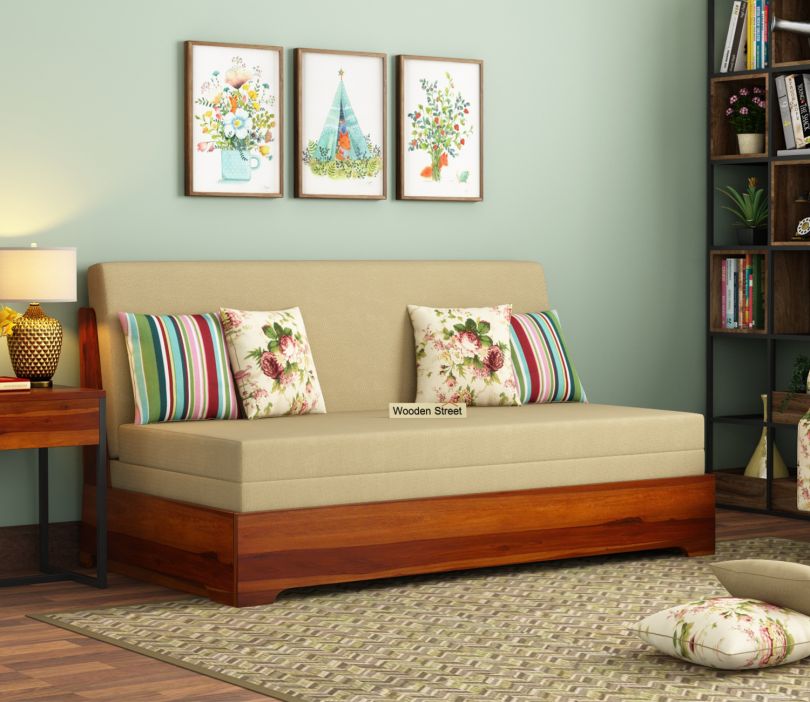
Consider the Della armless sofa bed. Its product listing gives it a sofa length of 61 inches and an opened bed length of 81 inches. That extra twenty inches is the difference between an attractive purchase and an argument with the coffee table. The useful innovation is easy to understand: one object earns its place twice, provided the room can accommodate its second assignment.
The same listing calls the material sheesham wood and discloses MDF or plywood inner panels. Read both lines. A material headline does not describe every component. Wooden Street’s custom-furniture offer includes choices of fabric, finish and size, with availability depending on the piece. For a buyer, those options can solve an awkward corner or match an existing room. They still require a careful conversation about the actual specification.
The wider catalogue covers beds, dining tables, wardrobes, office furniture, lighting, mattresses and decor. Wooden Street occupies a familiar middle ground: shoppers want more choice and coordination than a local purchase may offer, with opportunities to personalize. Alternatives include local carpenters and retailers, alongside brands such as Pepperfry, Urban Ladder, IKEA and Wakefit. Compare the product and service commitment.
The order had to survive the journey
Some early friction appeared after checkout. In a 2021 interview, Lokendra described unreliable third-party delivery networks and the company’s decision to develop its own logistics solution, including installation. It also worked on tracking and artisan training. A finished wardrobe still has to become a usable wardrobe in someone’s home.
There is a revealing detail in Wooden Street’s August 2025 partnership with Unicommerce. The system was designed to connect online orders with inventory across more than twenty warehouses and route orders to a nearby facility. It also allowed an order to travel in parts. Ready cushions or decor could leave before a slower furniture item. The cushion no longer had to wait for the sofa.
- 01Discover
Online - 02Inspect
In store - 03Specify
Materials + fit - 04Install
At home
The business earns money by selling products and home services through its own channels and marketplaces. Manufacturing and fulfillment are part of delivering that offer. This gives the company more places to correct a problem, and more places where a problem can occur. Owning responsibility makes the promise clearer; it does not make execution automatic.
Confidence comes with a capital bill
The founders initially funded the business themselves. External backing came in stages: a reported $1 million in 2018, $3 million in 2020 and a $30 million Series B led by WestBridge Capital in 2022. That Series B mixed primary and secondary investment, so the headline amount should not be mistaken for money all spent on operations. In December 2024, Premji Invest led a ₹354 crore Series C, approximately $43 million.
The priorities included stores, manufacturing and supply-chain capacity. The company’s own timeline separately records a $4 million to $5 million warehouse investment in 2020. A showroom needs rent and stock. A warehouse needs space before the customer needs delivery. Reassurance is expensive to put within reach.
₹ crore · Reported financial figures. Net loss is shown as a positive magnitude. Scales reset for each measure.
Reported revenue rose from about ₹260.2 crore in FY24 to ₹294.8 crore in FY25. Net losses rose from ₹10.9 crore to ₹74.3 crore. Sales growth alone cannot tell us whether the expansion is earning its keep. These numbers make the next chapter harder: the company has to turn its larger operating base into better economics.
After the Series C, Premji Invest described work on delivery timelines, installation quality and customer-service responsiveness. It also helped recruit operating leaders and develop dashboards. Those are telling priorities. A company can open another store faster than it can teach every part of a growing network to handle the same problem consistently.
The cushion no longer had to wait for the sofa.An order-system detail with a very human payoff.

The room gets bigger
In May 2026, Lokendra discussed expansion in southern India and a broader home-interiors offer, including kitchens and wardrobes. The stated ambition was ₹1,000 crore turnover within three years, alongside profitability. That is a target. Whole-home work also raises the coordination stakes: more materials, more installation steps, more decisions that depend on each other.
The lesson a smaller business can borrow is to locate the customer’s unresolved doubt. Show the material. Confirm the dimensions. Track delivery and installation as carefully as the sale. The approach needs enough demand to support physical locations and enough operational skill to honor custom specifications. For an urgent purchase, a room that cannot fit the opened mechanism, or a budget that cannot support the chosen materials, another option may serve better. Start with a measuring tape. Then take a seat.