Two people can share an age, a ZIP code, and an income bracket, yet spend their money on entirely different things. To a marketer buying a demographic segment, they may look interchangeable. To a company studying purchases, the differences are the point. A receipt records a decision. Enough receipts begin to describe a customer. The challenge for a marketer is turning that description into a useful decision about where to spend the next dollar.
That is the premise behind Wiland, the Colorado marketing data company founded in 2005. It takes consumer spending and interest signals, applies predictive models, and supplies audiences or additional data to brands, agencies, and nonprofits. The practical question is refreshingly specific: who is likely to respond to this offer, and who might keep coming back?
- Spending signals help identify likely buyers and donors.
- PersonaBuilder connects audience planning to activation.
- MarketSignals adds outside context to customer data.
- Campaign economics still need a fair test.
01A postage problem becomes a prediction business
The backstory begins beside a post office. In 1971, Phil Wiland started an earlier Wiland business in an upstairs office in Culpeper, Virginia. His work included the unglamorous machinery of direct marketing: organizing addresses and removing duplicate names. Printing and postage gave bad targeting a price you could hold in your hand.
The Smithsonian’s National Postal Museum records another detour: Wiland built consumer catalog businesses, including personalized merchandise and character brands associated with Snoopy and Garfield. He later sold the merchandise businesses to concentrate on marketing technology. By the time the present company launched, its founder had experience both selling products and building the systems behind the sale.
That history makes the current proposition easier to understand. Modern advertising has more channels, but the old arithmetic survives. Reaching someone costs money. Reaching someone who has little reason to care costs money, too.
Reaching someone who has little reason to care costs money, too.
02The missing step between a persona and an ad
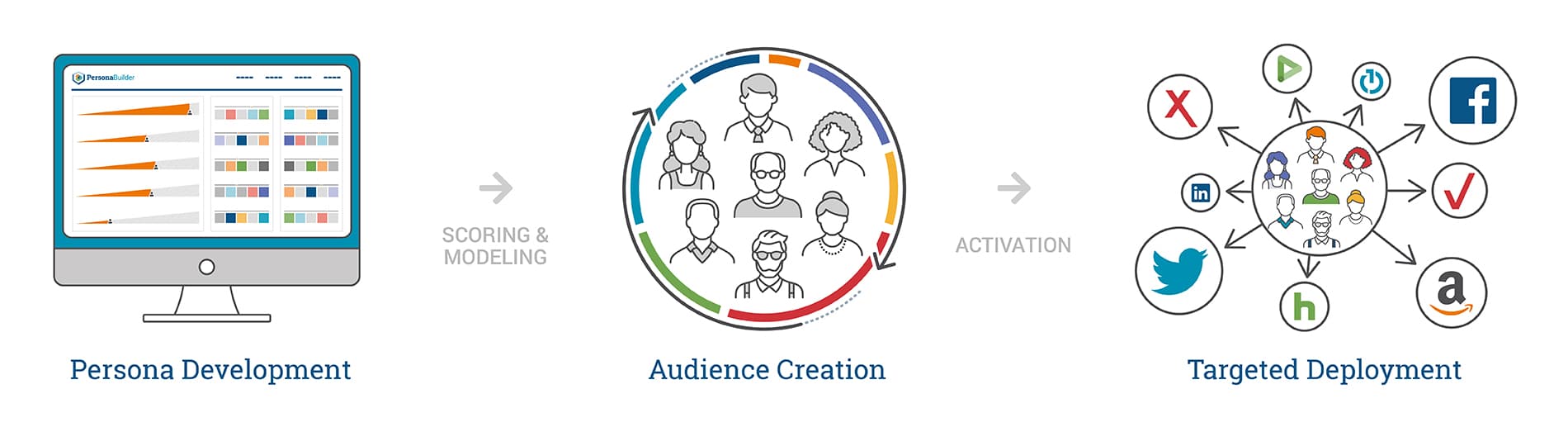
Wiland sells several ways to improve that arithmetic. Its audiences include ready-made segments and custom models for a particular campaign. Marketers can activate them in digital display, social advertising, connected television, and direct mail. These are audience inputs for a campaign; someone still needs an offer, creative work, and a media plan.
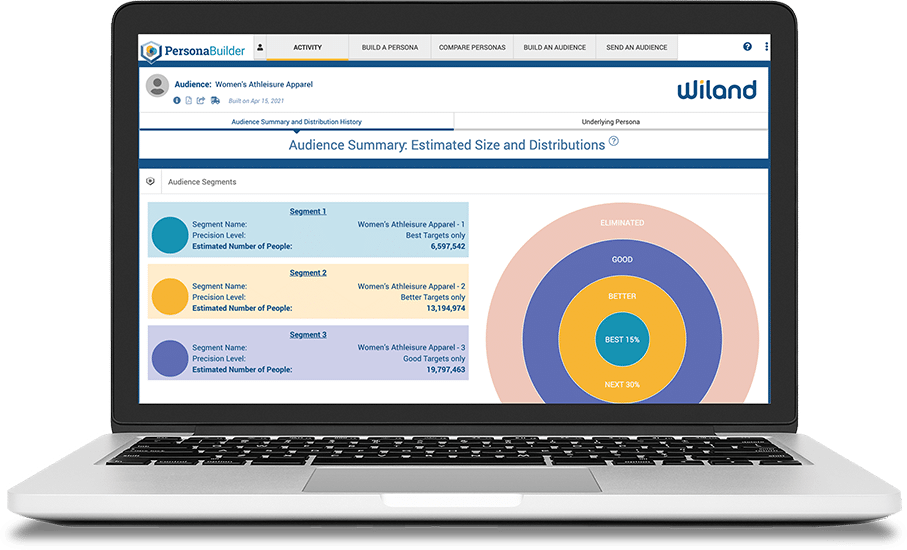
PersonaBuilder tackles a familiar office problem. A strategy team creates a beautifully detailed portrait of the ideal customer. A media buyer then has to translate that portrait into settings an advertising platform can actually use. Somewhere between the presentation and the purchase order, much of the detail can disappear.
Wiland’s application connects those jobs. Users develop personas from spending, engagement, and other indicators, compare their characteristics, and turn them into modeled audiences for activation. The useful feature is the handoff. A persona becomes something the buying team can deploy.
MarketSignals serves a different user: the organization that wants to improve its own customer records or models. Wiland offers data append, file installation, and cloud access, with more than 3,500 data elements on its current product page. It says the data refreshes every two weeks. A retailer can enrich a customer file; a fundraiser can look for promising donors beyond the information already in its database.
03What a better audience can actually change
Consider a transportation supply manufacturer in a Wiland agency case study. It wanted greater U.S. awareness and a stronger association with sustainability, while operating with a limited budget in a crowded market. Wiland and the agency used spending and social engagement signals to build audiences likely to respond to that positioning.
The company reports 7.41% overall post engagement in a corporate social responsibility campaign across Twitter, Instagram, and Facebook. That is an engagement result, not a sales result. The comparison in the case study is an industry benchmark rather than a randomized experiment. Still, the example shows the job: find people whose interests make the message relevant, then measure their response.
The economics deserve equal attention. Wiland’s audience page says custom modeling and audience creation carry no charge; customers pay when audiences are activated. PersonaBuilder’s terms put prices in the customer’s order and leave external platform fees and impression bidding costs with the advertiser. A targeting decision therefore belongs inside a complete campaign budget, alongside creative and media.
Overall social post engagement
Wiland’s 2021 manufacturer case study. Engagement, not sales lift.04The sports fan who never bought a ticket
Wiland’s customers span retail, fundraising, publishing, and other consumer markets. Sports offers a particularly revealing use case. An organization’s ticket database describes ticket buyers. It cannot, by itself, describe everyone who watches a team, buys related merchandise, or would appeal to a prospective sponsor.
FanSignals applies spending intelligence to that wider audience. In April 2026, Wiland announced a partnership with A Parent Media Co., operator of Victory+, the free sports streaming platform. The stated aim is to understand viewers, strengthen engagement, and support advertising revenue. It extends Wiland’s work into a business where the viewer can be valuable without paying for access.
The surrounding partnerships explain its place in the market. Snowflake provides a route for data integration. Viant supports programmatic audience activation. StellarAlgo connects Wiland’s analytics with sports customer data tools. Wiland supplies intelligence that other systems can use, rather than requiring every marketing task to happen in one application.
05Spend data still needs a fair test
This is a competitive neighborhood. Epsilon’s Abacus cooperative and Acxiom also sell data and audience capabilities; platform targeting is another option. Wiland’s pitch emphasizes individual spending signals and the connection between analysis and activation. Its expertise sits where database marketing, response modeling, and media execution meet.
A buyer can copy the discipline before buying anything: define the desired outcome, keep the offer comparable, test an audience against the current approach, and judge the additional value after all costs. More clicks can be useful. Profitable customers, repeat gifts, or incremental purchases answer a different question.
Fit matters. PersonaBuilder’s published terms cover online marketing to U.S. consumers and require honoring opt-outs. A campaign aimed elsewhere needs a different data assessment. Poor identity matches, stale customer inputs, or an offer nobody wants can also defeat precise targeting. These are reasons to design a test, not assume a model will rescue the campaign.
Wiland’s careers page puts its culture in four words: “Work Hard and Be Nice.” Its 2026 USA TODAY Top Workplaces recognition was based on employee survey feedback. The business has changed considerably since the office beside the post office. The question underneath it remains wonderfully stubborn: before you pay to reach someone, what makes you think they will care?
Follow the signals
Explore Wiland, PersonaBuilder, and MarketSignals. Read the company blog or the Victory+ announcement.