Alexander Starostin trained to read accounts. He ended up reading shopping habits. Between those two occupations came public relations, a digital production business and an uncomfortable discovery: work that once commanded a substantial fee could become something a customer assembled with a website builder. For an entrepreneur, this is a rather pointed kind of feedback. The market has learned your trick.
His response eventually led to First Data, the marketing technology company he co-founded in 2017. Its raw material is the record of a purchase. The ambition is to turn those records into a better understanding of what somebody might buy next, and when an advertisement might be useful. Starostin’s career follows that same progression: communications, then the machinery behind communications, then the evidence that any of it worked.
The accountant who went into PR
Starostin says he graduated from the Financial Academy, specializing in accounting, analysis and audit. He also says he never worked in that specialty. He went into PR instead, spending approximately eight years in the field before deciding to start a business during the 2008 crisis.
That business worked in digital production: websites, social networks, online groups and related services. Over time, he recalls, demand changed. Substantial website projects gave ground to landing pages that could be made with increasingly accessible tools. Building large social communities gave way to keeping a conversation going with existing members. The services still existed. Their economics were changing underneath them.
His account of the shift is practical. The business needed to adapt. Advertising using external data offered a different direction. Rather than continually making another digital destination, the company could help an advertiser decide whom to reach. The next question was which information would make that decision more useful.
A shopping habit is a clock
Consider the difference between liking a category and repeatedly spending money in it. Interest can be broad and persistent. A purchase has particulars: a date, an amount, a product and perhaps a discount. Those particulars give an advertiser something more precise to investigate. Starostin has made that distinction central to his public explanations of transactional data.
Frequency matters. So does the interval since the last purchase. A category can also change meaning with the season. In his explanation of the approach, customers can be grouped by how recently they bought, how often they buy and how much they spend. The resulting groups let a brand ask a narrower question than whether a person fits a demographic description.
There is an appealing modesty to the unit of evidence. A receipt has no interest in sounding interesting. It records a transaction. The interpretation comes afterward, when people and models try to establish which patterns deserve attention. That is where the advertising business begins.
- 01PurchaseWhat was bought?
- 02PatternHow often, and when?
- 03AudienceWho may buy next?
- 04TestWhat changed?
First Data’s company history places its founding in 2017, with four founders and pre-seed backing from IIDF. The early proposition was to aggregate depersonalized purchase information for advertising and other uses. Building that proposition required relationships with organizations that held transaction records, alongside the technology that could process them.
The company’s subsequent milestones trace those relationships: agreements with cash-register and telecom businesses, projects measuring online advertising against offline purchases, and later products for customer communications. Starostin leads a business whose materials come through partnerships. Even an elegant algorithm needs something to read.
The sale has to survive the spreadsheet
There is a second question hidden inside the targeting question. Suppose an advertisement reaches a plausible customer, and sales rise. How much credit should the advertisement receive? Weather, prices and other circumstances can change purchasing behavior too. A rising sales chart can be excellent news while remaining an incomplete explanation.
Starostin’s published discussion of offline measurement describes dividing an audience into test and control groups. One group sees the advertising; the other provides a comparison. Purchases can then be examined across the groups. The method brings the conversation closer to the commercial event the advertiser cares about, particularly when the transaction happens in a shop rather than on a website.
This is consequential for his role as a founder. The company has to persuade clients to buy a way of working they may not already understand. Showing an audience is one part of that task. Showing how its value will be assessed is another. A clever segment without a useful comparison gives the sales team plenty to explain.
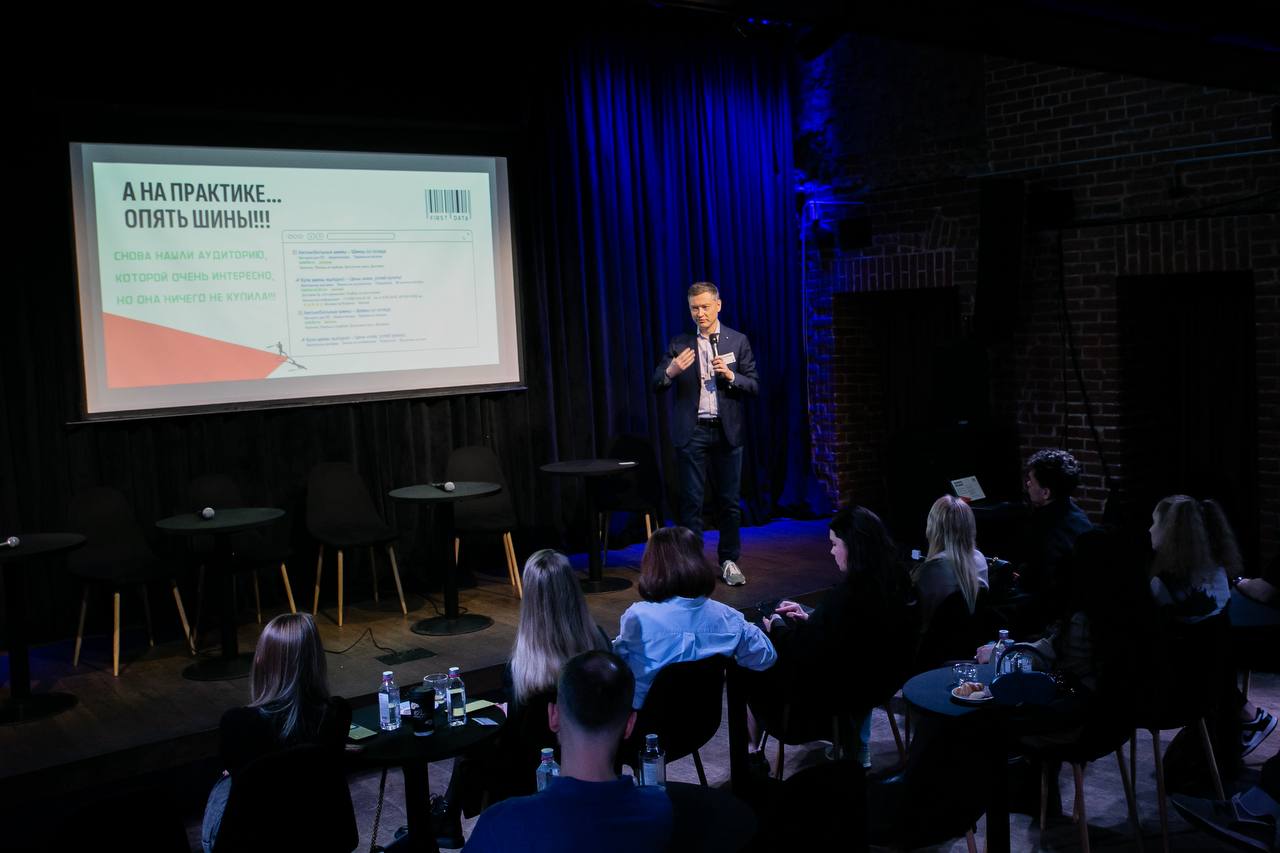
In March 2022, his advice addressed a particularly unsettled market. Brands were leaving Russia, consumers were looking for replacements, and advertisers were reconsidering where they could reach people. He discussed using a brand’s own customer information alongside external data, including ways to find former customers of competitors. The underlying problem was continuity: how to recognize a useful audience as the available advertising environment changed.
For Starostin, this made the data relationship part of the operating strategy. An advertiser’s knowledge of its own customers had value beyond a particular placement. Enriching that knowledge could help it navigate a different set of channels. The marketing question had become an infrastructure question too.
The machine still needs a question
Starostin’s account of AI is grounded in the scale of the work. First Data has reported analyzing more than a billion purchases a month. At that volume, examining the records manually is hardly a plausible business plan. Models look for relationships between previous and subsequent purchases; data science specialists check and supplement the work.
He has used Excel as an analogy. Automating the table does not settle which numbers belong in it or what they mean. For advertising specialists, the useful task is learning to work effectively with the tool. His emphasis is on the interaction between people and AI, with the commercial question still requiring human judgment.
That position gives his technology business a distinctly ordinary obligation. Someone has to decide what the client is trying to achieve. Someone has to examine the output. Someone has to explain the result. An algorithm can process records at considerable speed while leaving a meeting agenda recognizably intact.
New markets, familiar questions
In 2023, Starostin discussed opportunities in Kazakhstan and Uzbekistan. He argued that those markets could adopt established ways of working with data while avoiding mistakes made elsewhere. His stated ambition was practical adoption: give brands access to more relevant audiences and make the advertising consumers receive more useful.
First Data joined the Central Asian Advertising Association that spring and the Marketing Association of Uzbekistan in the autumn. Those affiliations fit a business that depends on local commercial relationships. A model can be transported; the network of partners and customers still needs to be assembled.
In Uzbekistan, Starostin described using information beyond a brand’s existing customer records, including ways to reconnect with inactive customers. The attraction was the same as in his earlier work: find a commercially useful moment, then communicate with the people for whom it might matter.
A wardrobe with a memory
Clothing makes the timing question tangible. In First Data’s account of its work with Finn Flare and MediaNation, the initial audience was refined using purchase frequency, average spending and seasonal patterns. The team looked for people who regularly refreshed their wardrobes in autumn, then tested different shopping behaviors.
The campaign ran from October 2024 to February 2025. Its first flight recorded 6,399 post-view conversions against a plan of 346, according to the published case. Post-view describes the attribution method: a conversion recorded after an advertisement was seen. The figure compares an observed campaign result with a plan; it does not establish that every purchase was caused by the advertising.
Starostin’s comment on the work stressed removing unsuitable records and identifying active, regular buyers. The detail is revealing. Much of the work sits between acquiring information and using it: choosing a group carefully enough that the eventual advertisement has a reason to arrive.
A case published on October 14, 2026 brings the same argument into another wardrobe. Working with EKONIKA and Starlink, First Data identified recurring buyers of clothing, shoes and accessories at a comparable price level. Starostin explained the selection through seasonal repetition: premium footwear was already part of these customers’ purchasing habits.
The campaign used banners on Yandex placements, refreshed its audience and optimized placements weekly. Its reported cost per action declined 40.3% from the beginning to the end of the placement period. These are campaign participants’ reported results, measured within that campaign’s attribution setup. The interesting connection to Starostin’s career is the specificity: category, spending level, repetition and timing, assembled into an advertising decision.
What the founder has learned to leave open
In a December 2025 interview, Starostin described becoming more adaptable after an earlier tendency toward perfectionism. He also explained the Rostelecom partnership, following the telecom company’s investment in 2024, as a way to scale a product whose market had been established. Infrastructure and access to data were part of the attraction.
“In business, people believe in only one argument - sales growth.”
Alexander Starostin / translated from Russian
His stated development plans included personalization in SMS and email, alongside work on financial technology. They extend the same question into other channels: what communication would be useful now? For a founder who moved from making websites to interpreting purchase records, the question has proved durable.
The receipt remains an unusually plain starting point for a business about prediction. It records what already happened. Starostin’s work begins with that small certainty and moves toward a much less certain event: the next purchase. Between the two lie the choices his company has to make, test and explain.