A life in data / The long read
In August 2025, Dan Jaye changed chairs. The co-founder who had been running Aqfer as CEO became its chief technology officer, and Bill Schild took over the business. Aqfer announced the switch alongside a new way for artificial intelligence systems to reach enterprise data. For a founder whose career has repeatedly involved building the machinery underneath someone else's bright idea, the pairing was rather apt.
There is a familiar version of the technology founder's story: an invention, a company, a sale, a victory lap. Jaye's has more awkward furniture. There are databases that need assembling before the product can work. There is an advertising business trying to protect privacy while learning about people's interests. There is a measurement company whose customers can get a competing service free. The engineering is only part of the examination.
His current work makes more sense with those earlier chapters in view. Jaye helped establish Engage in 1995, became president of TACODA, co-founded Korrelate, and started Aqfer with Raymie Stata in 2018. Across those businesses, the recurring question has been how to turn scattered information into something another person can actually use. Then comes the less glamorous question: who will pay for it?
02Before the browser, a warehouse
Jaye studied astronomy, astrophysics and physics at Harvard, graduating magna cum laude. His subsequent work took him through Andersen Consulting and Epsilon to Fidelity Investments, where he directed high-performance computing. The subject matter had changed from the sky to customers. The need to organize observations had survived the journey.
At Fidelity, he managed the retail marketing data warehouse and applications, with responsibilities extending to customer management and sales-process redesign. These were working business systems, with all the stubborn particulars that phrase implies. Information had to be processed, organized and made useful to people trying to make decisions. A handsome theory could not substitute for a system that ran.
By 1995, he and David Wetherell were building Engage. Bringing database marketing onto the internet meant connecting two worlds: the established business of learning from customers and the new stream of activity arriving from websites. Browsing created evidence of interests. Software could use that evidence to make advertising more relevant. The browser was becoming a place where observation and commerce could meet.
The idea also brought a choice about identity. Engage's profiles were designed without personally identifying information. Its interest scores could help choose an advertisement without attaching the person's real-world name. That was a specific architectural ambition, and a consequential one. An advertiser wanted useful knowledge; the person at the other end of the connection had a reasonable interest in how that knowledge was obtained.
THIRTY YEARS, FIVE STOPS
- 1995Engage
Early web advertising - 2007TACODA
President; AOL acquisition - 2010Korrelate
Online-to-offline attribution - 2018Aqfer
Marketing data infrastructure - 2025CTO
Aqfer’s technical roadmap
03A cookie with conditions
Jaye's early web work included trying to give privacy preferences a technical form. He participated in the World Wide Web Consortium's Platform for Privacy Preferences project, known as P3P. The contributor lists put him alongside browser companies, advertising businesses, researchers and privacy representatives. Agreeing on what software should say about data practices was already a crowded conversation.
He also worked on an internet proposal for trust labels associated with cookies. The proposed mechanism would attach signed information that a browser could evaluate when deciding how to handle a site's cookies. A preference could become a processing rule: accept, reject or otherwise treat a cookie according to the practices described. The proposal remained an expired Internet-Draft, rather than an adopted IETF standard.
That distinction matters. A proposal records a problem someone tried to solve; it does not establish that the world adopted the solution. Here, the problem was making privacy usable by machines as well as legible to people. A policy page is one thing. A browser capable of acting on a user's preferences demands another layer of work.
Years later, Jaye was still writing about that gap between a declaration and an enforceable practice. In 2019, he warned about consent fraud in advertising: a consent signal could travel through the system without providing the assurance its recipients assumed. His argument favored accountability and respect for consumer preferences. The vocabulary had evolved. The question of whether the machinery honored the promise remained.
04The car purchase beyond the click
TACODA gave Jaye another setting for behavioral advertising. He joined in early 2007 and became its president; AOL bought the company that year. Curt Viebranz later credited him with helping focus product development and contributing to the sale. The recommendation describes an executive comfortable moving between technical and business questions, a useful combination when a product must survive contact with an acquirer.
Korrelate, co-founded in 2010, put that combination to a different test. A car shopper could browse a manufacturer's website, research a model and eventually buy at a dealership. The online system saw activity. The purchase happened elsewhere. Korrelate worked on connecting the two, using vehicle-registration data to understand the relationship between digital behavior and completed purchases.
Its collaboration with BlueKai examined whether online audience signals corresponded to actual buying. In 2012, Jaye discussed the affinity between researching a particular brand and purchasing it. For a marketer, that distinction matters: finding people who might buy any car is a different task from finding people interested in the car you sell. The work aimed to make that difference measurable.
But a measurement business still needs a business model. By February 2014, Korrelate had suspended operations. J.D. Power's acquisition was announced that April, with remaining employees moving to the buyer and Jaye leaving while continuing to advise. It was an exit after a difficult interruption, with the technology finding a home. Deal terms were undisclosed.
Looking back, Jaye summarized a competitive problem in five words: “We were competing with free.” A rival sold targeting data and supplied measurement without a separate charge. Better analysis has a hard sales pitch when the alternative arrives bundled into something a customer already buys. The lesson sits close to the center of his next venture.
“We were competing with free.”
Dan Jaye, looking back on Korrelate
05Build the part everybody builds
Aqfer began in 2018 with Jaye and Stata, a former Yahoo chief technology officer. Its business addresses the underlying data work that marketing technology companies repeatedly need: collecting information, resolving identities, constructing audiences and making data available to applications. Instead of each provider assembling the whole foundation, Aqfer supplies infrastructure that providers can use in their own products.
That changes what is being sold. Standalone analytics competes for a customer's attention and budget as a finished answer. Infrastructure earns its place by helping another company deliver its answer. The distinction does not remove commercial risk. It does place the technology closer to work the customer must perform, regardless of which dashboard eventually gets the credit.
In November 2021, Aqfer announced an initial closing of an $11 million Series A led by Resolve Growth Partners. Its first appearance on the Inc. 5000 followed in 2022, at number 1,165. The figures belong to the company, rather than to Jaye personally. They mark the infrastructure business gaining financial backing and a place on a growth ranking.
Aqfer's design also keeps customer data within the customer's cloud environment. That brings the privacy question into the placement of software itself. Where does information live? Who governs access? How much copying is necessary? These are practical concerns for a marketing business with data in several systems, and they become more pressing when new applications want to act on that data.
Aqfer’s announced Series A, led by Resolve Growth Partners. November 2021.
06The tables look tidy. The meanings disagree.
Jaye's later writing gets quite specific about why data is difficult. In a November 2025 essay, he described structured datasets that look orderly but fail to line up. One supplier's age ranges differ from another's. Income brackets use different boundaries. The rows and columns remain perfectly respectable. The meanings have quietly stopped agreeing with one another.
This is a wonderfully untheatrical software problem. Nobody needs to pull a fire alarm. A table can validate and a dashboard can render while the analysis becomes less useful. Jaye argues that techniques associated with unstructured information, including embeddings and machine learning, can help recover relationships that rigid schemas handle poorly. He also discusses ways to preserve explanations of the resulting decisions.
The August 2025 leadership change placed him squarely on that technical terrain. Aqfer said his CTO remit would include reinforcement learning, vector-store integration and real-time context for AI. Its remote Model Context Protocol server was intended to give AI applications governed access to data where it already lived. The product claim is practical: make existing information reachable without first relocating the whole collection.
A chatbot's apparent fluency can obscure that prerequisite. Before an application can produce a useful answer about a customer, it must reach the right records and understand what those records mean. Jaye's work concerns the preparation and access that precede the answer. The conversational interface may be new. The warehouse still has to be in order.
BEFORE THE AI ANSWER
07Give the agent a chaperone
His December 2025 forecast for AI emphasized constrained autonomy. He expected demand for supervision, audit trails, kill switches and smaller models suited to particular jobs. These were predictions, rather than a report that the changes had already happened. They reveal the conditions under which he thought enterprise AI would become useful: people needed ways to inspect it, limit it and establish whether it worked.
There is a commercial interest in that outlook, and Jaye acknowledges it. A founder selling data infrastructure benefits when companies decide infrastructure deserves more attention. That makes the argument worth examining on its particulars. Does the system have usable information? Can access be governed? Can its output be evaluated? Those questions survive any change of fashion.
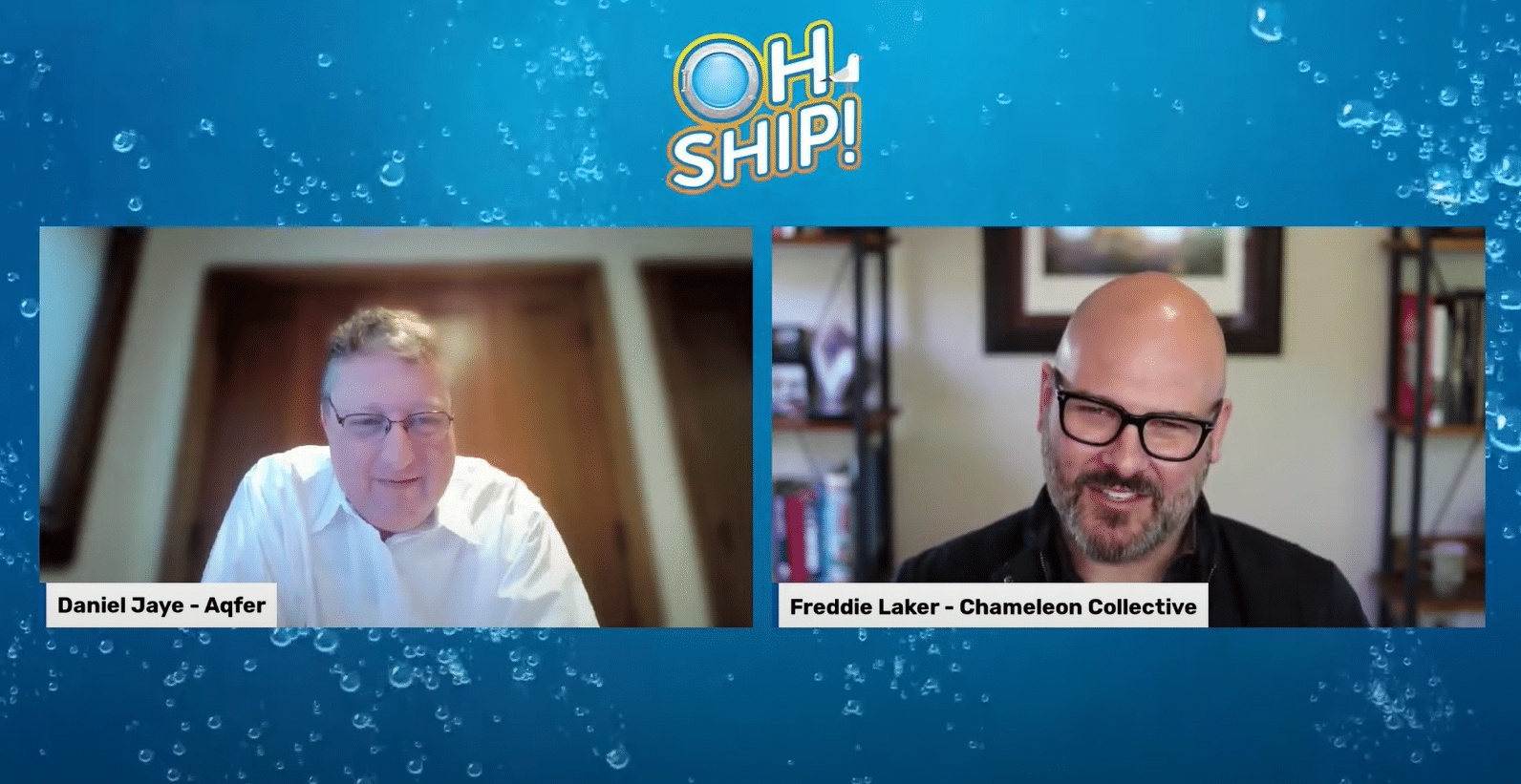
He also hosts MADTech Momentum, interviewing people from the advertising and data business. A January 2026 conversation with Stata considered AI's effects on engineering, including how junior developers learn when experienced engineers work with agents. The discussion extended from software architecture to the advertising economy. A career spent building these systems now includes asking other builders what the next version might displace.
Jaye's move to CTO offers an unusually concrete final detail. He remains at the company he co-founded, with a role focused on its technical roadmap. The systems have changed since Engage's early profiles, and the ambitions attached to them have grown. There is still information to organize, a promise to make good on, and a bill somebody must be willing to pay.
Continue the conversation
Read, watch and listen to Jaye’s work.
- Aqfer / Marketing data infrastructure
- Daniel Jaye on LinkedIn
- MADTech Momentum on YouTube / Spotify / Apple Podcasts
- Paleo Ad Tech: starting it all with Engage
- When Structured Data Becomes Unruly
- For AI, 2026 Will Be the Year of Constrained Autonomy
- Aqfer’s leadership announcement
- The Korrelate acquisition
- Jaye’s archived HTTP trust-labels proposal