A dashboard can tell you a great deal about an advertisement. It can tell you that people ignored it, that a different version did better, that the money might have been more usefully employed elsewhere. It cannot, by itself, make the next advertisement. Sinisa Rakovic built a company that had to reckon with that distinction.
Hunch began by offering data science and analytics software. Customers steered it toward a different job: helping them produce creative material and automate media buying. Rakovic described the change without the usual theatrical equipment of a startup reinvention. “Hunch is purely customer-driven,” he said in 2022. The people using the product had helped change the product.
That turn makes a useful entrance into his career. Rakovic, also known professionally as Siggi Rakovich, has moved between California and Serbia, construction technology and advertising, measuring a problem and building something to address it. The continuity lies in his willingness to let the work change shape. A founder can spend years defending an original idea. His customers appear to have been given a vote.
The return journey
In 2005, Rakovic came to Serbia and founded Building Explorer. He had started his career in California and studied information systems and management. Building Explorer made software for virtual construction, placing his early entrepreneurial work in a world of buildings rather than shopping feeds. Before the small screen became his business problem, the task was helping people work with structures that occupied rather more space.
His education included California State University. His professional profile also describes involvement with Stanford’s Center for Integrated Facility Engineering in 2008: serving on its Technical Advisory Committee and presenting to master’s and doctoral candidates about virtual design and construction technologies. Those details put some substance behind the construction chapter. He was working with the processes through which an industry planned and built things.
Building Explorer was acquired in 2010. The later move into marketing would change the customers, the vocabulary and the output. Software for virtual construction and software for advertising hardly belong on the same conference programme. Yet both sit between a plan and its execution. That resemblance offers a way to read his career without pretending he followed a single immaculate blueprint.
Rakovic has described returning to Belgrade to reconnect with his roots and connect Western markets with talent in the East. The ambition involved building across places. His current professional profile lists New York, with work spanning New York and Belgrade. Geography, in this career, has been a working arrangement as well as a personal choice.
Virtual construction
Marketing software
International expansion
Customers rewrite the brief
Rakovic started Hunch in 2016. At a MarTech Challenge talk, he described the earlier analytics and data science tool as having served 400 companies. That gave the team a considerable number of people to listen to. Over time, the questions coming from those companies pushed the business toward creative production and advertising automation.
The distinction matters because analysis and production ask different things of a company. An analytical product helps someone understand what happened. A production tool enters the daily work: creating versions, handling data, getting campaigns ready. Hunch’s direction brought it closer to the moment when a marketing team has to do something with what it has learned.
By December 2019, the business was describing a process that extended from creating advertising material to managing campaigns and improving results. Its customer base was still small, a little over twenty, spread across the United States, South America, Europe and Asia. Rakovic spoke about choosing innovative companies that would push Hunch as much as Hunch pushed them.
There is a particular kind of confidence in choosing customers who will make demands. A quiet customer can be pleasant company and poor instruction. Rakovic’s description suggests he valued the friction of people trying to do something new. The resulting relationship gives the founder useful constraints: the software has to work in somebody else’s business, on somebody else’s timetable.
The team itself carried a longer history than the product. In February 2022, Rakovic described a founding group that had worked together for more than fifteen years. Igor Simovic, Hunch’s CTO, appeared alongside him in the earlier account of the business. A young product could therefore draw on established working relationships. The company was learning a market without requiring everyone to learn each other from scratch.
More products. Smaller screens.
Rakovic’s explanation of the advertising problem begins with an awkward collision. Online commerce puts more products in front of shoppers. Mobile shopping puts those products on smaller screens. Each brand must make something worth pausing over, and then do it again for another product, audience or context. The thumb has no obligation to admire the production budget.
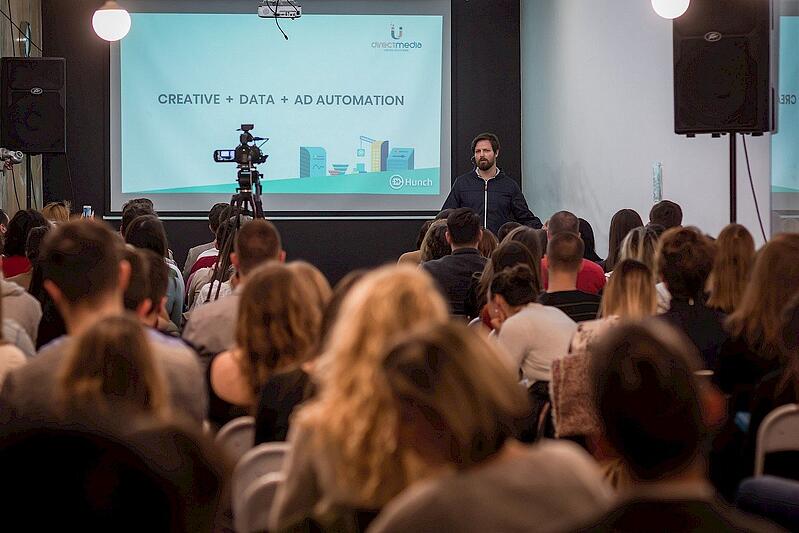
His response has been to connect creative work with data and automated delivery. The desired result is a supply of relevant images and videos that can vary with what a business needs to say. A creative idea still matters. So does the machinery that lets the idea appear in the right form, with the right information, without requiring a fresh manual production exercise for every variation.
At the MarTech event, he framed the agency’s difficulty around three competing demands: scale, performance and profit. Increasing output by expanding the team can put pressure on margins. Increasing output without learning what works can simply generate more material to ignore. Hunch’s proposition addresses the work between those demands, bringing creative production and campaign operations into a common process.
That is also why the origin in analytics remains relevant. The problem that customers brought him did not eliminate the need to measure. It enlarged the assignment. A team needs to produce, deliver, understand the result and act again. Rakovic’s business has gradually taken responsibility for more of that sequence. The dashboard acquired a job outside its own window.
The money came with a map
On May 31, 2022, Hunch announced a €4 million funding round led by Catalyst Romania, with Euroventures, North Base Media, SeedBlink and South Central Ventures participating. Catalyst was backed by 3TS Capital Partners. The plan included tripling the sales team and increasing marketing investment to support expansion in Europe and the United States.
The round also brought advertising experience into the boardroom. Rob Norman, formerly CEO of GroupM North America, and Craig Atkinson, formerly COO at Tinuiti, joined the board. For a founder moving from product discovery into international expansion, those appointments put people familiar with advertising organisations close to the business. Capital arrived with connections to the industry it needed to serve.
Earlier that February, Rakovic had reported average monthly growth of 11% over the preceding eighteen months and described customers pulling Hunch from smaller businesses toward larger accounts. Those are figures from a particular stage of the company. They capture the pressure of that moment: a product’s audience can change faster than the organisation built to sell and support it.
The ambition he expressed then was to make sophisticated creative capabilities available to more businesses. His shorthand was “Intelligent Creatives”. Beneath the category language sits a practical question: how can a company make varied, useful advertising without allowing the production effort to consume the commercial benefit? That question survives changes in channels, funding cycles and fashionable terminology.
“Hunch is purely customer-driven.”Sinisa Rakovic · 2022
Focus, even in a business of distractions
Rakovic’s advice to other startups has sometimes been narrower than his company’s global ambitions might suggest. In a 2019 discussion of business marketing, he urged founders with limited resources to concentrate deeply on a channel where their customers actually were. The appeal of being everywhere can be expensive. An account on every platform is a remarkably efficient way to acquire more work.
He has also kept returning to creativity as an operating concern. His writing on retail strategy considers the relationship between social advertising and shoppers’ changing expectations. His essay on creative differentiation argues for giving advertising material more attention as familiar advantages become harder to sustain. These are connected interests: the distribution system is only useful if there is something distinctive to distribute.
In 2023, his conversation with Irina Obushtarova ranged beyond campaigns to entrepreneurship in Eastern Europe, his American experience and the infrastructure needed to support founders over time. The return journey was still part of the story. Building a company from the region had become an occasion to think about the conditions that help other companies emerge there.
His public biography compresses another part of his life into a neat pairing: father of three, founder three times. The symmetry is memorable without requiring a lesson to be extracted from it. There is a person attached to the operating vocabulary, with commitments that extend beyond an advertising account. The short version of a career is never the whole allocation of a life.
The next version is already in the brief
In September 2024, Rakovic described presenting with Gareth O’Neill at Meta’s Performance Marketing Summit in London. His subject was the changing role of agencies as AI and automation entered their work. He pictured agencies taking more responsibility for interconnected systems that could respond to new information, extending a discussion he had been having since Hunch’s earlier customer conversations.
By June 2026, Hunch was announcing that TikTok advertising could be built and launched alongside Meta and Snapchat campaigns inside its platform. The addition continues the effort to connect work that would otherwise happen in separate places. Hunch’s stated direction now includes a loop in which campaign results inform what gets produced next. That remains an ambition to build toward, rather than a reason to declare the work finished.
The revealing decision in Rakovic’s story is still the earlier one. Customers wanted help doing the work, and he let that request alter the company. His journey from construction software to creative automation contains plenty of technology, but its turning point is recognisably human: somebody was asking for something different. He listened closely enough to change the brief.