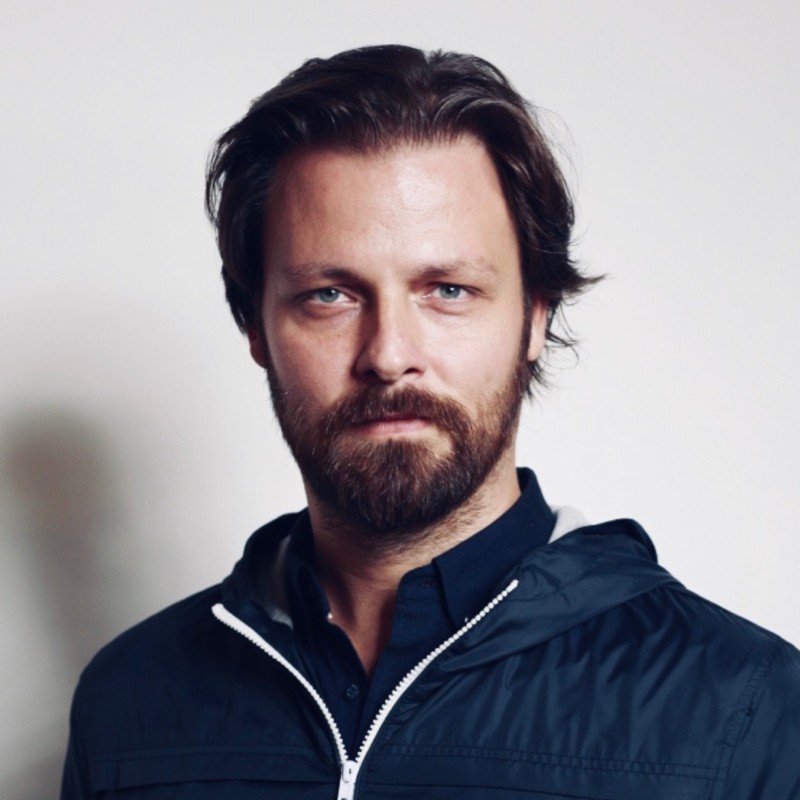
The Operator Behind Hunch
Rakovich runs a company called Hunch. Hunch takes one ad template and turns it into a thousand. It does this for paid social teams at global brands, and it does this across Meta, Snapchat, and TikTok, which is to say it does this in the three places on the internet where attention is currently priced and sold in real time. He calls himself Siggi. His LinkedIn calls him Siggi. Everyone calls him Siggi. This is a small thing, but it is the kind of small thing that tells you a person has been in rooms with Americans long enough to stop correcting them, which turns out to be a load-bearing detail in his career.
Hunch was founded in 2018 with two co-founders, Igor Simovic and Nikola Milenkovic. The three of them had already been working together for over fifteen years. That is a startlingly long runway for a "new" company. Most founding trios meet at a hackathon or a party or on a Thursday. Rakovich's trio has essentially been co-workers since the George W. Bush administration. When Hunch pivoted from data-science SaaS into creative automation, they did not have to negotiate the pivot the way founding teams usually do, with slack messages and long walks and the vague low hum of resentment. They had done pivots before, together, at other companies, in another decade.
The pivot that made the company
Hunch did not start as a creative platform. Hunch started as an analytics play - a data-science and insights SaaS that was supposed to help marketing teams make better decisions. Customers, being customers, kept asking for the wrong thing. Or rather, they kept asking for a different thing. They wanted the platform to make the creative, not just measure it. They wanted it to buy the media, not just analyze the buys. Rakovich, in interviews, has been remarkably calm about this, which is unusual, because "customers dragged us into a different market" is the kind of story most founders launder into a bold strategic vision after the fact. Rakovich mostly just says the customers pulled and he listened.
Hunch is purely customer-driven. Every aspect of our businesses is being influenced by our customers' needs.Sinisa Rakovich, SeedBlink interview, 2022
The result is a platform that takes a single creative template - a video, an image, a layout - and assembles it, on the fly, into thousands of variations. Real pricing pulled from a product feed. Local languages. Live discounts. Regional offers. All rendered in the ad server's native units and bid on in the ad platform's native auction. The company likes to boast that a team can launch two thousand localized ads in thirty minutes. This is the kind of claim you have to squint at until you realize that adtech, as a business, mostly consists of turning creative production from a bottleneck into a spreadsheet.
Belgrade to New York, quietly
Hunch is a Serbian company. It is also a New York company. Its address in the Apollo record is 228 Park Avenue South, which is the kind of Manhattan address that means "we take American enterprise buyers seriously." But the engineering and product weight of Hunch sits in Belgrade, which is where Rakovich and his co-founders built the machinery. In 2022 the company closed a €4M round led by Catalyst Romania Fund II with backing from 3TS, Euroventures, North Base Media, SeedBlink, and South Central Ventures - an investor cap table that reads like a map of Central and Eastern European venture funding in the early 2020s.
The new capital will help us accelerate our technology roadmap that will support our customers in growing their revenue faster.Sinisa Rakovich, on Hunch's €4M raise, Tech.eu, 2022
The eight-year gap
Before Hunch there was Building Explorer, Inc. Rakovich founded it, ran it, and sold it in 2010 to a company called PBF. Building Explorer was in real estate - a platform for the industry - and after the exit Rakovich went quiet in the public record. He appears to have spent some of that time around Stanford, where he did coursework in the CIFE program on Virtual Design and Construction, which is the sort of thing former real-estate-tech founders study when they have money and curiosity in roughly the same amount. He also has a degree from California State University, Fullerton, in Information Systems Decision Science, which was, in the 1990s and 2000s, roughly the coastal California version of a computer science degree with the sharp edges filed off.
Then, eight years after the Building Explorer sale, Hunch. Serial founders sometimes bounce from one company to the next in a rush, treating years off as a personal failing. Rakovich, on the evidence, did not. Eight years is enough time to think about what you actually want to build. Hunch is what he thought.
What Hunch calls itself
Rakovich has said, more than once, that Hunch is trying to consolidate a new category called "Intelligent Creatives." Categories are a founder's oldest party trick - you say your company is inventing a category because it is easier to be the biggest thing in a new category than a merely large thing in an old one. But the label is also useful shorthand. What Hunch does does not fit neatly into "creative agency" or "ad server" or "DSP." It is a platform that treats ad creative the way ad buying was treated a decade ago - as something to be automated, personalized, and measured at scale rather than lovingly hand-crafted per placement.
Hunch is creating and consolidating a new category called 'Intelligent Creatives.'Sinisa Rakovich
The current Hunch marketing insists that the company is "a partner, not just a tool." Every SaaS company on Earth has said this. Most of them are lying. Hunch's version of this claim comes with usage-based pricing, hands-on onboarding, and a dedicated strategist for enterprise accounts, which is at least an operational answer rather than a slogan. Also: Hunch is a Meta Business Partner and has picked up multiple G2 awards in 2025, which is the sort of external validation that adtech buyers actually check before they sign.
What he sounds like
Rakovich, in interviews, does not sound like a hype merchant. He sounds like an operator. He talks about "zone of genius" on The Recursive Podcast in a way that suggests he has read the same business books everyone else has read, but he uses them to explain team design rather than personal branding. He talks about customers dragging Hunch into new markets in a tone that is closer to gratitude than complaint. He talks about growth in numbers - 11% month-on-month, 18 months in a row - which is the kind of number founders quote when they have grown at 11% month-on-month for 18 months in a row.
The public record does not, notably, contain a lot of hot takes from Sinisa Rakovich. He does not appear to be a Twitter guy. He does not appear to be a Substack guy. He has co-authored posts on the Hunch blog and appeared on a handful of podcasts and interviews, and the total accessible output is measured in dozens of pages, not thousands. This is not, in 2026, the default posture of the venture-backed adtech founder. It might be part of why the company works.
The bet
The bet Rakovich is making is that creative production is the last part of the paid-media stack still done by hand, and that automating it is a several-billion-dollar problem. He is making this bet with a team he has known for fifteen years, from a headquarters split between New York and Belgrade, on top of the Meta / TikTok / Snapchat ad ecosystems, with roughly €4M of European venture capital and a hundred-plus enterprise customers. If he is right, "Intelligent Creatives" ends up being a real category with a real market leader. If he is wrong, he has an interesting decade to think about it before he founds the next one.