At sixteen, Wendy Tan White sent her computer programs through the post. She wrote them on graph paper, put them in the mail and waited to learn whether they worked. Debugging required patience, handwriting and a functioning postal service. It is a pleasingly physical beginning for someone now occupied with getting software to cooperate with the physical world.
Tan White is the founding CEO of Intrinsic, the industrial robotics software business that joined Google in February 2026. Before that, she helped people put their businesses and enthusiasms online through Moonfruit. Her career has included investing, internet banking, design school and Alphabet’s moonshot factory. Follow the user through those changes and the route becomes surprisingly direct: she keeps encountering useful technology with a difficult entrance.
Code, by return of post
Her first programming machine was a BBC Micro, which she began using at eleven. Both parents worked in technology. Her mother’s workplace included women in successive levels of management, giving her an early picture of technical leadership in which a woman’s presence required no special explanation. Computing was familiar enough to be something a teenager might consider rebelling against.
She nevertheless went to Imperial College London to study computer science, graduating in 1992. Work on assembly-line systems gave her an early encounter with industrial computing. She then worked at Arthur Andersen and in financial-services IT. The sequence is useful context for the robotics job: factories entered her working life well before the current enthusiasm for physical AI.
Egg supplied a different education. Helping establish the internet bank brought her close to the emerging possibilities of online communities. She became interested in how people could share what mattered to them. An encouraging boss helped seed her next venture and allowed her to work part time while getting it started. The transition had a mentor and a continuing income behind it.
“If you couldn’t code, you couldn’t publish.”
Wendy Tan White, recalling the early web
The customers who kept the lights on
In 1999 she co-founded Moonfruit with Eirik Pettersen and Joe White, who later became her husband. The proposition was straightforward: give people a way to create their own websites without first acquiring a programmer’s education. A small business could have something of its own on the web. The underlying work might be complex; the customer had other things to do.
Money came in, the team expanded and users arrived. Revenue did not keep pace. When the dot-com crash hit, the advertising-led model could no longer support the business. Moonfruit contracted from sixty people to two. Tan White and Pettersen carried on working in an attic while White took outside work to help support them.
A contraction in the team. A second attempt at the business model.
The customers provided the next move. About a tenth agreed to pay. That gave Moonfruit enough income to continue, reinvesting what came in and improving the product. A service that had struggled to sell its audience to advertisers found people willing to buy the service itself. The change sounds tidy in retrospect. Living through the reduction from sixty colleagues to two would have made it rather less tidy.
Yell acquired Moonfruit in 2012. The sale is one milestone in the story; the willingness to rebuild is another. Between the original enthusiasm and the eventual buyer lay years of making the economics work. There is something instructive about a website builder being kept alive by people who wanted to keep building websites.
A degree in things that change colour
Her education also took an unexpected turn. During time away from leading Moonfruit, Tan White studied design at Central Saint Martins, exploring colour-changing fabrics and soft sensors. She also helped launch Zopa, the peer-to-peer lending service. The work crossed software, materials and how people interact with unfamiliar systems.
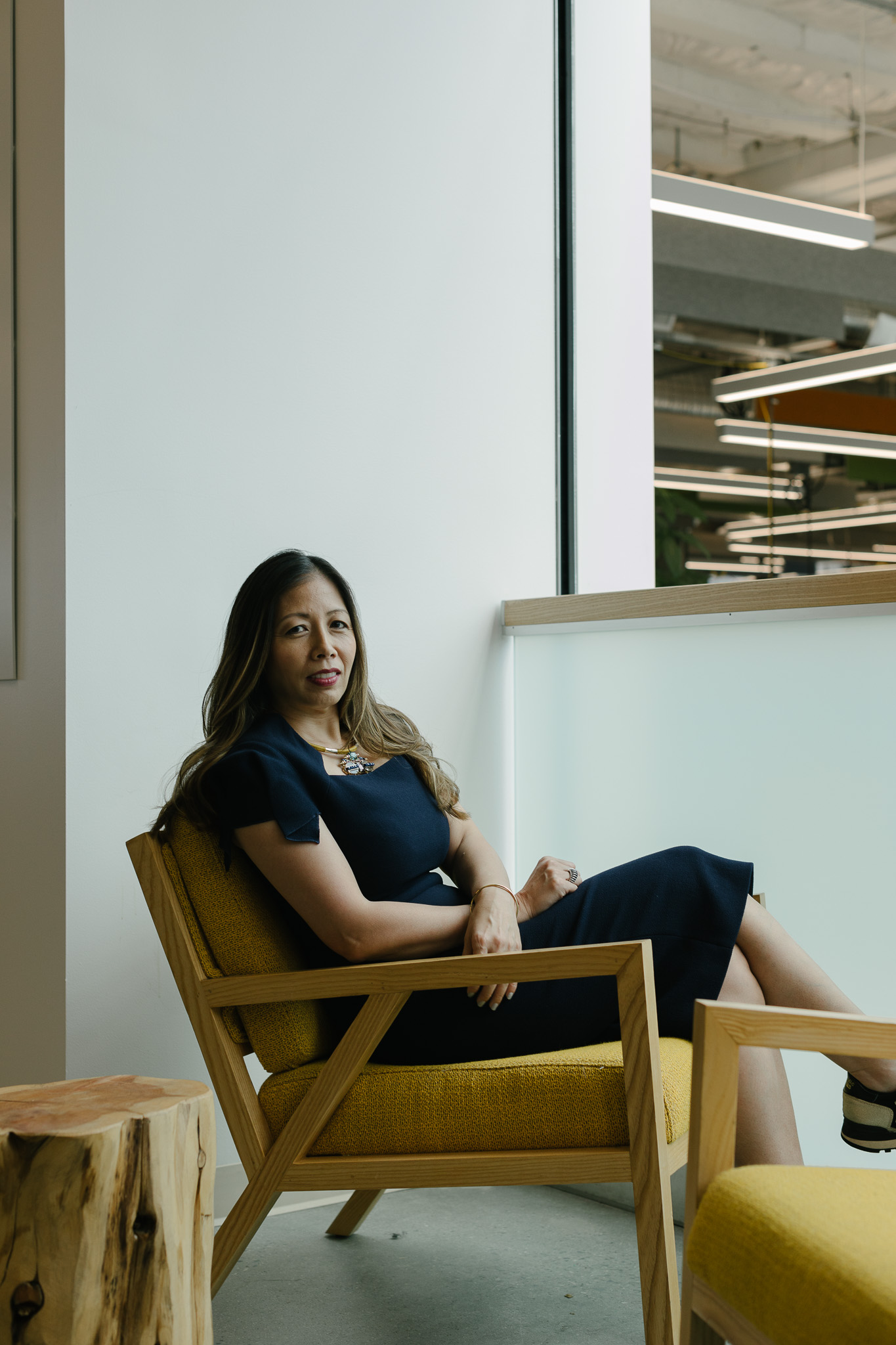
A computing degree and a textile-design master’s make a more interesting pairing than the usual executive biography allows. One concerns instructions; the other brings materials, behaviour and use into view. At Intrinsic, those concerns sit beside each other again. A robot can have an impressive collection of capabilities and still be cumbersome for the business trying to put it to work.
She received an MBE in 2016 for services to technology and business. Her subsequent roles have included chairing Imperial’s US advisory council. Those connections keep her close to the institutions where technical careers begin, while her own has moved repeatedly between starting things and helping other people start them.
From backing founders to building robots
At Entrepreneur First, she became a general partner, working in a model that helps technical people find co-founders and build companies. She then joined BGF Ventures in 2017. Her argument for different perspectives in venture capital was practical: finding unusual businesses requires people capable of recognising different kinds of possibility.
She had already occupied the founder’s side of the conversation. That matters when considering her move into investing: the person evaluating a team had once been trying to keep a team together. Her experience spanned the pitch, the product and the long period when a promising idea had to become a business customers would sustain.
In 2019 she joined X as a vice president. There she coached teams and leaders, including work associated with Mineral and Tidal. Intrinsic emerged as an independent Alphabet company in July 2021 after five and a half years of development at X. Tan White became its founding CEO, returning from supporting teams to leading a company with a specific industrial problem.
- 1999Moonfruit
Let people build a website. - 2017BGF Ventures
Help technical founders grow. - 2021Intrinsic
Let more people build with robots. - 2026Inside Google
Connect the platform with AI and infrastructure.
Her opening explanation of Intrinsic reached back to Moonfruit. Creating a website once involved a procession of technical tasks before the creator could get to the thing they actually wanted to publish. Robotics presented a comparable barrier. Expensive hardware could demand extensive specialist programming, and changing the job could mean another expensive exercise.
The resemblance has limits. A website does not have to grasp a part or account for the resistance of a connector. But the ambition is recognisable: give people tools that absorb more of the machinery, leaving them more attention for the application they want to build.
A factory is an unforgiving interface
Intrinsic introduced Flowstate in May 2023, with Comau as its first industry partner. The web-based environment lets developers design robotic applications, simulate them and deploy them. Reusable skills can handle elements such as perception, motion planning and insertion, rather than requiring every application to be assembled entirely from fresh code.
Simulation is a particularly useful part of that proposition. Developers can arrange a virtual workcell and try a process before moving it onto hardware. The distinction matters to a manufacturer whose production equipment has a day job. Experimenting in software gives the people building an application somewhere to revise their decisions.
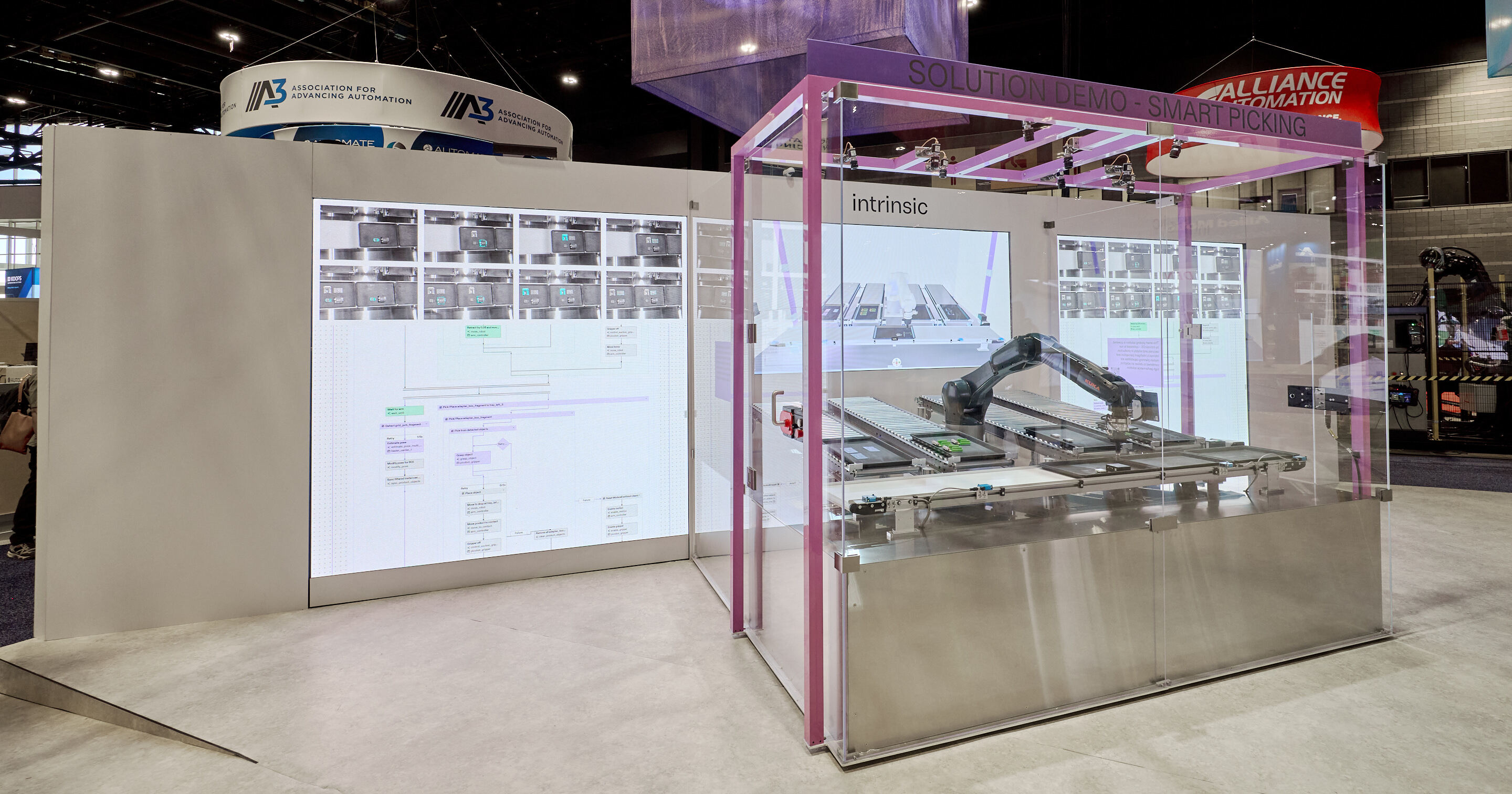
Building this platform also meant bringing in people with different histories. Intrinsic agreed to acquire Vicarious’s business in 2022. Later that year it acquired the commercial business of the Open Source Robotics Corporation, welcoming Brian Gerkey and colleagues. The separate nonprofit foundation continued stewarding open robotics tools. That distinction mattered for a community whose work depended on those tools remaining available.
The customer ambitions became more concrete with the Foxconn joint venture announced in November 2025. Its focus includes electronics assembly, inspection, machine tending and logistics. The stated direction is toward more general-purpose intelligent robotics, reducing the need to re-engineer automation around each new generation of product.
Joining Google in February 2026 put Intrinsic in closer contact with Gemini, Cloud and Google DeepMind while retaining it as a distinct group. In June, the team previewed a modular Intrinsic Intelligence Cell. A custom version for electronics assembly was planned for pilots in Foxconn facilities. These are practical settings in which the promise of reusable software has to earn its keep.
The door opens a little wider
September 2026 brought a further opening: Intrinsic Core, an open-source set of ROS-compatible capabilities released under Apache 2.0. It includes tools for real-time control and a digital twin, allowing developers to start with existing foundations. For a company led by someone who once helped remove the programming barrier from publishing, the choice has a familiar shape.
The release also includes an open machine-tending reference solution, giving developers an application to customise. Its control framework is designed to work across hardware, while motion and grasp planning supply capabilities that would otherwise require additional development. That is a concrete expression of the access argument: someone can begin with a working foundation and spend more of their effort on the particular task. It gives the next builder a different starting point from the person who had to assemble all the foundations first.
5,000developers
115countries
One shared task: help a robot manipulate flexible cables and insert connectors.
The accompanying results of Intrinsic’s AI for Industry Challenge offered an unusually concrete test of the developer argument. Five thousand developers from 115 countries had participated. Team Flex won; TCS-PLGRM placed second. Two teams achieved a 100 percent success rate in the final stage. Nearly half of registrants came from outside traditional robotics.
The task involved cables and connectors. It combined the sort of thing people do without a business plan with the sort of thing machines find maddeningly difficult. The successful approaches mixed AI with established methods. The results belong to a defined challenge, rather than proving that every factory problem has been solved. They do show people bringing different skills to a shared physical task.
Tan White’s ambition depends on more of that participation. The tools must work for developers, the applications must work for manufacturers, and the machines must work with objects that decline to behave like neat abstractions. Her career keeps returning to this meeting between capability and use. Once, the obstacle was getting a website made. Now it might be getting a plug into a socket. The entrance has changed. She is still working on the door.