A customer needed her Roomba repaired. Colin Angle suggested sending it back. She refused. The vacuum had a name, Rosie, and apparently you did not put Rosie in the post. In a company making machines to pick up dirt, a conversation about customer service had wandered into the territory of family loyalty.
Angle and his colleagues had taken turns answering the support line in Roomba’s early days. They were learning something the specifications could not tell them. A round appliance could acquire a place in somebody’s household that exceeded its modest job description. You bought a vacuum. Somehow, you ended up worrying about its feelings.
For Angle, that attachment has become unfinished business. He co-founded iRobot in 1990, helped bring Roomba into homes in 2002, and stepped down as chief executive and chairman in January 2024. In May 2026, he introduced the first prototype from Familiar Machines & Magic. It had four legs, a soft coat and an assignment considerably harder to explain than cleaning a floor.
The degree was in building things
As a child, Angle used construction toys to solve problems and fix things around the house. Making things was his natural occupation. When MIT asked what he wanted to study, his answer was “whatever lets me build the coolest things”. It was an admirably direct career plan, though an awkward title to print on a diploma.
There was no robotics degree waiting for him. He assembled a course of study across mechanical engineering, electrical engineering and artificial intelligence. A summer job building robots helped settle the direction. He earned a bachelor’s degree in electrical engineering in 1989 and a master’s in computer science in 1991.
His surroundings supplied another education. At MIT’s Alpha Delta Phi fraternity house, he watched fellow students start companies. By his count, five multimillion-dollar businesses began among his fraternity brothers during his time there. Entrepreneurship became less mysterious when the people doing it were people he knew. A company could begin close enough to observe, before it acquired the polished origin story.
That experience also widened his idea of making things. A team could build something beyond the reach of one inventive student. The engineer’s workbench could grow into an organization, with all the complications that implied.
“Whatever lets me build the coolest things.”
Colin Angle, on choosing what to study at MIT
Twelve years before the vacuum
Angle founded iRobot with Helen Greiner and Rodney Brooks, the MIT professor whose lab had brought them together. The famous consumer product arrived twelve years later. That interval matters. Roomba can make iRobot’s history look inevitable when viewed backward; the early company was trying several doors.
There were robots for research, defense and exploration. NASA was an early customer. Greiner later explained to a Senate committee that the agency bought walking and tracked robots partly to help an industrial base in robotics develop. These were customers buying hardware, while also making room for an industry that barely existed.
Angle worked on small walking robots, including the six-legged Genghis. His work at NASA’s Jet Propulsion Laboratory contributed to the development of behavior-controlled rovers that preceded Sojourner’s arrival on Mars in 1997. The connection is a contribution to a chain of engineering, with plenty of other people in it.
Contracts kept the business going. Alongside that work came efforts in industrial cleaning and toys, including a robotic baby doll for Hasbro. These apparently scattered projects supplied practical lessons: how to cover an area, how to manufacture affordably, how to make a machine respond to somebody holding it. A doll and a mine-hunting robot are unusual colleagues. Both had something to teach a future vacuum.
The Pepsi department of robotics
People kept asking Angle when his robots would clean their floors. It was a useful customer request, persistently delivered. The difficult part was making something that could do the job at a price a household would accept. Lessons from the company’s earlier projects converged in Roomba, which launched in 2002.
Even a working robot needed explaining. After an encouraging start, sales disappointed. Then, around the Thanksgiving period, the direct-sales team noticed a sudden jump. Nobody could connect it to an advertising campaign of their own. An engineer offered a possibility: a Pepsi commercial.
The advertisement featured Dave Chappelle and an improbably thirsty robotic vacuum. The machine pursued the drink, and the joke ended at the expense of Chappelle’s trousers. The device in the commercial was not a Roomba. The distinction proved less consequential than the idea it planted: a vacuum could move around by itself, and you could actually buy one.
In Angle’s telling, sales tripled. A robotics company had received an accidental lesson in public understanding from a soft-drink advertisement. The technology needed a legible role in an ordinary home. A joke accomplished some of the explaining that engineering had left undone.
iRobot went public in 2005. By Angle’s departure in 2024, more than 50 million of its products had reached homes worldwide. The little disc had become a business, a familiar household sight, and occasionally a household name in the most literal sense.
A household has veto power
The naming of Roombas fascinated Angle. In an interview with an education company, he described the difference between asking prospective buyers whether they would name a vacuum and watching what happened after the robot came home. The abstract suggestion could provoke indignation. The actual machine, working away in the same room, could earn affection.
He connected that response to something broader about robots. People could perceive a little life in them, even with limited behavior. A machine did not need an elaborate human face to be treated as a character. It needed to share space, do something understandable, and give its owner room to supply the rest.
There was a less flattering lesson, too. In 2026, Angle recalled how easily a Roomba could lose its place in a routine. It might start cleaning while someone watched television. The person would switch it off. Sometimes it stayed off. All that navigation engineering could be defeated by the reasonable desire to hear the programme.
That is the peculiar discipline of household robotics. The home contains people whose priorities change, who do not organize their evenings around a product demonstration, and who can withdraw permission with one finger. Angle’s next project would have to make sense inside that untidy arrangement.
Leaving the company he helped build
Amazon’s proposed acquisition of iRobot ended in January 2024, after the companies concluded there was no path to regulatory approval in the European Union. Angle stepped down as chairman and CEO as iRobot announced a restructuring. His formal tenure as chief executive had begun in June 1997; he had become chairman in October 2008.
The departure came with a blunt acknowledgment that the company needed a leader with turnaround experience. It was a difficult ending to a long operating career at the same business. The scale of the installed base could sit beside falling revenue and a need to cut costs. Both belonged in the account.
On the day he left, Angle wrote that he was not done either. Familiar Machines & Magic gave that remark a concrete destination. His co-founders are Chris Jones and Ira Renfrew. The company brought together experience from iRobot and other organizations working in robotics, AI and expressive machines.
Four legs, twenty-three degrees of freedom
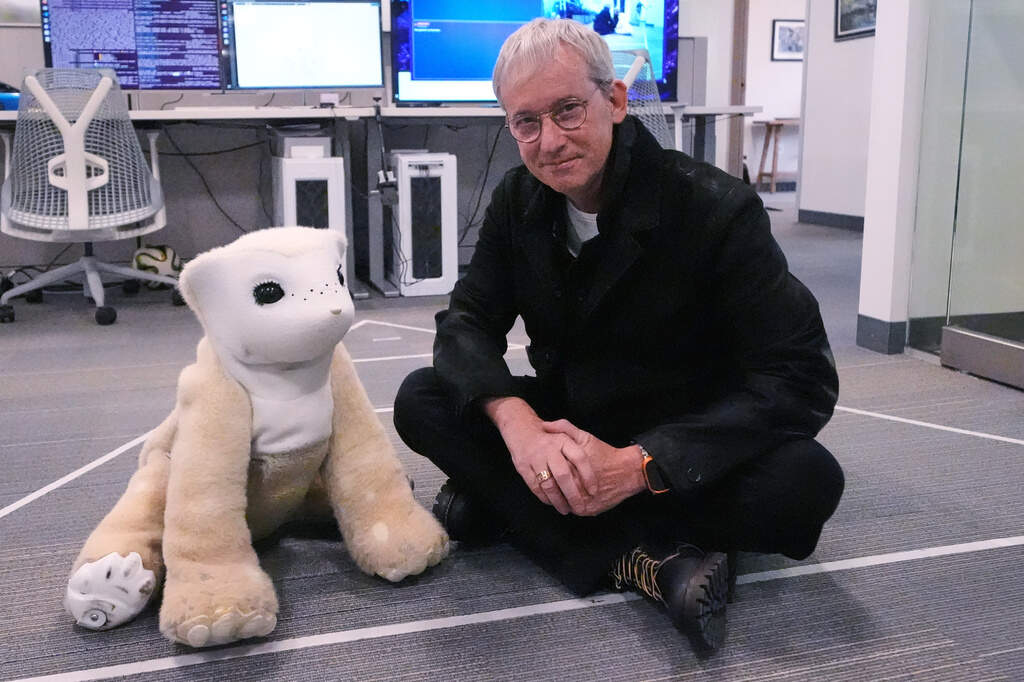
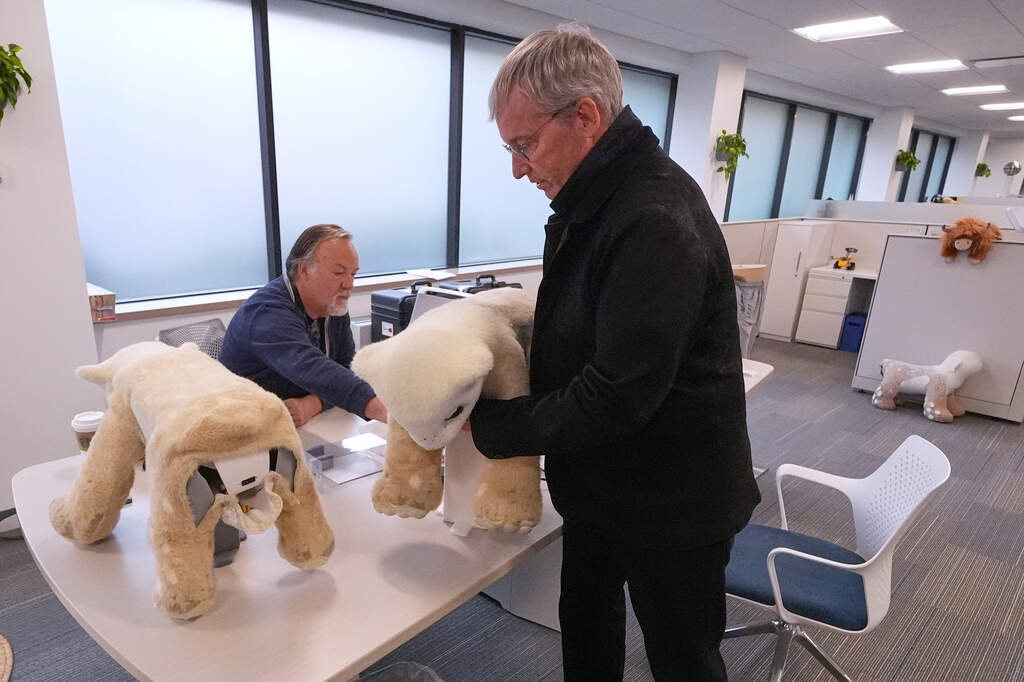
On May 4, 2026, Angle unveiled the Familiar at The Wall Street Journal’s Future of Everything conference. The prototype’s appearance invited comparison with animals without being a straightforward copy of one. Its four-legged body had 23 degrees of freedom, a touch-sensitive coat, cameras and microphones. It was designed to communicate through movement and expression.
The choice of shape is part of Angle’s thinking about expectations. A human-shaped machine invites a formidable list of assumptions about what it ought to do. A new creature gives the designers more room to establish its behavior on its own terms.
Familiars are intended to learn household rhythms, remember interactions and develop distinct personalities. Those are the company’s design goals, with a consumer product still ahead. In his May interview about the unveiling, Angle put the planned product launch in 2027. The prototype was an introduction to the work.
The company says data is stored on the device, with users controlling whether it is shared with the cloud. That belongs beside the soft coat in the product description. Welcoming a machine into a living room involves decisions about what it notices and remembers, as well as whether anybody enjoys having it there.
A touch-sensitive coat, onboard AI and expressive movement. Design intentions are still being turned into a consumer product.
Still building, with more company
Angle’s connections extend beyond his own startups. He is a founding board member of MassRobotics and helped establish National Robotics Week in 2010. He has also supported hands-on making at MIT. The pleasure he found at a workbench has become an interest in giving other people access to one.
In March 2026, he received the Massachusetts Technology Leadership Council’s Commonwealth Award. The celebration included a reckoning of the companies descended from iRobot’s people and experience: more than fifteen, by the organizers’ count. A founder’s work can leave through the door with employees and turn up elsewhere.
At an Endicott College talk in 2023, Angle wore a shirt reading “Powered by Optimism”. It suited somebody willing to discuss the failures as well as the inventions. The Familiar now asks another demanding question of that optimism: can a machine earn a lasting place through the way it behaves around people?
Rosie’s owner had supplied one answer years earlier, without being asked to join a research programme. She cared about a vacuum. Angle has gone back to the workshop to see how much further that impulse can go.
Follow the next experiment
More reading on this chapter
- MIT: The founder’s journey
- NOVA: Colin Angle
- The Consumer Technology Hall of Fame profile
- An interview from the iRobot years
- On robots, learning and naming the vacuum
- The Familiar prototype in Woburn
- The Commonwealth Award, March 2026
- Angle’s talk at Endicott
- The January 2024 leadership transition
- The iRobot company profile