A recruiting business has a small, stubborn problem. Candidates arrive in one place, client conversations live in another, and somebody must remember what happens next. Solving that problem once is administration. Solving it repeatedly can become software. At Vy Ventures, that passage from everyday work to a separate business is a useful place to begin.
- Enterprise services came first, with Vy Systems in 2002.
- The group now spans software, training, immersive computing and AI.
- Its portfolio is founder-funded; strategic investors are being invited in.
The Santa Clara-based group presents itself to investors through technology ventures. But its origin story starts with delivery: engineers, customers and the work required to keep technology useful. Founder and chairman Ramesh Santhanam is described as an active mentor who sometimes takes hands-on roles in the businesses. The portfolio grew around that operating history.
The business before the portfolio
Vy Ventures dates its beginnings to Vy Systems, established in 2002 across Singapore, Santa Clara and Chennai. Software development acquired a dedicated home in 2006, when the business now called Codenatives began as Vy Consulting. The group’s history dates its training institute, VyTCDC, to 2012. Canadian and British Vy Systems entities followed in 2018 and 2019.
There is a sequence here worth noticing. Customer work came before the newer product categories. Vybog and VyVoxel appear in the group’s 2020-2022 expansion into SaaS and immersive computing; cogentAI enters its history in 2025. The names have multiplied, but enterprise technology remains the connecting thread. Each business addresses a different part of getting something useful into production.

A product hiding in the paperwork
Vybog makes the sequence especially clear. The group says the platform grew from a tool refined through more than a decade of practical use before its formal launch in 2020. That is an unusually patient route to a software product. Internal users supplied something a brainstorm cannot: repeated exposure to the same awkward handoffs.
Today, Vybog’s website presents Tal for recruitment, Parser for document extraction, People for workforce administration and CRM for sales. Shared accounts and a common data layer are the organizing idea. For a staffing firm, the appeal is straightforward: fewer disconnected records between finding a candidate, managing a customer and running the organization that employs the recruiters.
The intended buyers include staffing businesses and teams managing talent, sales and operations. Vybog advertises a free tier and a 15-day trial without a credit card. That gives a prospective customer a practical starting point: try an actual workflow. A convincing demonstration should follow a record through the work, including the unglamorous handoffs where information usually disappears.
Three connected activities. The value depends on how well they work together.
Old systems meet new ambitions
Codenatives addresses another familiar enterprise complication: the new system rarely replaces everything. Its offering combines generative AI development with modernization of existing enterprise software, low-code application work and managed services. A business buying automation may also need its underlying infrastructure maintained. Codenatives pitches involvement across that lifecycle, including ongoing operational support.
Its delivery footprint includes Chennai, Karur and Pondicherry, alongside a British subsidiary, Felkam, associated with retail transformation. The commercial logic combines engineering engagements, continuing service relationships and software productization. For buyers, the useful distinction from a standalone application is responsibility across more of the implementation. The relevant comparison is with other engineering and managed-service partners.
VyVoxel serves a different kind of interface: augmented, virtual and mixed reality. It offers industrial training simulations, visualization and custom immersive applications for sectors including manufacturing, healthcare and energy. A safety-training buyer and a recruiting-software buyer have different jobs to do. The group’s breadth makes sense only when each offering earns its place against that particular job.
The people are part of the machinery
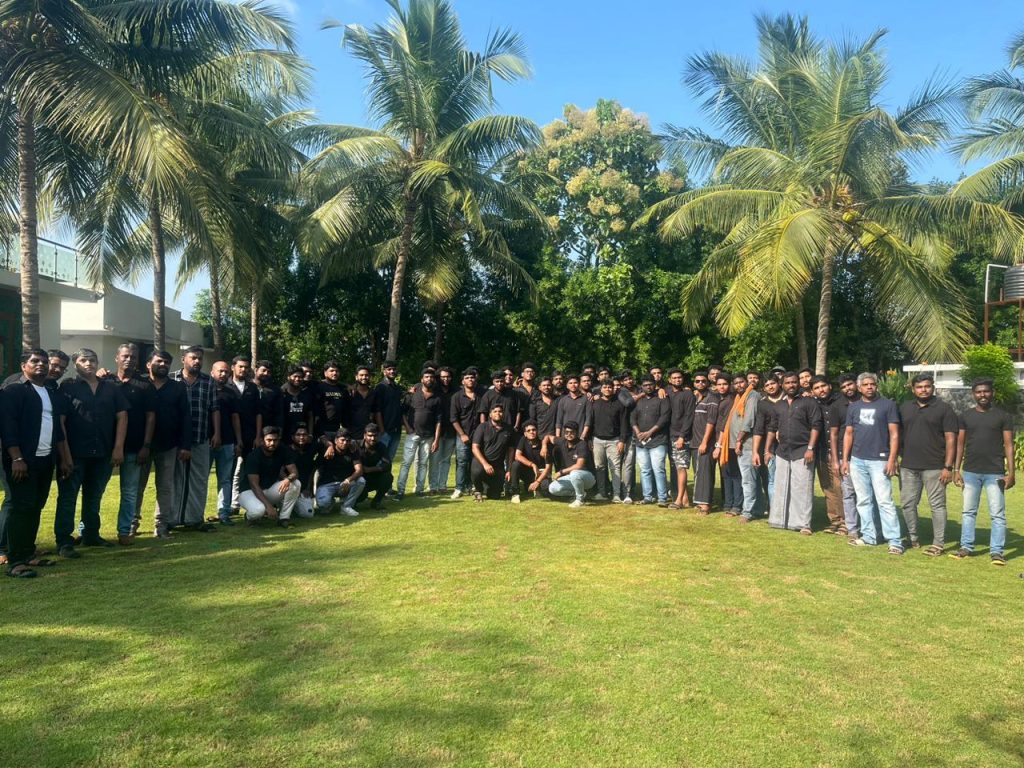
VyTCDC adds the workforce side. Its programs include instructor-led technology training, corporate upskilling, internships and career support, with centers in Chennai, Pondicherry and Karur. The stated emphasis is on skills businesses currently need. Within this group, training sits alongside the companies that sell technology delivery, rather than appearing as an unrelated educational sideline.
The company history reports more than 5,000 professionals trained and placed. That is the group’s own count. The more transferable idea is the feedback loop: a training curriculum can learn from the work employers actually commission. For another business to copy that approach, it would need dependable access to current delivery problems and practitioners who can teach them.
“If you’re closest to the problem, you’re empowered to lead the solution.”
Vy Ventures, “The Vy Ventures DNA,” July 2025
The company’s culture essay emphasizes initiative and accountability. Those expectations fit a group whose founder describes mentoring entrepreneurs and remaining involved in their operations. They also set a demanding standard: autonomy is useful when people can make decisions and carry them through. The public statement tells a prospective employee what leadership says it expects.
Now the invitation changes
Vy Ventures says its portfolio companies are bootstrapped and founder-funded. Its current investor invitation seeks strategic partners for the next stage. That changes the conversation from building operating capability to deciding how outside participation might help it expand. The invitation is a business proposition; it should be assessed through the particular company, its customers and its economics.
cogentAI, the newer AI business, proposes agents that execute workflows within enterprise infrastructure, with attention to private deployment and auditability. It extends the group’s interest in the spaces between existing systems. The lesson readers can copy is modest: watch where work repeats, build around that need, and train people for the resulting job. It takes patient resources and recurring demand. A collection of company names cannot supply either.
Vy Ventures ↗ LinkedIn ↗ Try Vybog ↗ Codenatives ↗ VyVoxel ↗ VyTCDC ↗ cogentAI ↗