The most revealing number in Vsevolod Leonov’s recent public life is not a sales target, an acquisition price or a market-share chart. It is $7 an hour. In January 2025, Leonov wrote that he was renting a machine with eight NVIDIA H200 GPUs, 1,128 gigabytes of memory in all, for roughly that sum. The setup, he said, could handle Llama 405B or recent DeepSeek models. Then he offered to share the configuration with anyone curious enough to ask.
This is an unusual posture for someone whose career is usually described with words like partnerships, new business and go-to-market. Leonov spent nearly a decade at Google leading commercial relationships across Russia, Ukraine and the CIS, then mobile and gaming partnerships across EMEA, then app-focused new business in North America. He knows the air-conditioned rooms where platform strategy becomes a deck. Yet here he was, counting GPU memory and hourly rental costs like a proprietor checking the electric meter.
The meter matters because Leonov’s current public mission is concise: “Building the data layer for AI agents.” The sentence sits on his LinkedIn profile alongside a role at a stealth startup in Menlo Park. It is both specific and coy. The product is hidden; the bottleneck is named. Agents can reason, call tools and produce charming demonstrations. To become dependable workers, they also need context, memory, permissions and data that arrives in useful form. Someone has to build the plumbing, and plumbing rarely trends until the kitchen floods.
A career measured in platforms
Leonov’s résumé reads like a tour through the internet’s changing unit of value. In the late 1990s, that unit was the website. He co-founded Actis and worked as a frontend developer. By 2006, at Microsoft, the unit had become the portal and its constellation of services. He marketed MSN and Windows Live in Russia while Google was establishing its own local presence. The corporate rivalry was obvious, but so was the larger lesson: distribution could make a collection of software feel like a world.
Then came games. At Astrum Online Entertainment, Leonov served as vice president of business development as Russian browser games traveled into Germany, Turkey and other markets. Legend: Legacy of the Dragons reached five million registered players during his tenure. In a contemporary statement, he pointed to the game’s fast German uptake and profitability as evidence for both the production quality and the free-to-play model. A recommendation from Astrum president Igor Matsanyuk credits him with establishing the company’s brand in Asian markets, licensing games and managing developer relationships there.
The job was not to invent the game engine. It was to make a product survive translation: language, culture, contracts, payment behavior and partner expectations. Leonov carried that skill into international business development at Mail.ru, now associated with VK, and then into Farminers Startup Academy as a venture partner and US general manager. He was learning the same idea at different scales. A platform is never merely software. It is software plus a route into somebody else’s life.
The app economy’s unfinished questions
Google gave Leonov a wider map. From 2012 to 2021, his remit expanded from partner solutions in Russia, Ukraine and the CIS to mobile and gaming across EMEA, then new app business across North America. A Google round-table publication from 2015 captures the industry at a hinge. Developers were debating advertising against in-app purchases, experimenting with subscriptions and looking for smarter, less fragmented advertising technology. Leonov’s summary began with a useful sentence: “The debate on the dominant business model of the future remains open.”
“The debate on the dominant business model of the future remains open.”Vsevolod Leonov, on mobile app economics
The line has aged well because dominant business models enjoy arriving late. Technology appears first. Then comes an awkward interval when everyone can see what the product does but no one agrees how the value should circulate. Mobile developers cycled through paid downloads, advertising, virtual goods and subscriptions. AI companies are now running a similar experiment with token pricing, seat licenses, open weights, hosted inference and agents paid for completed work.
Leonov’s commercial specialty has been that awkward interval. He enters after the technical possibility exists but before the route to market feels inevitable. Partnerships matter most there. They join missing capabilities, import distribution and reveal which party is willing to pay. Done poorly, a partnership is two logos sharing a rectangle. Done well, it is a temporary bridge over a gap the product cannot yet cross alone.
After the meeting, the machine room
After Google, Leonov founded a consulting practice publicly associated with Gromozeka LLC. He later led partnerships at Headroom, an AI meeting company that Upwork acquired in 2023. The path continued through advising and a documented go-to-market affiliation with Mirantis, the cloud-infrastructure company. His public trail increasingly narrowed from the market around software to the machinery beneath it.
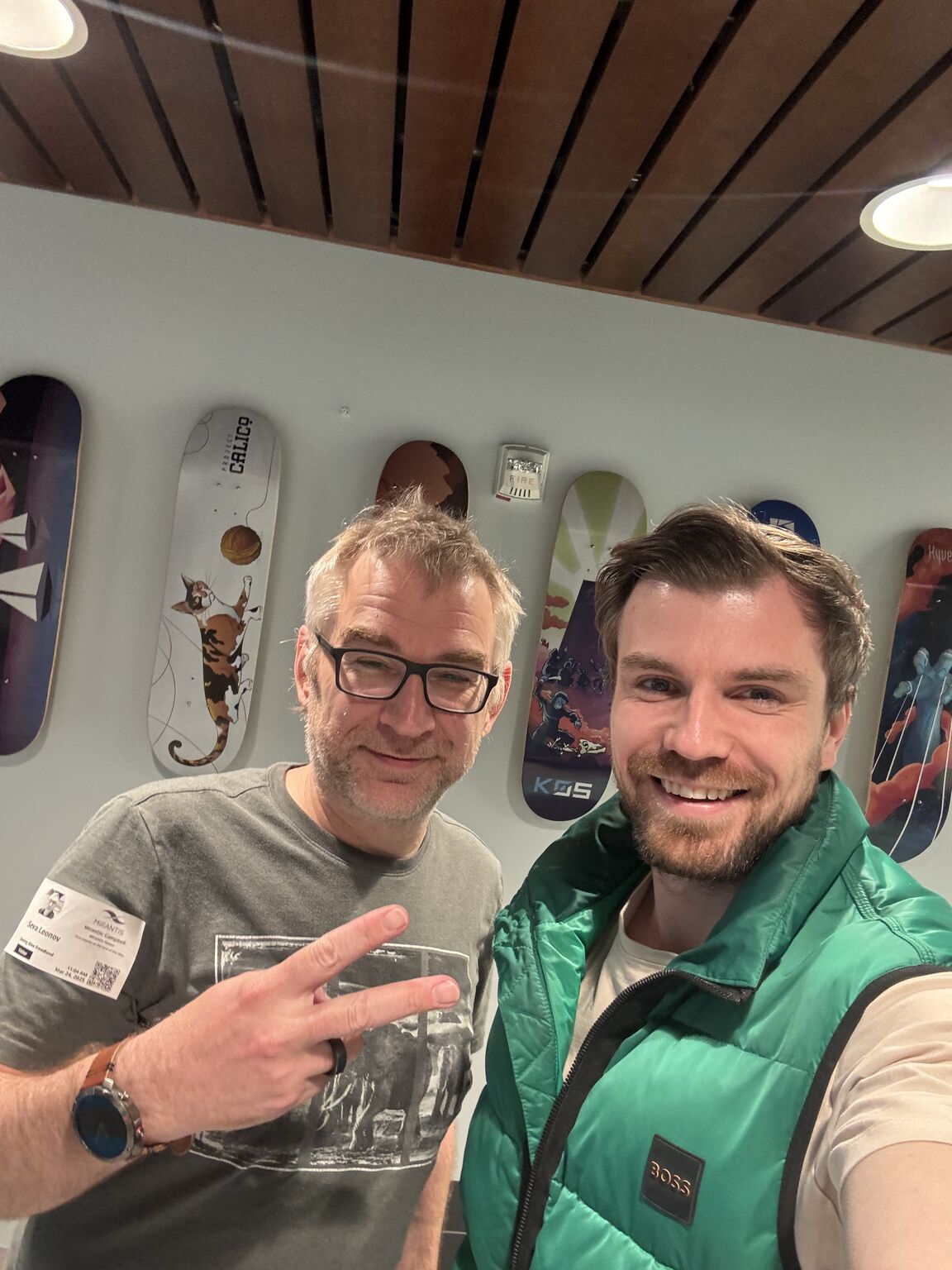
A candid from March 2025 makes the transition delightfully literal. Leonov stands in a Mirantis office beside Seva Vayner after a conversation about the AI GPU market. Vayner posted the photograph. Leonov replied, “Not every day you get two Sevas in the same room. Something’s definitely brewing!” It is a small joke, but a useful character note. Technical subjects do not require the personality of a rack-mounted server.
By then, Leonov had been publishing a different kind of evidence. His Hugging Face account lists interests in MLOps, scalable inference, quantization, long context and fine-tuning. Its collections include quantized versions of Prometheus 2 evaluation models and Llama 3 variants with extended context. His GitHub profile includes collections of B2B agents and agents based on Y Combinator’s Startup School curriculum, along with a compact Llama implementation. These are not presented as landmark research. Their value is plainer: they show the workbench.
His public posts dwell on details that convert enthusiasm into a budget. In June 2024, he discussed TensorRT performance inside NVIDIA NIM and the potential effect on the unit economics of serving open models. In January 2025, he focused on falling H200 rental prices. Cheaper compute, he argued, makes open models more accessible and puts pressure on proprietary-model pricing. Whether every benchmark survives another environment is less important than the habit on display: measure the thing that can sink the business.
“I’m amazed at how fast GPU prices are plummeting.”Vsevolod Leonov, January 2025
The operator who can inspect the engine
There is a popular caricature of business development as professional sociability: introductions, conferences, dinners and a heroic number of calendar invitations. Leonov’s record suggests a sturdier version. The commercial operator becomes more useful by understanding the constraint closely enough to challenge it. At Astrum, the constraint was international distribution. At Google, it was app monetization and partner growth. In AI infrastructure, it is a shifting mixture of memory, latency, data quality and compute cost.
Leonov does not publicly present himself as a research scientist. A better description is a translator with a socket wrench. His 2023 sequence of DeepLearning.AI certificates, covering machine learning, TensorFlow, convolutional networks and natural-language processing, fits the same pattern. The courses did not erase a commercial career; they gave it another surface for grip.
That combination is especially relevant to agents. A chatbot can tolerate a vague relationship with company data. An agent that takes action cannot. It must know which information is current, which system is authoritative, what the user may access and how one action changes the next. The “data layer” is where policy, context and memory meet. It is also where a technical architecture collides with procurement, security, integration and the sober question of who maintains it on Friday night.
Leonov has not publicly disclosed the stealth company’s product, customers or launch plan. The available statement is enough to reveal direction, not destination. He is moving toward the layer where the agent economy must become operational. That is consistent with the rest of the journey. He has repeatedly followed software from novelty into distribution, then stayed until the market’s unanswered questions became visible.
Follow the bottleneck
A career can be organized by promotions, but promotions are often the least interesting geometry. Leonov’s is better understood as a narrowing spiral. Each turn brings him closer to the mechanism: from marketing software, to licensing games, to structuring platform partnerships, to running model experiments, to building data infrastructure for agents.
The lesson is not to collect job titles from every technology cycle. It is to stay close enough to the product that your commercial judgment can be disproved. Rent the GPU. Run the model. Notice the bottleneck. Ask whether the cost curve moved while everyone was polishing last quarter’s assumptions.
Leonov once wrote that app developers faced too many technology options and needed something more unified. AI now has the same clutter at much greater speed. Models multiply, context windows stretch, inference engines improve, prices fall, and agents wait for dependable data. Somewhere inside that confusion is a business. Leonov has spent two decades learning how to recognize it, usually just after the machinery starts humming.