At Blur Studio, the problem with inexpensive storage was what happened when it stopped being inexpensive. The animation company ran FreeBSD-based ZFS systems that had initially been economical and capable. Then came manual management, capacity constraints and failures. More than 500 rendering systems depended on the pipeline. A storage interruption could become an interruption for hundreds of artists. The disks had a price. The waiting had another.
- Qumulo manages large file and object datasets across data centers, clouds and remote sites.
- Its distinguishing proposition combines storage visibility with consistent access to distributed data.
- The practical buying question: how much work disappears when the files become easier to manage?
The bargain that stopped being a bargain
Blur installed a seven-node Qumulo cluster through a phased, self-managed transition. Its case study describes easier expansion, snapshots for recovering deleted files and a Capacity Explorer that lets production staff inspect consumption themselves. The change gave people outside IT a way to understand what their projects were using.
“Downtime meant hundreds of artists losing hours of work.”Sean Cody · Head of Systems, Blur Studio
This is an unusually useful way to think about enterprise storage. A terabyte is easy to count. An artist’s interrupted afternoon is harder. Qumulo’s opportunity lives between those two measurements: the difference between having somewhere to put a file and having a system people can depend on.
Three storage veterans, eighteen months of questions
Peter Godman, Aaron Passey and Neal Fachan founded Qumulo in 2012 after working at Isilon. They knew distributed storage. Yet their new company spent 18 months researching users before settling on what to build. The revealing discovery was that adding storage did not necessarily make growing collections of data manageable.

That distinction still explains the product. Qumulo Core combines a distributed file system with live analytics, snapshots, replication and interfaces including NFS, SMB and S3. Administrators can investigate capacity and performance while applications continue using familiar ways to access files. The expertise is in distributed systems and their daily administration, rather than simply manufacturing another enclosure for disks.
The company’s ambitions attracted substantial capital. In July 2020, Qumulo announced a $125 million Series E led by BlackRock Private Equity Partners at a valuation exceeding $1.2 billion. That is a historical financing milestone, not today’s price tag. Douglas Gourlay now leads the business. Its stated principles emphasize customer success, long-term engineering and straightforward communication.
One file, several places
Now consider the copying problem. A team needs a dataset in another location, so someone makes another copy. Then somebody changes the original. Which version should a colleague use? How much infrastructure is maintaining the duplicates? These questions multiply more readily than the budget does.
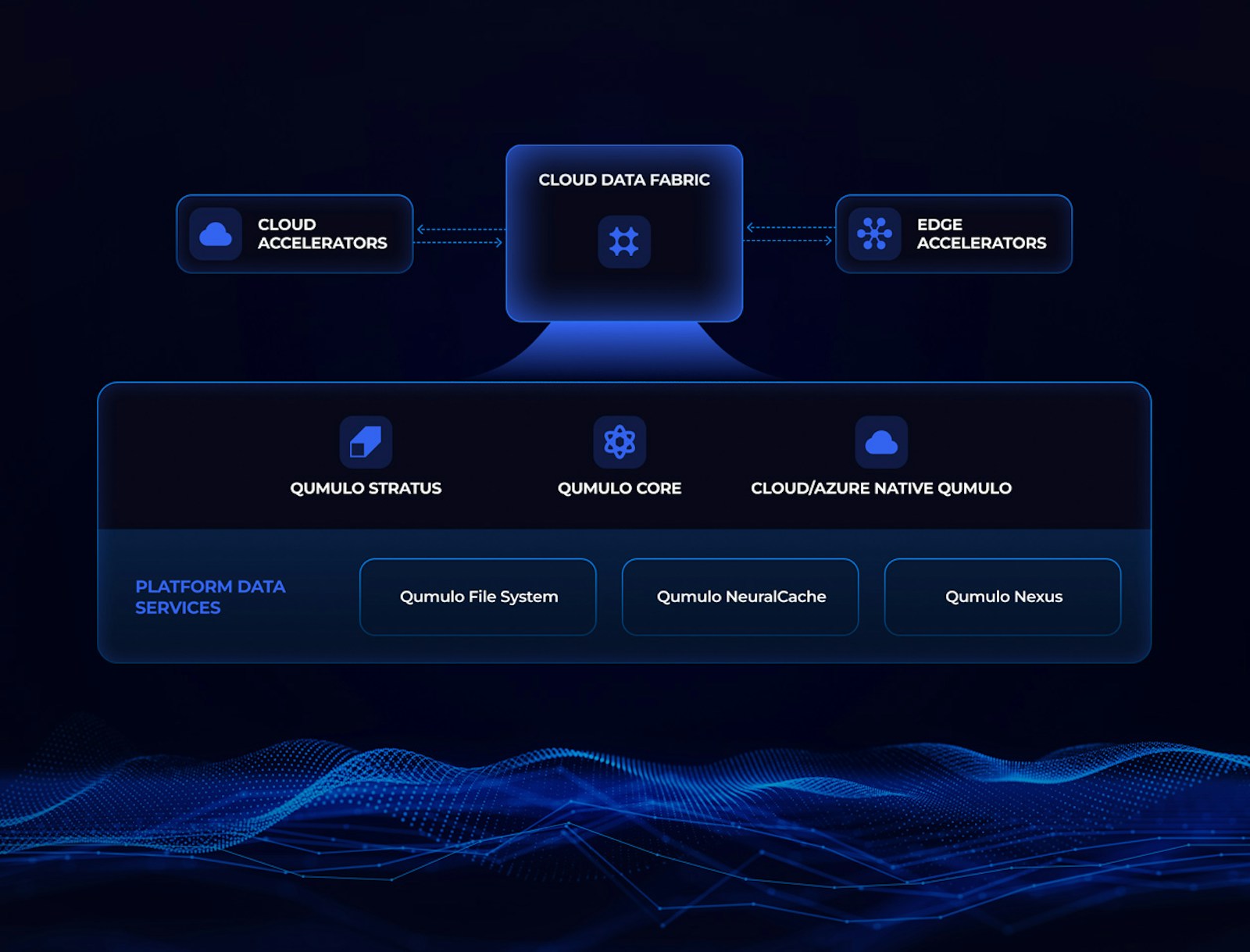
Cloud Data Fabric addresses that problem through a shared global namespace, local caches and strict consistency. Data remains durably stored at a core; remote endpoints fetch blocks on demand. Repeated reads can use the local cache. Global locking coordinates writes. NeuralCache predicts subsequent requests and prefetches data. Bytes still cross networks. The aim is to avoid maintaining complete independent datasets for each working location.
Conceptual architecture · Caching moves data; it reduces the need for whole-dataset copies.
The name sounds like a cloud requirement, but the fabric can connect private facilities without a public cloud. That flexibility matters to organizations choosing where sensitive datasets live. It also changes the migration conversation: access can expand before an organization decides to move everything.
The cloud has a meter
Cloud Native Qumulo pairs cloud compute and flash caching with object storage. Its attraction is familiar file access over a different storage foundation, with performance resources that can change as workloads change. AWS, Azure and Google Cloud are deployment options; managed and self-managed offerings require different operational commitments.
The economics deserve a pencil. For self-managed deployments, the cloud provider bills the infrastructure separately. Software, compute, object capacity, requests and network traffic all belong in the calculation. Cloud Data Fabric licensing depends on the amount of data shared. A subscription quote alone cannot establish the total cost.
Software + compute + storage + transactions + network traffic
Compare the full workload cost, including administration and recovery.Stratus brings another architectural choice: separate performance resources from storage capacity. Its dedicated Accelerator clusters and tenant encryption keys are intended to isolate workloads sharing underlying infrastructure. A busy division need not automatically dictate every other division’s configuration.
A different kind of storage comparison
Qumulo sits among enterprise alternatives such as Dell PowerScale, NetApp, Pure Storage, VAST Data and WEKA. Its case rests on software portability, visibility and distributed access. Buyers should compare those properties against their actual applications, alongside throughput, recovery requirements and price.
STRADVISION illustrates the demand. Its automotive vision developers had more than 20 fragmented NAS units, hundreds of simultaneous users and recurring freezes. According to its Qumulo case study, it moved to two on-premises clusters and an AWS-connected cloud deployment in less than a month. The decisive irritant was unreliable concurrent work, not a fashionable desire to adopt new storage.
Qumulo’s July 2026 NeuralSearch announcement and Databricks partnership extend the proposition into governed data discovery. May’s NeuralProtect launch adds storage-layer threat inspection with Cisco Hypershield and Splunk integration. These are announced capabilities; they should earn their place through testing.

The useful habit to steal
A buyer can copy Blur’s operational lesson before buying anything: give project owners visibility into consumption, measure interruptions and let recovery enter the purchasing conversation. Then test representative files, concurrent users, cold-cache reads and network interruptions. Caching depends on access patterns and connectivity; unfamiliar datasets still need to arrive.
For a small, single-site workload, the operational savings may never justify an enterprise platform. For teams drowning in copies and manual intervention, the calculation looks different. The useful question is wonderfully unfashionable: when somebody needs the right file, how much work must everybody else do?