The small aircraft display on Chuck Tatham’s desk does one job. A round screen plots nearby planes, labels them and updates as they cross the sky. Tatham assembled it from an ESP32 board, a tiny display, some wire and a 3D-printed frame. The first was for his father, a retired private pilot and lifelong aviation enthusiast. Then he planned to build five more for friends and family.
It is the kind of side project that makes an enterprise software career snap into focus. The device takes a noisy stream of data and turns it into a clear, useful signal. There is no dashboard committee. No one needs to export a CSV. A glance tells you what is happening and invites the next question: where is that plane going?
At Kubex, where Tatham leads marketing and business development, the data is less charming and the stakes are higher. Containers ask for too much CPU. Cloud instances idle. GPUs sit expensive and underused. Platform engineers protect performance, finance watches spend, and application owners understand the quirks of each workload. Everyone has a piece of the truth. The difficult part is turning those pieces into a change that people trust.
A career organized around the handoff
Tatham’s résumé reads like a compact history of enterprise software. He held senior sales and channel roles at Lotus Development, the company that helped define workplace collaboration before the browser absorbed much of that territory. By 2002 he was vice president of marketing at Changepoint, explaining software that managed the work, workflow and economics inside IT services organizations. When Compuware acquired Changepoint in 2004, he moved into IT governance marketing.
The terminology belonged to its moment: professional services automation, project portfolios, governance. Yet the practical question was already familiar. Leaders had projects, people, interruptions and budgets scattered across systems. Software could make the operation legible. In a 2004 interview about Compuware’s governance product, Tatham described the need for visibility and control over IT. Two decades later, those are still favored words in cloud management. Their survival tells you something. Visibility is repeatedly sold because control is repeatedly hard.
Lotus Development
Senior sales and channel roles in the collaboration-software era.
Changepoint
Marketing enterprise systems for the work and economics of IT.
Compuware
IT governance marketing after the Changepoint acquisition.
CiRBA
Data-center intelligence for consolidation and workload placement.
Densify
The company identity shifts toward cloud resource optimization.
Kubex
Kubernetes, cloud and AI/GPU optimization under a new company name.
By 2007, as vice president of marketing at CiRBA, Tatham was talking about a bridge between strategy consulting and execution. CiRBA modeled data-center environments so companies could decide what to consolidate, virtualize or move. The alternative was people with discovery tools and spreadsheets, making consequential placement decisions by hand. In later commentary, Tatham was blunter: organizations overwhelmed by the complexity of empirically managing workloads tend to throw more capacity at the problem.
More capacity feels safe because the bill arrives later and the outage might arrive now. That asymmetry has powered a large part of Tatham’s working life. His job has been to explain why measurement can be safer than padding, why a model can see patterns a hurried operator cannot, and why efficiency and performance do not have to be enemies.
The nouns change. The argument survives.
CiRBA became Densify in 2017 as the center of gravity moved from on-premise virtualization to public cloud. A server was no longer necessarily a box in a company-owned room. It was an instance on a metered platform, easy to create and easy to forget. In 2019, as Densify introduced container optimization, the company described its task as characterizing application demand, predicting what a workload would need and matching that demand to supply.
The recurring enterprise optimization loop
That matching problem has only grown more granular. A Kubernetes cluster contains nodes, pods and containers, each with requests, limits and actual behavior. An application can reserve far more than it uses, stranding capacity even while the dashboard shows a cluster that looks allocated. Reduce requests too aggressively, however, and a container can be throttled or killed under pressure. The cheapest setting is not automatically the right setting.
Tatham’s explanation of Intel Cloud Optimizer captured the distinction. A production-critical workload may require conservative optimization because uptime and performance dominate. A less-sensitive workload can be tuned more aggressively. The analytics, he said, can be adjusted to fit the sensitivities of the business. It is an operator’s point disguised as a marketer’s line: context is part of the calculation.
The appeal of that framing is easy to miss. Most cost tools begin with price. Tatham keeps returning to the workload. What does it do? When does demand peak? Who owns it? What failure threshold is acceptable? Price becomes an output of a better technical decision, not the only input. It also gives engineering and finance a shared object to discuss. They may care about different outcomes, but they can look at the same resource behavior.
The psychology inside the machine
Tatham holds a Bachelor of Science in psychology from the University of Toronto. It is an unexpected credential for a career spent near data centers, cloud catalogs and Kubernetes manifests, but a fitting one for the actual work. Infrastructure optimization is full of human defenses. Teams overprovision because they are punished for outages, not for invisible waste. Recommendations wait because no one owns the final change. Dashboards proliferate because observing is less risky than acting.
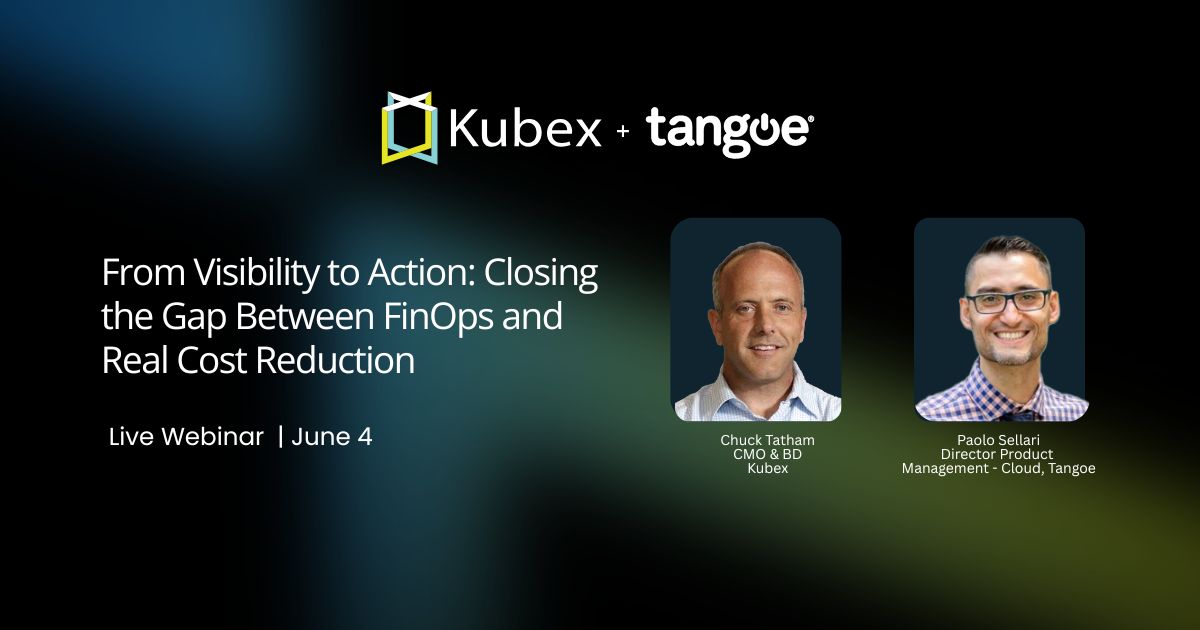
The buying committee mirrors the problem. Platform engineering wants control. Finance wants measurable savings. Procurement wants leverage and predictability. Application owners want their service left standing. In announcing a 2026 partnership with Tangoe, Tatham argued that optimization must be continuous, automated and integrated into the infrastructure management stack. He described a common resource truth serving engineering, finance and procurement. The phrase “single point of resource truth” is corporate, but the ambition is social: give people with different incentives a fact pattern they can share.
This is also why automation has taken so long to become the center of the pitch. A recommendation is advisory. Automation touches production. It needs guardrails, explanations and a way to account for the business attributes a metric stream cannot reveal on its own. The product challenge is not simply making the model confident. It is making the humans appropriately confident.
From machine learning to a machine you can talk to
On January 1, 2026, Densify adopted Kubex as the company name. The rebrand followed an 18-month effort to rearchitect the platform around Kubernetes resource optimization, GPU and AI workloads, a new automation controller and an agentic interface. It was the second major name change Tatham had worked through with the same company lineage. CiRBA evoked placement and capacity. Densify made utilization the idea. Kubex plants the flag in Kubernetes while leaving room for the infrastructure around it.
Tatham’s recent writing has moved accordingly. He has published about GPU optimization, AI factories, infrastructure waste and the people explaining the operational layer of enterprise AI. His argument is that models are becoming easier to access while the systems required to run them reliably and economically are becoming the constraint. GPUs add a sharper version of the old problem: scarce, expensive capacity paired with workloads whose demand can be difficult to predict.
His own experiments keep the subject grounded. In one LinkedIn post, Tatham described connecting Claude to Home Assistant through the Model Context Protocol. The setup could build automations and dashboards he once configured manually. “Will I miss messing with YAML? Noop,” he wrote. The joke carries a product thesis. Natural language can shorten the distance between intent and configuration, but the dependable part is the connection to a deterministic system underneath.
That is the bet inside Kubex AI as well: let more people ask questions of infrastructure without discarding the specialized analytics required to answer responsibly. A chat box can broaden access. It cannot replace the operating model behind the answer.
The durable problem
A quarter-century of enterprise technology can look like a sequence of replacements. Lotus gave way to browser collaboration. Project portfolios expanded into governance. Virtual machines migrated to public clouds. Containers rearranged the unit of management. GPUs made capacity planning urgent again. AI now promises to operate the tools that once only reported to us.
Tatham’s career suggests another reading. Platforms change faster than organizational bottlenecks. Companies still struggle to connect technical evidence to business context. They still buy visibility and postpone the decision. They still protect themselves with excess capacity when complexity exceeds confidence.
The aircraft display avoids all of this because its purpose is narrow and its feedback is immediate. Enterprise infrastructure cannot be made that simple, but it can be made more legible. Tatham has spent more than two decades selling versions of that possibility: collect the behavior, understand the constraints, make a recommendation, and help someone act.
The useful lesson is not merely to use less. It is to build a trustworthy route from knowing to doing. Waste lives in the gap.