An aircraft can be ready in almost every respect. Crew available. Passengers waiting. Fuel aboard. Then a component needs attention, and the useful question becomes surprisingly small: who has the part, who can repair it, and how soon? VSE Corporation has built its aviation strategy around that question. The Florida company occupies the space between the people who make aircraft equipment and the people who must keep using it.
- The work: aircraft parts distribution, component repair, exchanges and licensed manufacturing.
- The pivot: sell federal and defense operations, then fleet services, and concentrate on aviation.
- The test: turn an expanding collection of specialists into an operation that serves customers better together.
The useful life after the sale
The aftermarket begins where the original sale leaves off. Aircraft continue to need fuel controls, hydraulic components, engine accessories and other equipment throughout their working lives. VSE sells replacement parts and maintains components already in service. Its customers include commercial airlines, regional carriers, cargo operators, repair providers, manufacturers and private aircraft owners. These buyers share an unromantic requirement: equipment that works when it is needed.
For an operator, VSE offers several routes through the problem. Buy a part. Send a component for maintenance, repair and overhaul, usually shortened to MRO. Use an exchange involving a serviceable rotable component. Arrange inventory and distribution support. The combination matters because a buyer’s problem can move between those categories. A purchasing department and a repair shop are often working on different pieces of the same delay.
First, sell the old company
VSE began in 1959. Founder John B. Toomey was its first chairman, president and chief executive. For decades, government engineering and technical services helped define the business. The modern aviation company emerged through a deliberate narrowing of that portfolio. This was a management choice with contracts, buyers and exit costs attached.
The first conspicuous snag came in September 2023. VSE and an affiliate of Bernhard Capital Partners terminated their agreement for the federal and defense business. Necessary approvals and closing conditions were no longer expected within a reasonable time. The original terms contemplated $50 million at closing and as much as $50 million in earnouts. Neither party paid a termination fee.
VSE kept pursuing the exit. Substantially all the operational assets were sold through two transactions in February 2024; the eventual cash consideration was $42.9 million. In April 2025, Wheeler Fleet Solutions went to One Equity Partners for up to $230 million, including contingent proceeds. VSE’s own explanation was consistent: concentrate on higher-growth, higher-margin aftermarket distribution and repair. The failed transaction changed the route to that destination.
A repair manual has commercial value
VSE’s competitive argument rests partly on its relationships with original equipment manufacturers, or OEMs. Consider Eaton. In April 2025, Eaton named VSE Aviation its first authorized aerospace service center in North and South America, covering hydraulic components for large commercial and regional aircraft. The arrangement includes official technical documentation, OEM spare parts and an independent spares inventory. VSE can also provide overflow capacity for Eaton repair stations.
That is a specific kind of independence. VSE operates outside the manufacturer while offering a manufacturer-supported repair route. For customers comparing VSE with an OEM’s own shop, another independent specialist, or a broader supplier such as AAR, the useful comparison is the particular component, authorization, inventory position and turnaround requirement. A large company name cannot answer every maintenance question.
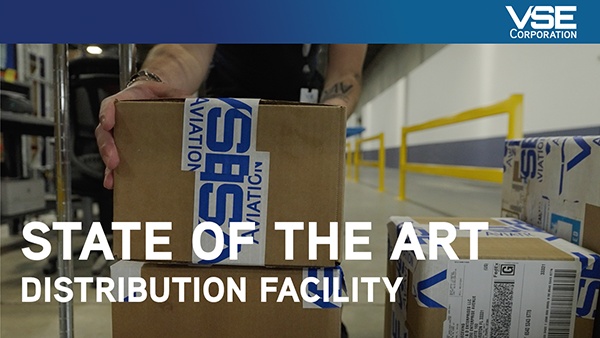
The Honeywell fuel controls program takes the relationship further. VSE holds exclusive rights to manufacture and support certain controls and subcomponents, covering more than 340 unique fuel controls. Distribution brings a part to the customer; licensed manufacturing adds responsibility for producing it. That gives the company more work to own within the same equipment ecosystem.
The bill for getting bigger
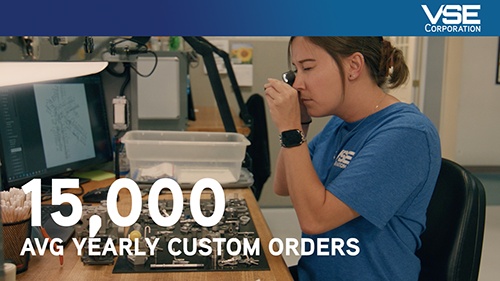
The next move was considerably larger. On May 5, 2026, VSE completed its purchase of Precision Aviation Group. The approximately $2.025 billion upfront price comprised $1.75 billion in cash and about $275 million in equity. Another $125 million could become payable based on performance. Financing included equity-related offerings and a $900 million term loan.
“With the transaction closed, our focus shifts to integration and synergy realization”John Cuomo, President and CEO · May 2026
At closing, the combined network encompassed 61 locations across eight countries, including 48 repair facilities and 11 distribution centers. Cuomo identified the practical work ahead: cross-selling, bringing repairs inside the group and purchasing more efficiently. Those are operational tasks. A repair capability acquired on paper becomes useful when salespeople know it exists, technicians can handle the work and customers receive the promised service.
65% total growth
Approximately 14% organic growth. Acquisitions also contributed.
Read the growth twice
The second quarter of 2026 showed both kinds of expansion. Revenue reached $449.1 million, up 65%, while organic growth was approximately 14%. Net income from continuing operations was $28.5 million. The distinction is useful: the acquired businesses enlarged the company, and the existing operations were growing too. Neither number should stand in for the other.
Expansion continued in August with Atech Turbine Components. Its specialized engine repairs came with proprietary approvals covering more than 300 part numbers. That detail explains the acquisition logic more clearly than the language of scale: VSE was adding permission and expertise to perform particular work.
The part worth copying
For another business, the transferable idea is to identify the recurring customer problem, then add capabilities that address adjacent parts of it. VSE’s sequence suggests a discipline: decide where to concentrate, exit activities outside that focus, and buy expertise with an identifiable use. The difficult work continues after the announcement.
This approach depends on scarce technical skills, durable supplier relationships and enough capital to hold inventory and integrate acquisitions. VSE reported $966.7 million in debt at June 30, 2026. Weaker aviation demand, lost authorizations or disrupted integration would make the arithmetic harder. The customer’s final judgment remains wonderfully concrete: was the right component available, was the work done properly, and could the aircraft return to service?