John Holmes had a sensible plan: spend two years at AAR, then move on. He joined the aviation services company in 2001, bringing an investment banking background to a mergers and acquisitions job. By 2016, he was still there, running its Aviation Services business and cheerfully admitting that his original timetable had slipped. Two years had become fifteen. The exit strategy had developed an inconvenient attachment to the place.
There is a familiar career story in which an ambitious financier buys a business and promptly improves it. Holmes’s story takes a slower route. He went from evaluating transactions to running a parts business, then accumulated responsibility for the operations that keep aircraft working. The acquisitions continued. So did the apprenticeship.
Today he is AAR’s chairman, president, and chief executive. The company is based in Wood Dale, near Chicago, and serves commercial and government aviation customers internationally. Its work happens mostly outside the passenger’s view: supplying replacement parts, repairing components, maintaining aircraft, and organizing the information that accompanies all of it. A boarding pass contains remarkably little room for these contributors.
The detour into the parts business
Holmes studied finance at the University of Illinois Urbana-Champaign and earned an MBA from the University of Chicago. Before AAR, he worked in investment banking and private equity. His first assignment inside the company, director of mergers and acquisitions, fitted that preparation neatly. What followed required a broader education.
In 2003, he moved into operations as general manager of the parts trading business. Over time his remit expanded across inventory management, distribution, supply chain services, and maintenance. By 2015 he was chief operating officer of Aviation Services. In June 2017 he became president and chief operating officer of AAR; in June 2018, he succeeded David Storch as CEO.
The succession carried unusual continuity. Founded in 1955, AAR had reached only its third chief executive. Holmes had spent roughly seventeen years inside the business before taking the job. He inherited a company whose customers, suppliers, and working habits he had encountered through successive operating roles. In January 2023, he also became chairman, following Storch’s retirement from the board.
One small answer from his earlier career is more revealing than another title. Asked in 2016 about his biggest challenge, Holmes pointed to the difficulty of finding time for everyone he wanted to meet. He also described enjoying AAR’s pace and entrepreneurial culture. The attractions he named were people, opportunities, and the reach of aviation. His two-year plan had plenty of competition.
A complicated company, a shorter explanation
By 2020, Holmes was trying to make AAR easier to explain. Its history included manufacturing, cargo activities, even a period of owning and flying aircraft, alongside parts sales and repairs. The collection could make sense to the people running it while leaving everyone else reaching for a diagram. He described a sustained effort to simplify the company’s story.
His discussion of technology was similarly practical. An experienced mechanic could guide several less experienced colleagues remotely, seeing what they saw on screens. That offered a way to spread judgment built over decades without requiring the most elaborate augmented reality equipment. The useful question was whether the tool helped someone finish a real maintenance task.
This gives his financial background a more interesting setting. Aviation services involve inventory, facilities, specialized labor, and customers who need dependable execution. An acquisition has to become part of those routines. Buying capability is one step; making it useful across the rest of the company is the continuing assignment.
“Having enough time to see all the people I want to see.”
John Holmes, on his biggest challenge in 2016
The deal that took a decade
Consider Trax. AAR bought the aircraft maintenance software company in March 2023 for $120 million upfront, with additional contingent consideration. The relationship had begun about ten years earlier. Trax’s owners had not been ready to sell then. Holmes and his colleagues kept getting to know the business.
When the transaction finally happened, the product had evolved. Cloud delivery and mobile applications gave the software business a different proposition. Holmes saw two uses for digital investment: improving AAR’s own efficiency, including moving away from paper, and earning revenue by providing digital services to customers. Trax put more weight behind the second ambition.
The patience matters. A decade is an awkward interval for a neat deal-making anecdote, but a useful one for understanding Holmes’s approach. The eventual purchase joined a long relationship to a changed product. The business he acquired in 2023 had moved on from the version AAR first encountered.
Repair capability grew too. In March 2024, AAR completed the $725 million purchase of Triumph Group’s Product Support business. The transaction brought five principal locations, including one in Thailand, and expanded the range of repairs AAR could perform. Software and physical maintenance were becoming more closely connected in the portfolio he led.
A conceptual guide to AAR’s parts, repair, and software strategy.
A hangar needs people
There is a stubbornly human limit to an aviation growth plan: somebody has to do the work. In 2019, Holmes was already discussing the difficulty of finding qualified mechanics and competing for them with airlines and manufacturers. Career pathways, tuition support, and help obtaining qualifications belonged in the business conversation alongside facilities and contracts.
AAR launched its EAGLE Career Pathway Program in 2018. Its routes into aviation maintenance now include education partners, apprenticeships, and high school programs. The company also describes a flow-through arrangement offering technicians preferential consideration when they are ready to move to Alaska Airlines. That acknowledges a career can extend beyond the employer that helped it begin.
In Oklahoma City, those workforce questions acquired an address and three maintenance bays. AAR celebrated the substantial completion of an expansion in January 2026, adding more than 80,000 square feet capable of accommodating all Boeing 737 variants. The project supported a long-term Alaska Airlines commitment and the creation of 200 additional full-time careers.
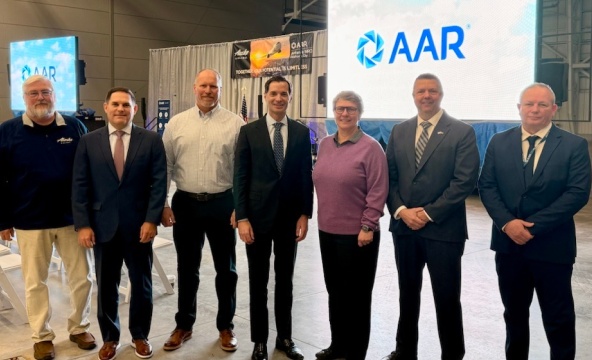
Holmes thanked Alaska for its trust and the local partners for their support. Maintenance operations at the location stretched back more than fifty years. Expansion, in this case, meant adding space to an established relationship. The new building arrived with an existing history.
The other set of decks
Chicago sees another side of Holmes. At Shedd Aquarium’s October 2022 THRIVE gala, he was a trustee and co-chair. He also DJed in the Soundings After Dark lounge. Some board members bring a speech; this one could also supply the music. The event’s paddle raise brought in nearly $2.2 million for conservation, education, and animal care.
His civic commitments range across the city’s cultural and business institutions. He joined Columbia College Chicago’s trustees in 2012 and became chair in July 2023. He had co-chaired its Unleashed 2022 gala, which raised more than $750,000 for student persistence scholarships. As of September 2026, the college lists him as vice chair.

The college role also involved difficult decisions. In 2024, with Columbia facing a $38 million deficit, its board approved restructuring and spending reductions amid objections from faculty and staff. Holmes backed the changes as necessary to its future. Civic leadership brought disagreements over how to preserve an institution, alongside the more photogenic evenings raising money for it.
He joined the GATX board in January 2024, adding another transportation business to his responsibilities. His public conversations have also covered raising children in the city and his DJ hobby. Those details give the calendar some texture: aircraft maintenance, institutional budgets, family, and occasionally a set list.
The obligations that travel with growth
AAR’s expansion has also proceeded alongside scrutiny of past conduct. In December 2024, the company reached resolutions with U.S. authorities over foreign bribery matters, with total payments of $55.6 million. AAR had self-reported the matters in 2019. The settlement is part of the company Holmes leads, as much as the acquisitions and earnings announcements.
Related Nepal proceedings require careful distinction. AAR has said its subsidiary was convicted and that Holmes was not personally convicted; it said the subsidiary’s sentence was assigned to him under Nepalese law as its principal executive. AAR disputes the proceedings’ due process and has said it does not intend to participate or pay the fine. These remain the company’s stated account and position.
A larger test of the original idea
For fiscal 2026, AAR reported $3.3 billion in sales, up 19% from the preceding year. In the next reported quarter, ended August 31, sales reached $918 million, up 24%. Those are company results, produced by its workforce and businesses, and the scale against which Holmes’s choices can be judged.
The latest numbers also show why growth needs more than a sales headline. In that August quarter, AAR reported $40.1 million in net income. Its operating margin fell from 8.8% to 7.9%, even as its adjusted operating margin increased. Acquisition and integration work comes with expenses. Holmes’s next chapter will be measured in the relationship between those costs, the service customers receive, and the earnings the combined activities can produce. The company can describe its direction in three words. Delivering it requires a much longer account.
On September 28, 2026, AAR announced an agreement to acquire a 65% controlling interest in MRO Holdings for approximately $1.8 billion in equity value, alongside repayment of existing borrowings. Completion was expected in the fiscal quarter ending February 2027, subject to approvals and other conditions. It remained a proposed transaction at this profile’s publication.
Holmes’s stated logic was that more heavy maintenance work could also create demand for component repairs, parts distribution, and software. Connecting those activities on a larger scale is the next test. Twenty-five years after joining AAR, he is still working on acquisitions. The difference is how much of the business he has learned to run between them.