A wall and a deck can belong to the same house and still live in different corporate worlds. Different brands. Different sales calls. Different routes to the contractor who has to make everything fit. Aaron Erter has put a considerable part of his career's next chapter into closing that distance.
In July 2025, James Hardie completed its acquisition of AZEK. Erter, its chief executive since September 2022, stayed at the helm. The company known for fiber cement siding now had a broader collection of products for the space outside the front door, including TimberTech decking, AZEK trim and StruXure pergolas. A homeowner could see a finished exterior. Erter had to make the businesses behind it work together.
The transaction had been announced at approximately $8.75 billion, including debt. That is an expensive way to suggest that the siding and decking departments should talk. It also makes a revealing frame for an executive whose working life has passed through power tools, paint, coatings and specialty manufacturing. His recurring subject is how a physical product finds a customer.
The education beside the sales counter
Erter holds an economics degree from Wharton and an MBA from Notre Dame. Notre Dame identifies him as an Executive MBA graduate of 2004. The academic credentials sit alongside a long commercial apprenticeship: 15 years at Stanley Black & Decker, with leadership responsibilities in sales and marketing for Black & Decker and DEWALT.
Those brands put him close to the people who buy equipment to do a job. In its later announcement recruiting him, PLZ specifically credited his work expanding distribution channels at Stanley Black & Decker. Distribution can sound like the bit of business that happens after the interesting decisions. Anyone waiting for a missing delivery knows exactly how interesting it can become.
At Valspar, he moved through senior consumer-business roles. He was vice president and general manager for North America from November 2011 to December 2015, then senior vice president until June 2017. When Sherwin-Williams acquired Valspar, he joined the combined company. By August 2017 he was president of its Consumer Brands Group; in March 2019 he became president of the Performance Coatings Group.
There is a useful continuity in that sequence. The products changed, while the work kept crossing the boundary between industrial capability and consumer choice. His career suggests a preparation for James Hardie's particular puzzle: a material must satisfy the person installing it and the person who will look at it from the driveway.
Aerosols before architecture
In November 2020, Erter became president and CEO of PLZ, the specialty aerosol and liquid manufacturer based outside Chicago and owned by Pritzker Private Capital and management. Its business included formulation, manufacturing, packaging and distribution across branded and private-label products. The brand on the container was only one part of the assignment.
PLZ's chairman, John Ferring, described an agenda of acquisitions, stronger capabilities and expansion into new markets. Erter arrived at a manufacturer already pursuing those ambitions. It was a setting where customer service depended on operations as much as on persuasion. His tenure ran until August 2022.
James Hardie appointed him the following month. Its directors emphasized his experience commercializing products, understanding consumer needs and marketing to homeowners. He would work from Chicago. The brief brought together the two sides of his résumé: making a manufacturing organization perform and making its products matter to buyers.
For a siding company, that second task is unusually intimate. A buyer is choosing the appearance of a home, often at substantial expense, while relying on contractors to translate a preference into something buildable. Erter's appointment placed a sales and marketing veteran inside that chain of trust. The later AZEK deal would extend the chain across more of the exterior.
- 2017Consumer Brands
Sherwin-Williams - 2020President & CEO
PLZ - 2022CEO
James Hardie - 2025AZEK acquisition
completed
The house gets a bigger shopping list
The case for AZEK began with an ordinary observation about renovation: people considering siding may also be thinking about decking. Combining the businesses offered more chances to reach those buyers and more products for the contractors, dealers and builders already in either company's orbit.
In the March 2025 transaction presentation, Erter tied the proposed combination to growing with business partners. This was a commercial argument about shared relationships, alongside the argument about adjacent products. A bigger catalog would need people who could explain it, stock it and recommend it.
Asked in May about the first six to 12 months of integration, he answered with staffing, retention and clear priorities. “It all starts with people,” he said. The answer was practical enough to survive outside an earnings call. You can buy a business on a closing date. Its employees need reasons to stay and a workable understanding of what comes next.
“It all starts with people.”
Aaron Erter · May 2025
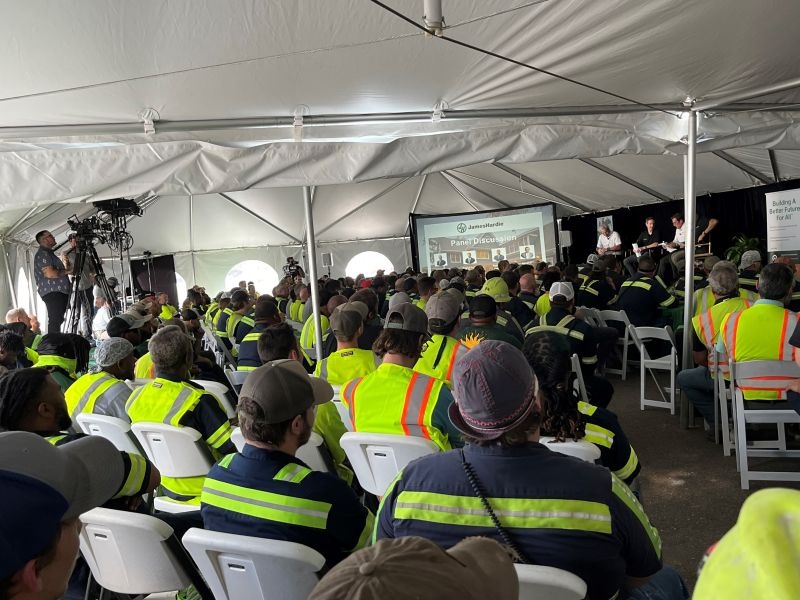
After the transaction closed, Erter described a Chicago town hall bringing the combined teams together, streamed to colleagues across the United States, Asia Pacific and Europe. He wrote about introducing the leadership team and answering employees' questions. The first job of a combined organization was, quite literally, getting everyone into the same conversation.
The shareholders had questions, too
Employees were one constituency. Investors were another. At the October 29, 2025 annual meeting, chair Anne Lloyd and directors Rada Rodriguez and Peter-John Davis ceased to hold office following the shareholder votes. Three directors arriving from AZEK, Howard Heckes, Gary Hendrickson and Jesse Singh, were elected to continue serving.
The company acknowledged that it had more work to do to deliver for shareholders and said its board would hold itself and management accountable. Those events belong in Erter's story because they changed the setting in which he had to execute the acquisition. A commercial proposition had become a test of confidence in the people overseeing it.
By November, Nigel Stein had been named chair. A new integration and performance committee included Erter and was chaired by Singh, AZEK's former CEO. Ryan Lada, previously AZEK's finance chief, was appointed CFO. These changes gave the integration a different governance and leadership structure.
The difficulty was compounded by a subdued housing market. In August 2025, Erter had described homeowners postponing expensive remodeling projects and builders moderating starts. A larger offering cannot make a household bring forward a renovation it cannot afford. His strategy therefore faced two separate questions: could the organizations combine effectively, and would enough customers buy?
Beautiful is a beginning
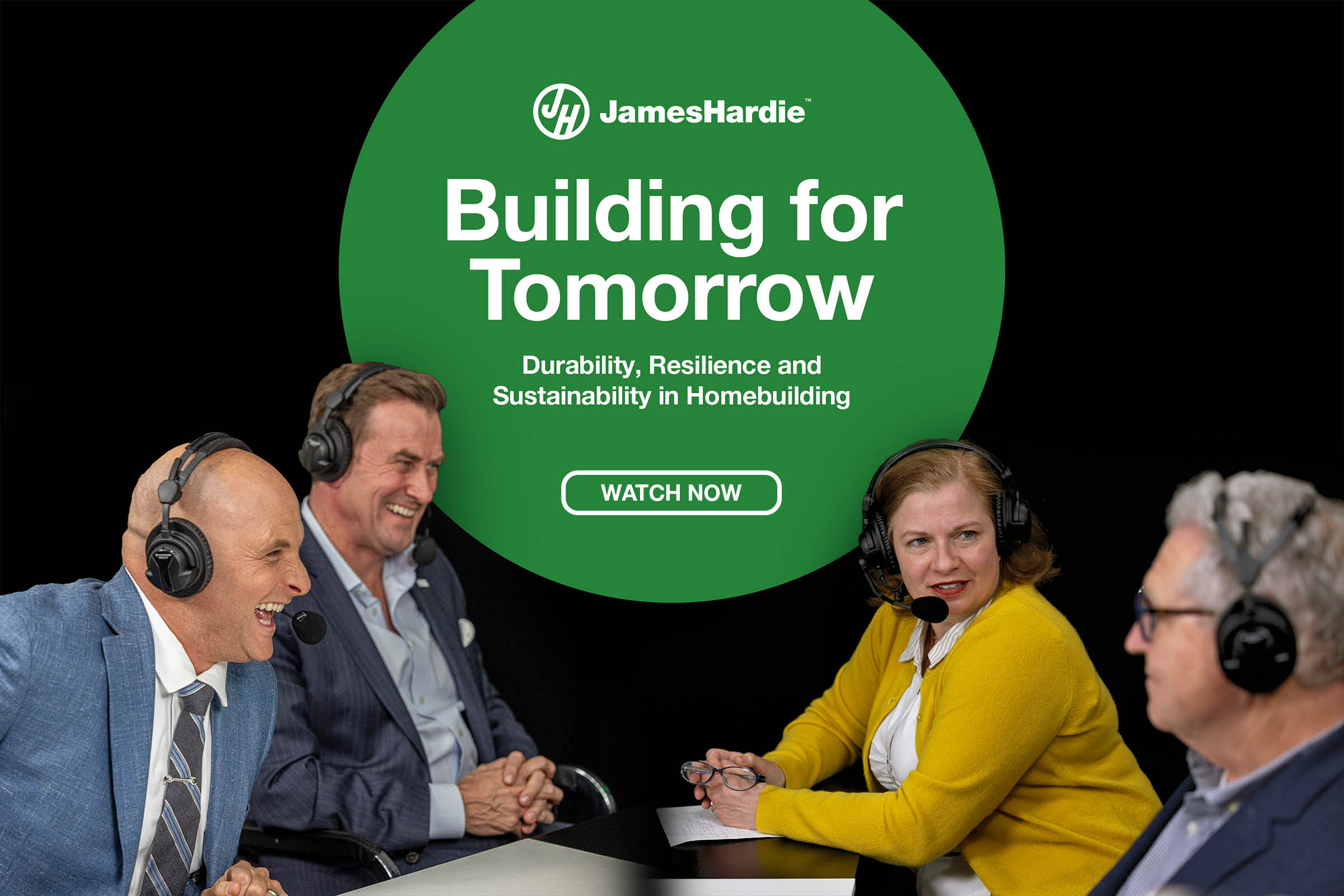
Earlier in 2025, Erter sat down at the International Builders' Show with Nicole Tysvaer of Symbi Homes and architect Peter Pfeiffer for a discussion hosted by Chip Wade. The projects under discussion included Queen of Zero near Washington, DC, and VISION House Austin. James Hardie supplied siding and sponsored both.
The conversation put a different vocabulary around his business. The panel discussed durability, climate, design choices and how homes would perform over time. Erter stressed that “these homes are built to last.” It was a claim about the intended life of a building, with implications that extend well beyond the day a contractor finishes the exterior.
That panel helps explain the breadth of his commercial task. Buyers care about appearance; builders also have to think about installation and how materials behave. His public argument connects those concerns. The opportunity is to make the design decision and the practical decision reinforce each other, with products that people want to specify again.
His outside commitments connect him to other parts of that world. He serves on the Chicagoland Habitat for Humanity board and the Pro Football Hall of Fame National Advisory Board. In June 2024, he joined Ball Corporation's board. Ball pointed to his packaging knowledge from Sherwin-Williams alongside his experience in product development, marketing and acquisitions.
The next test arrives by truck
By August 2026, the combination had produced a concrete distribution decision. James Hardie and Boise Cascade announced an expanded partnership, effective July 31, naming Boise Cascade the sole nationwide distributor for the complete exterior portfolio. Hardie siding and trim would sit alongside AZEK trim and TimberTech decking and railing in that arrangement.
For Erter, it brought the story back to the distribution channels of his earlier career. The intended benefits included broader product access, more consistent fulfillment and coordinated contractor training. Those are the ordinary mechanisms through which a large acquisition might become useful on a job site.
He was also narrowing the business elsewhere. On August 20, James Hardie announced an agreement to sell its European Fermacell business to Holcim for €840 million and its intention to close European fiber cement operations, subject to the required processes. The sale was expected to close in the first half of 2027. Expansion in one direction came with withdrawal in another.
Annual organic growth above the market: a company target, presented at Investor Day, rather than a reported result.
At September's Investor Day, management set out that growth target and said it expected to reach its original $125 million cost-synergy goal roughly a year early. Anticipated revenue synergies of $500 million remained part of the plan. The distinction matters: the larger promise still required future sales.
Erter's next chapter will be measured in those practical transactions. A dealer has the trim. A contractor understands the decking. A homeowner can put the choices together. After years selling the pieces that go into making things, he is asking a larger company to sell more of the finished picture. The distance between a wall and a deck is short. Making the businesses meet there takes longer.