A deck board is a modest place to look for a theory of leadership. It sits outside, gets walked on and rarely receives a word of thanks. Yet a question about what goes into one helped define Jesse Singh’s years at AZEK: could a manufacturer use more of the plastic other people had finished with? The question led toward new equipment, recycling capacity and a different way of thinking about the factory’s appetite for raw materials.
Singh arrived at AZEK in 2016 after a career that had already taken him through GE, investment banking, consulting and 3M. At the latter, his responsibilities included Post-it and Scotch, brands whose usefulness requires remarkably little explanation. He moved from the desk to the deck, carrying experience in both industrial operations and the business of persuading people to choose a familiar product.
On June 29, 2026, he became chief executive of Fortune Brands Innovations. Moen, House of Rohl and Master Lock put him back among objects people encounter without scheduling a meeting about them. His career now connects the note on the desk, the boards under the garden chair and the lock on the door. The objects are ordinary. Getting them made, distributed and chosen is complicated.
The input that changed the conversation
At AZEK, Singh’s interest in recycling had a practical economic premise. Recycled material could cost less than virgin plastic while keeping waste out of landfill. Amanda Cimaglia, an executive involved in the company’s sustainability work, later recalled that he questioned the quantities of raw plastic being used. She also described resistance to changing established methods. The answer involved retooling machinery and building recycling capability. Agreement alone would have produced very little decking.
A dedicated polyethylene recycling facility opened in Wilmington, Ohio, in 2019. The following year, AZEK brought Return Polymers into the business, adding PVC recycling and processing capabilities. These were commitments to handling material, sorting it and making it usable. They put machinery behind an idea that could otherwise have remained comfortably abstract.
Singh explained the approach in a 2019 interview with Ontario Teachers’ Pension Plan. He described recycling plastic waste and other scrap alongside equipment and processes intended to reduce energy and water consumption. At the time, he said TimberTech PRO and EDGE decking contained approximately 80 percent recycled material. The company was also reusing about 98 percent of the scrap it generated itself. Those figures describe that period, rather than every product sold today.
There is a particular discipline in this sort of change. A recycled input still has to become something a customer will buy. Color, finish, durability and reliable production remain part of the bargain. The environmental argument has to survive the journey through the factory and onto someone’s house. Singh’s AZEK chapter is interesting because it took that journey into the operating system of the business.
plastic
process
decking
An operating model: the recycling capability becomes part of manufacturing.
A business education in useful things
His formal education paired a bachelor’s degree in electrical engineering from Rensselaer Polytechnic Institute with an MBA from the University of Chicago Booth School of Business. The combination offers a useful way to read the subsequent career: technical training on one side, markets and management on the other. The record moves repeatedly between those two kinds of work.
He spent eight years at General Electric in operations and commercial leadership. Technology investment banking at Dain Rauscher Wessels/RBC and consulting leadership at Arthur Andersen added different views of how businesses function. His next long chapter was 3M, where he spent 14 years across a range of leadership assignments.
The breadth is worth pausing over. Alongside stationery and office products, he led 3M’s global electronics materials business and served as CEO of its joint venture in Japan. As chief commercial officer, his remit extended across a worldwide customer-facing organization. Factories and customers were recurring responsibilities, even as the products and geography changed.
That background helps explain the shape of his later work without supplying a tidy destiny. An electrical engineering degree does not contain a secret instruction to run a decking company. A career accumulates experience less elegantly than a biography arranges it. In Singh’s case, the result was familiarity with manufacturing, brands and distribution before he took charge of AZEK.
What leaves through the factory gate
Singh has described leadership in terms that extend past the product. In a 2017 interview, he talked about how employees’ experience at work carries into family life. An inspired employee and an unmotivated employee bring different evenings home. His stated purpose was to help people lead more fulfilling lives. That is a wider frame for a manufacturing job than the number of boards produced in a shift.
The same interview offered a glimpse of his own priorities. He spoke about taking his responsibilities as a father and husband seriously, helping his children develop a sense of place and the education to make their own contribution. He also valued travel and engagement with other cultures. These were his own descriptions of a life alongside the executive role.
In November 2021, he received an EY Entrepreneur Of The Year national award. An established company can provide room for entrepreneurial work, too. AZEK’s announcement emphasized experimentation and continuous improvement, and Singh returned to a compact daily question: “how can we be better today than yesterday?” It is easy to print that question. The more revealing part is what an organization agrees to change after asking it.
“My broader purpose is to enable people to lead more fulfilling lives.”Jesse Singh · 2017
A warehouse gets another job
In Boise, the transformation became tangible. AZEK opened a manufacturing facility in a former ShopKo warehouse in October 2022. At the opening, Singh said the company had invested $140 million to date in creating the plant, with further investment to come as it expanded. An old building had acquired a new purpose making products that themselves incorporated recovered material.
The facility also included training for contractors and other construction professionals. That detail matters because material conversion has a human side. A manufacturer can develop a board, but people need to know how to work with it. Capacity, installation knowledge and access to customers have to grow together. The warehouse offered a physical setting for several parts of the business to meet.
Other connections were less obvious. A partnership with clothing resale platform thredUP sent polyethylene Clean Out Bags and film waste toward AZEK’s recycling operations and eventually into TimberTech composite decking. Fashion and building materials make an unlikely pairing. Their meeting point was the plastic left after the clothes had moved on.
For fiscal 2023, AZEK reported using approximately 420 million pounds of waste and scrap in manufacturing, bringing its total since fiscal 2019 to 2.1 billion pounds. Its stated ambition was to use one billion pounds annually by the end of 2026. The ambition and the reported result are different numbers. Keeping them separate makes the scale of the work clearer.
Nine years, then a different seat
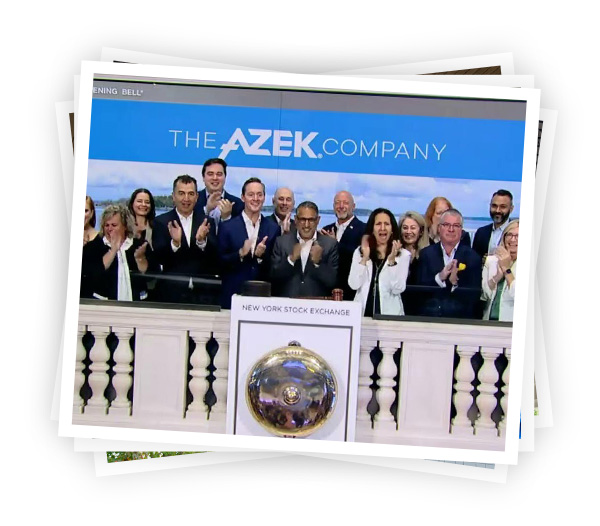
Singh led AZEK through its June 2020 public listing, which raised a reported $765 million. A company making products for the outside of homes was now answering to public-market investors as well as customers and employees. The stock-exchange photograph captures the ceremonial part. The manufacturing investments and the recurring demands of execution continued away from the bell.
In March 2025, AZEK and James Hardie announced their proposed combination. Addressing employees in a video message, Singh acknowledged that the news could be a surprise and would take time to absorb. He thanked the team and emphasized keeping commitments to customers while the transaction moved through its approval process. The public moment called for explaining a transition as well as celebrating a deal.
James Hardie completed the acquisition in July 2025. Singh’s AZEK chief executive tenure had ended in June; he joined the James Hardie board alongside Howard Heckes and Gary Hendrickson. Aaron Erter continued as chief executive of the combined company. Singh moved from running AZEK each day to a board role in the business that acquired it.
The next promise has to arrive on time
Fortune Brands brought him back to an operating role in June 2026. David Barry, who had served as interim CEO, became chief operating officer. Singh inherited a portfolio spanning water, doors, security and connected products, with brands already familiar to customers. His appointment connected the manufacturing executive to another set of household choices.
The early numbers supplied a sober setting. Fortune Brands reported second-quarter 2026 sales of about $1.2 billion, down 4.1 percent from the previous year. In August, Singh described spending time with business teams and beginning conversations with customers and channel partners. His priorities included better service, cost discipline, attention to core businesses and investment to improve execution. These were tasks in progress.
In September, Fortune Brands named Peter Clifford chief financial officer, effective September 21. The two had overlapping careers at AZEK. Praising Clifford’s appointment, Singh emphasized practical knowledge of manufacturing and supply chains alongside finance. It was a revealing choice of emphasis: the financial role was being discussed in terms of the day-to-day business.
His Fortune Brands chapter is still young. Its outcome will depend on the company’s performance over time, rather than the elegance of the career that preceded it. What Singh brings is experience asking useful questions about familiar things: what goes into a product, how people make it, and whether the organization can deliver what the customer expects. A deck board offered one answer. The taps, doors and locks now provide the next set of questions.