A robot can have excellent diction and still be terrible company. It can pronounce every syllable, wait for the end of a sentence and reply with impeccable grammar, while leaving the caller with the faint suspicion that the conversation has been assembled by a committee. Vladislav Chernyshov has spent years working on that suspicion. His business depends on the small, untidy things people do when they talk.
At Dasha, the company he co-founded and leads, conversation is something developers can build into software. His interest reaches beyond a voice that reads a script. He wants the exchange to survive contact with an actual person: someone who changes direction, interrupts, pauses or remembers the important detail halfway through answering. The technology has to accommodate the customer who has declined to behave like a flowchart.
There is a pleasing complication in Chernyshov’s story. Before he tried to make conversations more natural, he tried to make construction more predictable. Before the essays about artificial intelligence came essays about plumbers. The subjects sound far apart until you notice the recurring concern: how to turn a difficult, irregular human activity into a system that other people can use.
A contractor’s problem, a programmer’s instinct
Chernyshov graduated from Novosibirsk State Technical University in 2008. His background was in automation and computer engineering; his later work also connected him to the university’s applied mathematics and computer science research environment. The technical education matters because he approaches a business as something that can be taken apart, examined and rebuilt.
In his account of his early career, he started a home renovation business in Russia in 2008. He eventually closed it and returned to coding. By 2016 he was developing Dedal, a service for requesting licensed contractors. He described an idea that came during an Uber ride: steadier work could change the economics of a trade. A contractor’s calendar, with its inconvenient empty spaces, was part of the problem he wanted to solve.
This is an unusually concrete place to begin a career in conversational AI. Home renovation introduces a founder to arrangements that look sensible on paper and become less sensible when somebody needs an answer. A request must become a job. A job must reach the right person. Expectations have to survive the journey. Chernyshov’s later software would work on the exchange itself.
Two chairs and a very large idea
By 2017, Chernyshov was using conversational AI to help a construction company develop a dealer network. The practical assignment gave him a reason to study how automated conversations worked, and how they failed. A system could recognize words yet remain awkward to talk to. The gap between recognizing speech and participating in a conversation became the business.
Dasha’s formal company founding followed in October 2018. Ilya Stupakov, another Novosibirsk State Technical University graduate, was its co-founder and chief software architect. The university described the technology as growing from their scientific work. In March 2019 it reported a $2 million investment from RTP Global. This was a research project acquiring the commitments of a company: customers, financing and something that had to work outside the laboratory.
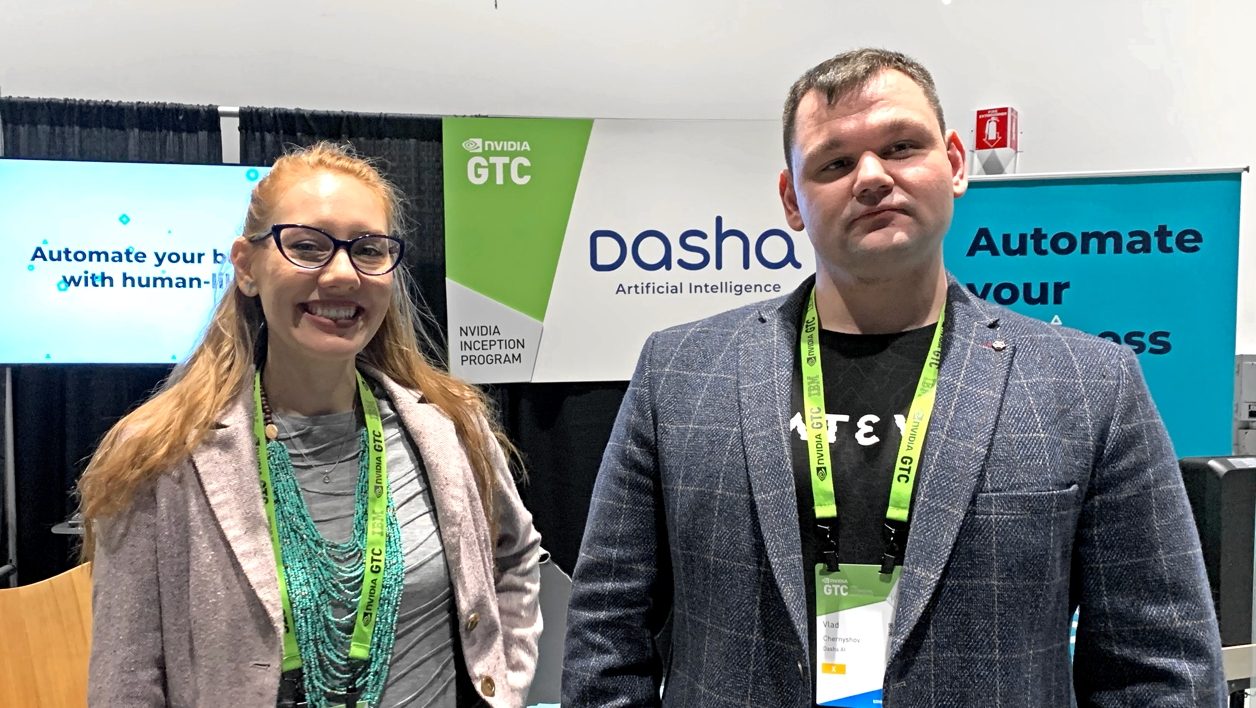
At NVIDIA’s GTC conference in 2019, Chernyshov demonstrated Dasha at a modest booth with two chairs and a laptop. The photograph catches him beside the company’s signage, wearing a conference lanyard and a jacket. It is the familiar startup exhibition arrangement: a small patch of rented space asked to contain a rather expansive future.
He also gave credit to Alexander Dyakonov, Dasha’s scientific director, for reworking the system. That detail gives the founder’s confidence some texture. He was willing to argue for the platform while acknowledging the specialist whose work had changed its foundations. Behind a demonstration that appears effortless lies the less photogenic business of replacing parts that do not work well enough.
The hesitation belongs in the design
Chernyshov’s attention to pauses and speech fillers is revealing. In 2020, discussing the details that help a machine sound natural, he put it plainly: “Those things are actually pretty much essential.” The little hesitation that an editor would remove from a transcript may be doing useful work in a spoken exchange.
Think about what a pause can ask of a listener. It might mean that the speaker is finished. It might mean that the speaker is searching for a word and would prefer you to stay out of the sentence for another moment. A conversational system has to operate inside that ambiguity. A beautiful voice reading the wrong thing at the wrong time remains the wrong answer.
Dasha’s focus on turn-taking makes Chernyshov’s ambition easier to understand. The caller experiences one conversation; the developer has to arrange its many moving parts. Timing becomes part of the interface. So does the ability to take a detour and return to the task. Ordinary talk supplies plenty of such detours without consulting the engineer first.
“Those things are actually pretty much essential.”
Vladislav Chernyshov, on the quirks of natural speech, 2020
His favorite comparison has a command prompt
In September 2020, Chernyshov wrote an essay comparing conversational AI with the software industry before MS-DOS. His interest was in the supporting structure that lets people create applications. A technology becomes more useful when developers have a shared foundation and tools that spare them from repeating the same underlying work.
The comparison tells you what sort of company he wanted Dasha to become. A useful application solves one problem. A platform invites somebody else to solve a problem its founders have not thought of. The second ambition requires a founder to care about the people building on the system, as well as the people using the finished product.
He returned to that argument in October, writing about the importance of documentation, examples, development tools and debugging. These are humble subjects for an essay with a sweeping title, “One conversational AI platform to rule them all.” Even an empire requires readable instructions. The developer who cannot make a first application run is unlikely to applaud the architecture.
The essay also discussed the difficulty of moving applications between platforms. Chernyshov understood that the foundation a developer chooses can shape what comes afterward. His historical analogy was a statement of strategy, rather than evidence that software history would obligingly repeat itself. It remains useful as a portrait of how he thinks: past the first application, toward the environment in which the next thousand might be written.
What he asks the humans
The founder studying machine conversation also had a human coordination problem. In a 2020 account of Dasha’s working practices, he described the confusion that arrived when the team reached ten people across two cities. Knowing who was doing what had stopped being automatic. A collection of capable people needed a way to share context.
He used weekly written reporting through Standuply, with questions about results, plans and obstacles. One of the questions was particularly direct: “Do you need anything from the company’s head?” It places responsibility back on the person receiving the report. Information should give a manager something to act on.
There is an instructive relationship between this habit and his product. In both cases, Chernyshov wants communication to produce a useful next step. The attractive idea has to arrive somewhere practical: a developer’s working application, a customer’s completed request, a colleague’s obstacle resolved. A conversation that ends without movement can be expensive, however fluent it sounded.
A founder who notices awkward prose
Chernyshov’s writing has room for jokes as well as diagrams. In his essay on neural text generation, he begins with Humpty Dumpty and examines why a language model’s continuation can sound unnatural. The topic is repetition, word choice and the problems of selecting what comes next. It is a technical discussion with a nursery rhyme doing the introductory work.
That essay makes an interesting companion to his voice project. A sentence can be statistically plausible and still feel peculiar to a reader. A spoken reply can be accurate and still arrive awkwardly. Both problems concern the difference between producing language and producing language that another person can comfortably receive.
He was writing about these difficulties in 2020, before the present familiarity of conversational generative tools. His explanations show an engineer willing to linger over the failure, rather than simply present the successful output. If you want to understand his taste in problems, look at the moments where a system almost works. That small remaining distance is where much of his attention goes.
The next application is somebody else’s
Dasha was named a Gartner Cool Vendor in Conversational AI Platforms in 2020. In December 2021, the company released a browser playground that let users try conversations and modify applications. Both developments fit the trajectory Chernyshov had described: make the infrastructure accessible enough for others to work with it.
By October 2026, Dasha’s public product offering includes support for more than thirty languages, different language models and transfers to human agents. Those are company descriptions of its capabilities. They also show how many practical decisions sit inside the apparently simple proposition of answering a call.
Chernyshov has continued to leave a public trail of developer work. His GitHub account, bloodcarter, includes a repository created in July 2026 for using Fly.io’s Sprites from coding agents. It is a small, specific piece of tooling alongside the larger voice business. The combination feels consistent with the person visible in his earlier essays: interested in ambitious systems, attentive to the awkward steps required to use them.
For Chernyshov, the future has repeatedly begun with an ordinary inconvenience. An uneven workload. A confusing handoff. A conversation that takes too long to get anywhere. The ambition is large, but its tests are intimate. Somebody speaks. Somebody else needs an answer. Between those two events is enough work to occupy a company.
Read him. Hear him. Try the tools.
Follow Chernyshov’s thinking through his essays, public profiles and a conversation about Dasha’s work.
- Dasha’s website and live voice demonstration
- Chernyshov on LinkedIn · Twitter / X · GitHub · Medium
- Watch: RPA Master Stories with Vlad Chernyshov
- His 2016 account of Dedal and construction
- His software history analogy · His platform essay
- His essay on neural text degeneration
- The 2020 interview · The 2019 GTC visit