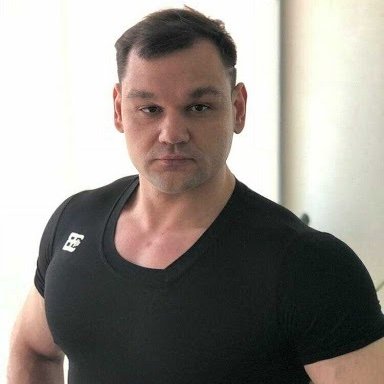
Who he is now
The company sells call-center automation. The founder is chasing something bigger.
Vlad Chernyshov runs Dasha.AI from an office on Third Avenue in Manhattan, and if you call one of the numbers his software answers, there is a decent chance you will not know you are talking to a computer. About nine in ten people can't. The trick is not that the voice is smooth. The trick is that it is not - it hesitates, it breathes, it says "uh," it starts talking a beat before you finish, the way people who are only half-listening do. Most engineers building voice systems spend enormous effort scrubbing those artifacts out. Chernyshov's team spends enormous effort putting them back in. "Those things are actually pretty much essential," he has said, which is the kind of sentence that sounds obvious only after someone has staked a company on it.
Dasha's product is, on paper, a platform for automating phone work - the surveys, the reminders, the inbound support calls that in 2018 occupied something like 30 million people in the United States alone and, by Chernyshov's count, roughly 120 million worldwide. That is the market. It is not, if you listen to him for more than a few minutes, the mission. "We have a mission of going after artificial general intelligence," he says, "the ability for computers to understand like humans do, which we believe comes through developing systems that speak like humans do because speech is so closely tied to our intelligence." The call-center revenue, in this framing, is the thing that funds the actual experiment.
A new category, not a new industry
Chernyshov is careful about the distinction. "This is not a new industry, but what we're doing is a new category," he told Sifted in 2020. Interactive voice response has existed for decades; press one for billing, press two for support. What Dasha claims to have built is different in kind: a "human-level, voice-first conversation modelling engine," paired with a hybrid text-to-speech system that models disfluency and a voice-activity detector that registers speech in under 100 milliseconds. That last number is the interesting one. A hundred milliseconds is faster than you can consciously react, and it is what lets the AI take turns and handle interruptions instead of waiting politely for silence that, in real conversation, rarely comes.
He is blunt about where this goes. He expects the field to consolidate into "two or three major AI platforms globally," and he has compared the moment to the early software industry: "Five years from now this will sound very weird that all companies are trying to build something." He has called conversational AI "the biggest paradigm shift of the last 40 years." These are large claims. He does not appear interested in hedging them.
The day after the rejection
The origin story has a good beat in it. Chernyshov flew to interview at Y Combinator. It did not go well. The day after the failed interview, in May 2017, a San Francisco dental practice became Dasha's first paying customer. The lesson he seems to have drawn is not that gatekeepers are wrong but that customers are the only vote that clears. Before that, in 2017, he had already built a custom conversational AI for a construction company to automate dealer outreach across hundreds of locations - proof, before there was a platform, that the thing worked.
The roots go back further, to Novosibirsk, the Siberian university city that has produced a disproportionate share of the world's competitive programmers. Chernyshov studied computer science there, earned a master's, and competed in the International Collegiate Programming Contest, the sport where the clock is always running and elegance counts for nothing if you miss the deadline. As a student around 2007 he built one of the first instant messaging apps for Android. He co-founded a company called Genome (2008-2015) and another, Dedal, in 2016, the same year Dasha began. His handle, on GitHub and elsewhere, is "bloodcarter" - the name he has been shipping code under since before any of this.
A research shop wearing a startup's clothes
The team he assembled reads less like a typical seed-stage roster and more like a graduate seminar. Chief Research Scientist Dr. Alexander Dyakonov was once the No. 1-ranked GrandMaster on Kaggle. The engineering group has included doctorates, PhD students, and more than sixteen ICPC finalists or semi-finalists. Dasha kept an R&D office in Russia in part to stretch its funding - a $2 million seed led by RTP Ventures and RTP Global in 2019, followed by a Series A, for total funding around $4.5 million. The whole stack, from speech recognition to synthesis to the natural-language layer, was built in-house and runs on NVIDIA GPUs in the cloud. There is even a domain-specific programming language, DashaScript, so that an ordinary developer can write a conversation the way they would write software.
What holds it together is a single conviction Chernyshov keeps returning to: that the way to make a machine understand is to make it talk, and that the small imperfections of human speech are not noise to be filtered but signal to be reproduced. "This technology should be advanced enough," he says, "but simple enough for massive adoption." He has been early on this. He may also, on the evidence so far, have been right.