Vitaly Pecherskiy went looking for a banking job in Toronto with a method that took the elevator pitch rather literally. He entered office towers, rode with people who looked employable and offered them his résumé. It was an unusually direct way to enter finance. Three weeks after moving to the city, he had a job in advertising technology.
That detour would eventually lead to StackAdapt, the company he co-founded with Ildar Shar and Yang Han in 2014. But the useful part of the elevator story is its lack of foresight. Pecherskiy had a finance education, a destination and the willingness to introduce himself. The industry that would occupy his working life arrived as a surprise.
He has since become an enthusiastic examiner of such surprises. His personal website carries birthday essays, letters to his children and accounts of decisions that worked rather less elegantly than a company biography might suggest. The co-founder who became chief executive in January 2024 keeps returning to a practical question: what, exactly, did the experience teach him?
A weekend to learn an industry
Pecherskiy was born and raised in Saint Petersburg, Russia. He moved to Canada with his family at 17, attended the University of Ottawa and graduated with a commerce degree focused on finance. Toronto was supposed to provide the next conventional step. Instead, a small technology company offered a much shorter course in changing direction.
At AdParlor, an early Facebook advertising partner, he encountered young founders running a business that made entrepreneurship seem available to someone his age. There was an immediacy to it. People were building something and customers were using it. The distance between having an idea and being allowed to act on it suddenly looked smaller.
His entry was brisk. Asked whether he knew advertising, he admitted that he did not. The company’s CEO told him to study over the weekend and return on Monday. By the end of the next interview, he had instructions to bring his laptop and start. A finance qualification had supplied quantitative habits; the rest would require doing the work.
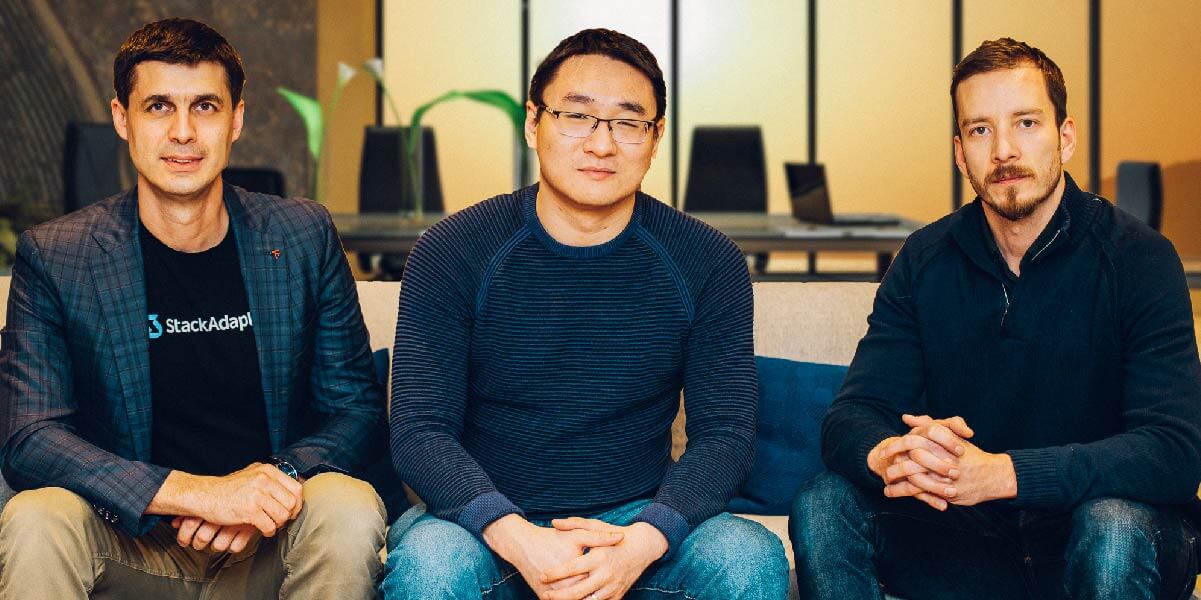
Later, working at an agency, he met Shar. They shared the frustration of buying advertising with tools that did not do what they wanted. Han supplied the technical partnership. The three began building software around the problem they had already experienced as customers: making digital media buying more useful and easier to operate.
The kitchen gets a much bigger job
The company began in Pecherskiy’s kitchen. Its early focus was programmatic native advertising: software buying placements that fit the surrounding page rather than arriving as a conventional banner. Beginning with a defined problem gave the founders a place to work. It also left them plenty of adjacent problems to discover.
Pecherskiy’s early responsibilities included publisher relationships, recruiting the websites that would carry the advertising. This was an exchange business with a very human dependency. However clever the machinery, someone still had to persuade people to join it. The aspiring banker’s willingness to make an introduction had found a different commercial use.
StackAdapt’s scope broadened over the following decade. Connected television, audio and digital billboards joined the familiar internet formats. The company’s work expanded from placing advertisements toward connecting more of a marketer’s activities. A business that started with a narrow advertising task was accumulating the complications of an enterprise software company.
StackAdapt launches with three co-founders.
Pecherskiy moves from COO to CEO on January 1.
Canada’s Top 40 Under 40 recognizes him; StackAdapt reports 1,800+ employees.
Outside money eventually arrived in substantial amounts. Summit Partners invested US$300 million in 2022. A further US$235 million equity round, led by Teachers’ Venture Growth, followed in February 2025. Those investments financed a company that had spent years learning to operate under constraints. The earlier difficulty of raising capital remained part of Pecherskiy’s explanation of its habits.
He became CEO after nearly a decade as COO. Shar stayed involved through the board; Han remained CTO. The change put a different set of demands on a founder who already knew the business closely. Knowing how a company works and knowing how to allocate a chief executive’s attention turn out to be separate assignments.
A job description saved on his phone
In April 2025, Pecherskiy described how he had approached the new role: reading, meeting current and former CEOs, and trying to understand what the position actually required. One framework from the book CEO Excellence stayed on his phone. He returned to it to check whether some responsibilities were swallowing the attention owed to others.
He then adapted the idea for account executives. He wanted a practical description of good work that people elsewhere in the company could use. His first attempt with ChatGPT produced an answer he considered too full of jargon and poor at setting priorities. He edited it. The episode is a small, useful glimpse of an AI company’s chief executive still exercising the old editorial privilege of crossing things out.
His account is appealingly unceremonious about expertise. Even after co-founding a company, he could find value in a clear statement of what his job entailed. He also admitted that, earlier in his career, following instructions had not meant fully understanding how to excel. The framework was a way to make expectations explicit.
“Cavalry is not coming.”
Vitaly Pecherskiy’s reminder about ownership
That phrase became the title of a July 2025 essay, prompted by a question at an introductory employee AMA. Asked which event had most shaped StackAdapt, he pointed to an internal change of attitude. The company had accepted responsibility for its own progress. Waiting for the perfect partner, investor or senior hire could become a sophisticated form of delay.
The argument allows room for assistance. It asks leaders to learn enough about the difficult parts of their businesses to judge the help they receive. An executive recruited to solve a problem still needs a capable colleague on the other side of the desk. Pecherskiy writes about this as a temptation he continues to recognize in himself.
Learning has an anniversary
There is another recurring appointment in his calendar: his birthday essay. By November 2025, he had reached the ninth year of the practice. The subjects shift because the exercise follows his attention. Business lessons share space with relationships and fatherhood. His website, originally a place for startup advice, gradually made room for a wider life.
He has written letters to both his son and daughter. In his 2023 birthday piece, he described how his daughter’s arrival expanded his sense of how much love he could give. The writing puts a familiar founder preoccupation with capacity into a domestic setting. Some of what he wants to understand cannot be settled in a business meeting.
In 2021, he established an entrance award at the University of Waterloo for Black or Indigenous engineering students. The award offered $20,000 for one student or $10,000 each for two. He had not studied at Waterloo himself. StackAdapt had hired its engineering graduates, giving him a concrete appreciation of the opportunities the education could create.
The entrance award he established for Black or Indigenous engineering students at Waterloo.
He and his wife had discussed how their family could help future leaders from underrepresented communities. Their answer was a specific educational opportunity. It makes a useful companion to the career story: an unexpected opening changed his working life, and some of his philanthropy concerns making openings available to others.
The asphalt had other plans
In 2022, the family helped fund and build a replacement basketball court at Christie Lake Kids’ camp near Perth, Ontario. Pecherskiy’s account spends considerable time on the old surface. The family went out with a jackhammer and sledgehammers to remove it themselves, then discovered sections with two layers of asphalt. Enthusiasm had been budgeted more accurately than labour.
More people and machinery followed. After roughly a hundred hours of work, they called professionals, who cleared the ground in a day. The new court opened on July 3. Pecherskiy also worked his network and sent cold messages until the Ottawa BlackJacks agreed to send players for a basketball clinic.
The episode supplies a welcome qualification to any doctrine of relentless self-reliance. Responsibility can involve picking up a sledgehammer; it can also involve recognizing who knows how to use the machinery. His version preserves the failed attempt alongside the finished court. It is a better story for leaving the asphalt in.
Permission to be a little ridiculous
His tolerance for experimentation extends to marketing. When an agency proposed a toaster as a symbol for StackAdapt, the team found it random and went ahead. A follow-up advertisement included a physical toaster they had 3D-printed. Two ads were enough for people to start asking about the company’s apparent toaster obsession. An enterprise software business had acquired a small domestic appliance problem.
The joke fits his broader interest in allowing measured experiments before perfect evidence exists. Some decisions deserve caution because their consequences are difficult to reverse. A small creative test can afford more room. For a leader working in advertising, where people are inundated with messages, being remembered has an obvious practical value.
In September 2026, Pecherskiy was named to Canada’s Top 40 Under 40. StackAdapt reported more than 1,800 employees worldwide. He credited his team, wife, partners and support system. Twelve years after the kitchen beginning, his public ambitions still circle around building useful technology and helping other people do more with it.
The scale has changed, but his writing retains room for unfinished thinking, awkward first attempts and outside help. There is something reassuring about a chief executive with a job framework on his phone and a failed asphalt-removal project in his archive. The next lesson may arrive in a meeting. It may also be waiting underneath the first layer.