An awards screener has an awkward assignment. It must travel widely enough to find the people who matter, while remaining unavailable to almost everybody else. A studio wants a voter on the sofa to press play. It wants the film to stay off the open internet. Vision Media has built a business around making those two wishes coexist.
- The job: deliver unreleased film and television to invited audiences.
- The offer: secure streaming, guild portals, and targeted awards outreach.
- The turning point: selling physical fulfillment in 2023 to concentrate on digital delivery.
There is a useful way to understand this company: follow the handoff. First it was a script moving between people. Later it was a digital file moving between systems. Now it is an invitation moving through an inbox, an access check, a television app, and finally a viewing. Each step gives somebody a chance to give up.
The delivery company that changed its cargo
Vision Media traces its origins to delivering scripts for movie studios. Founded in 1986 by Michael Alvarez Jr., it grew into physical and digital asset management, fulfillment, and distribution. The relationship with the studio mattered across formats: somebody still had to get valuable material to a particular recipient.
In January 2016, CenterGate Capital announced an investment. That October, Vision Media acquired Fordela, bringing cloud media management, transcoding, and streaming technology into the company. Fordela founder Jason Deadrich joined the business; he is now Vision Media’s CEO. Buying the technology also brought in people who knew how to build it.
The decisive separation came in June 2023. Vision Media announced it would sell its physical fulfillment and distribution arm to P3 Global Services. Alvarez, by then a P3 co-founder, was on the receiving side. Most non-executive fulfillment staff were expected to take parallel roles at P3. The old work had a destination.
Then-CEO Tim Shanahan attributed significant digital growth to the pandemic, which accelerated a transition already underway. The announcement described a choice about investment: more attention to screening rooms, FYC sites, and awards screeners. It is a more revealing account than a tidy story about an old business suddenly failing.

A velvet rope with a play button
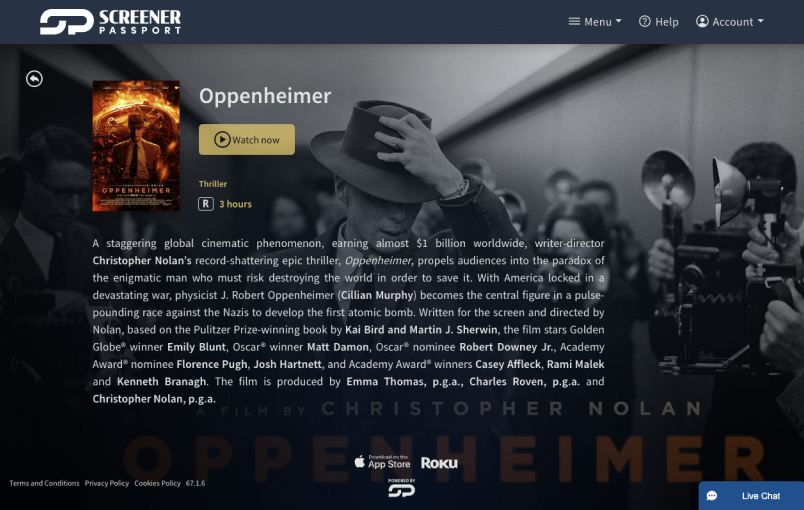
Today the offer has three main names. VMXStream handles secure screening for publicity, distribution, and other industry use. VMX Awards supports awards viewing and campaign workflows. VMXPromote handles targeted eBlast outreach. Screener Passport remains central to the company’s awards-screening identity.
The underlying sequence is practical. Upload the title and its metadata, prepare streaming versions, create a screening room, set access, and invite viewers. Vision Media advertises digital rights management, visible and forensic watermarking, protected viewing windows, and reporting. These controls address different parts of the handoff. Permission governs entry; watermarking adds a way to trace a viewing session.
the title
access
viewers
activity
The customers include studios, distributors, independent producers, festivals, and guilds. The company displays Disney, Netflix, and Paramount among its studio logos. Film Independent and Cindependent provide testimonials. Vision Media reports streaming screeners in more than 135 countries, suggesting that the restricted guest list can still be geographically enormous.
“going digital with Vision Media really made us borderless in an amazing way.”Evan Ward-Henninger, Film Independent
Company-published testimonial
The price of reaching the right sofa
The published VMXStream ladder starts at $249 a month for Creator, followed by $499 for Distributor and $999 for Studio. The entry plan lists 40 videos and 200 screening-room invitations monthly. Custom enterprise arrangements are available. Those subscription figures should be read as streaming prices, rather than the entire cost of an awards campaign.
Outreach has its own economics. VMXPromote lists a $250 send fee for up to 2,000 emails, rising with volume; guild list fees are separate. The distinction matters. Hosting a film and getting a qualified person to notice it are different purchases. A budget needs room for both.
Vision Media occupies a specialist corner of business software. Indee and Screeners.com also offer protected screeners and watermarking. The comparison therefore extends beyond a security checkbox to guild relationships, campaign operations, device support, and the experience of the invited viewer. Buyers should test the whole route from invitation to playback.
Seventeen links can still be a pile
Digital delivery removes a package, but can leave a scavenger hunt. Screener Passport’s public website now helps visitors find awards titles and viewing destinations. Its own explanation separates that free discovery site from the film and television screening portals. Finding a title does not grant permission to watch it.
The AwardsWatch collaboration adds news and analysis to that discovery layer. Elsewhere, Vision Media has moved closer to the tools and screens people already use. Its September 2025 Avid Media Composer panel lets editors publish sequences into screening rooms. The May 2026 Fire TV launch brings invited viewers another television option, requiring compatible devices running Fire OS 7 or newer.
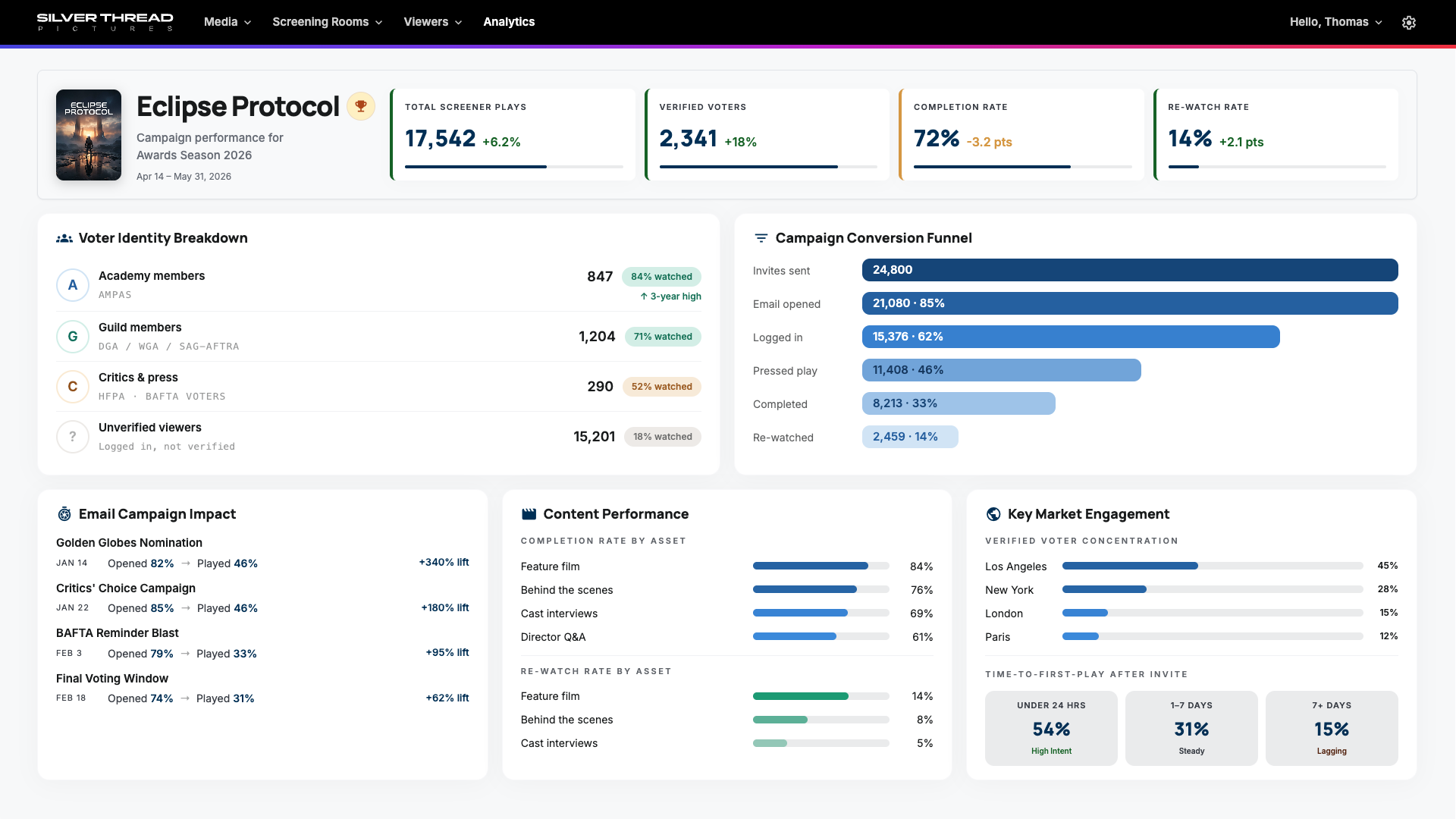
The GrayMatter partnership addresses another boundary: the gap between managing rights and delivering the corresponding content. In May 2026, Vision Media also previewed enhanced analytics, including invite-to-play conversion tracking. That is a telling measurement. An invitation is an opportunity; a playback is evidence that somebody crossed the threshold.
In August 2026, the company announced a published TPN self-assessment and Blue Shield status. The precise wording matters: a self-assessment describes documented security practices. It should not be read as a promise that content cannot leak.
The lesson for other businesses is to follow the customer’s task beyond the familiar delivery format. That approach suits a market where access must be selective and the recipient’s attention is scarce. A public video publisher seeking unrestricted reach has different priorities. Here, the useful accomplishment is wonderfully specific: the right person gets in, settles down, and watches.
Past the velvet rope
Explore Vision Media, current pricing, Screener Passport’s viewing guide, and company news.
Follow on LinkedIn, Instagram, and Facebook. Read about the physical-business sale, the Fordela acquisition, the Avid panel, and the TPN self-assessment.