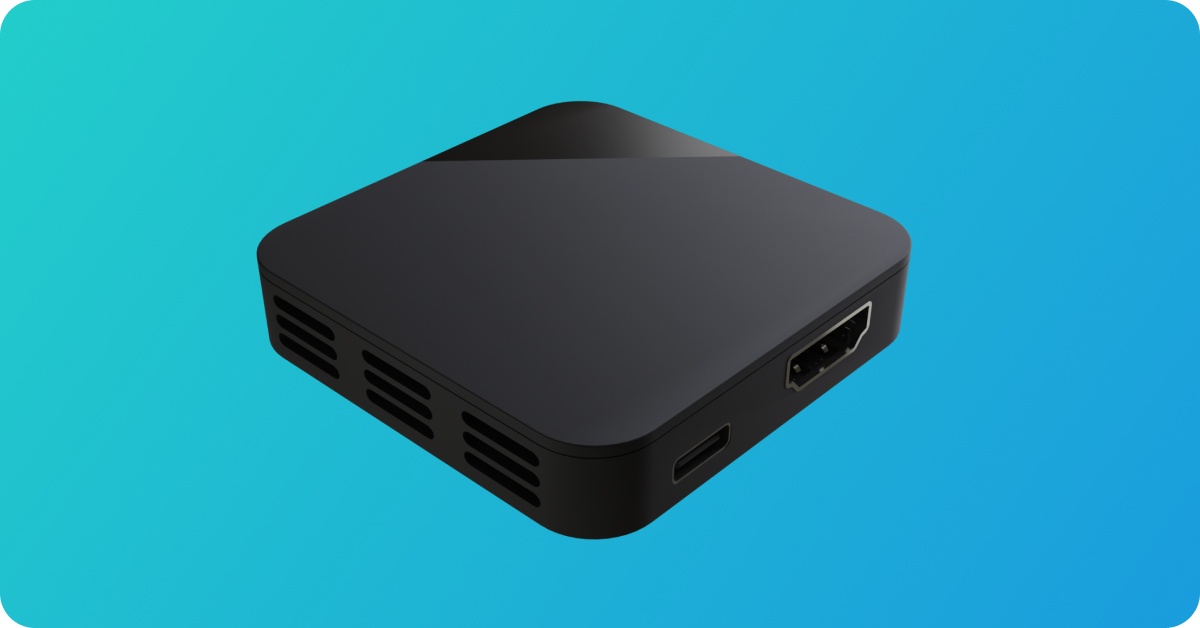
The little black box looks unambitious. There is an HDMI socket, some ventilation and very little to admire on the mantelpiece. That is rather the point. Synamedia's Senza Cloud Connector leaves the elaborate work of drawing a television interface to computers elsewhere. The device beside the screen can concentrate on playing video. For a business with roots in the set-top-box era, making the box less important is a revealing ambition.
It is also a useful introduction to a company most viewers will never knowingly buy from. Synamedia sells technology to the businesses that sell, package and protect television: pay-TV operators, telecom groups, broadcasters and streaming services. Its customers put their own brands in front of the audience. Synamedia handles parts of the machinery underneath.
That machinery changed ownership in July 2026. Lumine Group completed its acquisition of Synamedia's Video Network business, which now operates separately as Quortex. The remaining Synamedia is pursuing a more concentrated question: how can an established TV business persuade people to spend more time, and money, inside its service?
01A company born with customers
Synamedia opened for business in October 2018 after Permira funds acquired Cisco's Service Provider Video Software Solutions group. The transaction was reported at about $1 billion. This was a corporate carve-out with an installed customer base, rather than a venture-funded experiment looking for its first buyer.
At launch, Synamedia listed more than 200 pay-TV and media customers, including Comcast, Disney, Sky and Vodafone, and a portfolio of 590 patents. Those are historical launch figures. They explain the company's inheritance: long relationships, specialised engineering and systems that customers could not casually switch off.
Yves Padrines was its incoming chief executive; former NDS boss Abe Peled became chairman. Sky took a minority stake in January 2019, joining majority shareholder Permira funds. The customer was also an investor, a fairly direct vote for keeping the technology supplier close.
Acquisitions subsequently expanded the toolkit. Quortex brought demand-driven live-stream processing in 2022. But building a broader portfolio was not the final destination. Eight years after emerging from one corporate separation, Synamedia undertook another.
02The pipes leave. The screen stays.
The July sale is the dividing line for understanding Synamedia today. Encoding, distribution and delivery products associated with the former Video Network division belong in the Quortex story under Lumine. Synamedia's retained strategy centres on Go, Senza, Iris, ContentArmor and Gravity: streaming experiences, interfaces, advertising, security and broadband management.
The change in emphasis was explicit. In its June strategy announcement, management pointed to audiences discovering and consuming video through mobile and social experiences. The commercial problem had moved beyond getting a reliable picture onto a screen. Operators also needed reasons for people to choose that screen, return to it and buy something through it.
On July 1, Dr Tzvi Gerstl became chief executive, while Paul Segre moved to executive chairman. Gerstl's brief brings streaming, advertising, security and audience engagement together. That is an operating strategy, not evidence that viewers have already returned.
Go · Senza · Iris
ContentArmor · Gravity
Video Network business
Now operating as Quortex
“grow audiences, create new revenue streams, and reduce complexity.”
TZVI GERSTL · CEO · JULY 2026
03A TV menu with a cloud bill
Senza makes the strategy tangible. A browser in the cloud runs the web application and sends the rendered interface to the screen. Developers can use familiar web tools; the viewing experience is less tied to the processing power of a box installed years earlier.
Synamedia advertises Cloud Connector hardware components costing as little as $6, depending on territory, volume and other factors. Read that noun carefully: components. It is not a complete retail offer, installation budget or lifetime service bill. Senza uses a pay-as-you-go SaaS model and says it takes no share of subscription or advertising revenue.
The developer documentation makes the running cost more interesting. Foreground mode consumes cloud-browser resources and is billed by the minute. Background mode can stream the programme directly to the device without that Senza usage charge. A viewer browsing menus and a viewer watching a film therefore create different platform usage patterns.
That suggests a practical design discipline: measure how long the cloud browser actually needs to be awake. The streaming tutorial demonstrates switching between the two modes. The commercial calculation still includes content delivery and the rest of the service; a sleeping browser does not make television free.
Senza Ignite, announced in April 2026, extends the idea to existing connected devices through a firmware update while retaining native apps and broadcast functions. Its appeal is avoiding wholesale hardware replacement. Its suitability depends on the deployed device and network: an interface rendered remotely still needs a dependable path back to the viewer.
One hour. Two modes.
Move the slider to split an illustrative hour between cloud-browser activity and direct video playback.
04The next episode starts with a short clip
Go supplies the streaming platform around the experience. It supports live, linear and on-demand viewing, subscription and advertising models, content management and personalisation. Its modular design also connects to partners for applications, billing and subscriber management. An operator can assemble a branded service without writing every component itself.
GO Shorts, launched in April 2026, borrows a familiar mobile habit. It uses AI to surface personalised clips from an operator's existing library and provides a single-tap transition into longer content. The intended prize is discovery: make a catalog feel browsable before asking someone to commit to a whole programme.
There is a sensible hypothesis here, but a clip view is not a retained subscriber. An operator copying the approach should track the journey from short video to long-form viewing, then to repeat visits or payment. A busy feed that never sends anyone into the paid catalog would be activity without the intended commercial result.
MTN offers a concrete customer context. In April 2025, the telecom group announced a Synamedia partnership to develop a platform for mobile and fixed-broadband subscribers across Africa. The plan combined linear TV and on-demand content with subscriptions, advertising and free channels, adapted to local languages and viewing habits. Local relevance was part of the proposition from the start.
05Two households. One show. Different ads.
Iris addresses the money between programmes. Its cloud services manage targeted advertising across broadcast and streaming, bringing campaigns, audiences, inventory and reporting into a common system. The distinction matters to an operator that still has satellite or cable viewers alongside app users.
Astro's December 2021 announcement gives the idea an everyday shape: households watching the same programme could receive different advertisements based on information such as location and demographics. Advertisers could buy a campaign spanning live, streaming and catch-up viewing. The TV schedule stayed shared; the commercial break became more specific.
Synamedia also sells Iris in pieces. An operator can introduce ad routing or server-side ad insertion into existing infrastructure, instead of replacing its entire advertising system. The company's own product discussion acknowledges why: an existing system may already generate revenue, making replacement a risk that buyers would rather avoid.
That is one of the more useful lessons in the portfolio. Sell an improvement that has a measurable job. Better targeting still depends on usable audience information, advertiser demand and the ability to sell the inventory. Ad technology cannot manufacture those commercial ingredients simply by being installed.
06The leak can begin after the lock works
Security remains part of Synamedia's identity. Encryption and digital rights management control access to a stream. ContentArmor's forensic watermarking addresses a different problem: tracing a leak after content has reached an authorised recipient and been redistributed.
In May 2026, ContentArmor explained its move toward watermark insertion at the CDN edge, closer to delivery. Earlier edge infrastructure lacked the necessary computing capability, and watermarking methods depended on access to unencrypted streams. Advances in processing and distribution architecture changed what could be deployed where.
Here is a specific answer to what stopped working first: access control alone does not settle the problem of a legitimate recipient copying the output. Watermarking helps identify the source; the operator still needs a response process. Detection that arrives after a live event has finished has a different value from intervention while viewers are still watching.
Gravity addresses a less cinematic headache: managing broadband devices across mixed networks and manufacturers. Synamedia's account of Wyandotte Municipal Services describes moving away from proprietary systems and simplifying management during a fibre transition, with roughly 40 percent better operational efficiency. That is a customer-specific reported result, not a forecast for every deployment.

07The audience might be on a ship
The British Forces Broadcasting Service selected Synamedia following an international tender launched in February 2025. Their three-year partnership began in April 2026. The planned platform, working title The Hub, will consolidate services and introduce personalised access and new content formats for service personnel and their families.
The locations make the brief distinctive: ships, bases and remote postings. BFBS plans a phased launch. This is a transformation programme whose delivery matters more than the neatness of a product demonstration. It gives Synamedia a customer that needs broadcast experience and secure digital services to coexist.
That combination helps explain its place in the market. Kaltura offers competing cloud-TV and AI-assisted discovery capabilities; Irdeto supplies video-security alternatives. Buyers compare individual functions as well as full systems. Synamedia's argument is the combination of those functions with people who know how to integrate and operate them.
The service work includes scoping, integration, testing, training and ongoing support. Its careers material describes openness, inclusiveness and accountability; a 2025 Senza hackathon supplies a livelier detail, with projects including a crowd-judged breakdance app and a watch-party experience. The technical culture has room for both operational discipline and experiments in what a television might do.
For a prospective customer, the useful first move is a bounded trial: one device cohort, one content journey or one advertising workflow, with an agreed cost and outcome. Synamedia's own Senza sample apps make that starting point unusually concrete. The remaining challenge is the one no supplier can pre-install: giving the audience a reason to stay.
Keep watching
Explore the products, try the developer examples or follow the company’s next moves.