In 2013, Stefano Colonna was new to sales. Xenon arc was young, too. Years later, looking back on his time there, he remembered a company of roughly 30 people and a consequential vote of confidence from Chad Steigers and Adeline Honnas. They had taken a chance on him. The memory gives Steigers’s business career a useful human scale: before a commercial model can work, somebody has to trust the people who will make it happen.
Steigers is a co-founder and former chief executive of Xenon arc, the Bellevue business established in 2010 to help industrial producers reach smaller customers. His working territory has included specialty chemicals, technical sales, digital tools and distribution. These are subjects that rarely arrive wearing sequins. They do, however, explain how a considerable amount of the world’s business gets done.
A smaller order can carry a surprisingly large administrative life. It still needs product knowledge, a response, a transaction and delivery. Across his years at ChemPoint and then Xenon arc, Steigers worked on ways of organizing those relationships. The recurring question was wonderfully unglamorous: how should a large manufacturer pay proper attention to a customer who buys a little?
A chemical engineer meets the customer list
Steigers graduated from Washington State University with a bachelor of science in chemical engineering in 1982. The qualification places his professional beginnings in the materials themselves. His later public record follows the journey between those materials and the people buying them: which customer needs which product, in what quantity, with what technical assistance.
By 2003, he was managing director of ChemPoint.com. That March, Dow announced ChemPoint as its North American distributor for UCON fluids and lubricants, effective from January. Customers could order by telephone, fax, email or online. The fax is a useful period detail. Digital commerce was being introduced into a world that still expected several different ways to place the same order.
The arrangement included technical help for buyers purchasing less than a truckload. In that small phrase sits much of Steigers’s subsequent career. A producer’s scale and a customer’s requirements do not always match neatly. ChemPoint’s role combined the commercial transaction with assistance in selecting and using the material. The order book and the technical conversation belonged together.
Small quantities, substantial responsibilities
The partnerships accumulated. In September 2003, ChemPoint became Dow’s exclusive North American e-distributor for its glutaraldehyde-based biocide products. Dow’s Jerry Konst highlighted application information captured in ChemPoint’s customer relationship system and the work of its technically trained staff. Selling through a screen still involved knowing what somebody intended to do with the product.
In July 2004, BASF appointed ChemPoint its exclusive United States distributor for acrylic monomers in less-than-truckload quantities. Acrylic monomers are building blocks for a range of materials; the commercial assignment concerned the customers who needed smaller volumes. Steigers was again the managing director explaining a partnership built around that segment.
That September brought a Chevron Phillips Chemical agreement covering high-purity packaged solvents. ChemPoint would handle marketing, technical sales and order fulfillment for a group of North American package customers. The manufacturer’s sales manager, Marc Nagele, pointed to the ability to serve a large number of accounts. There was a recognizable division of labor: manufacturing strength at one end, focused customer service at the other.
The specificity matters. A biography can make a career sound like a succession of titles. Here, the product announcements reveal a succession of practical assignments. Fluids, monomers and solvents had different applications. Across them, Steigers’s work kept returning to the organization of technical knowledge, customer access and the smaller transaction.
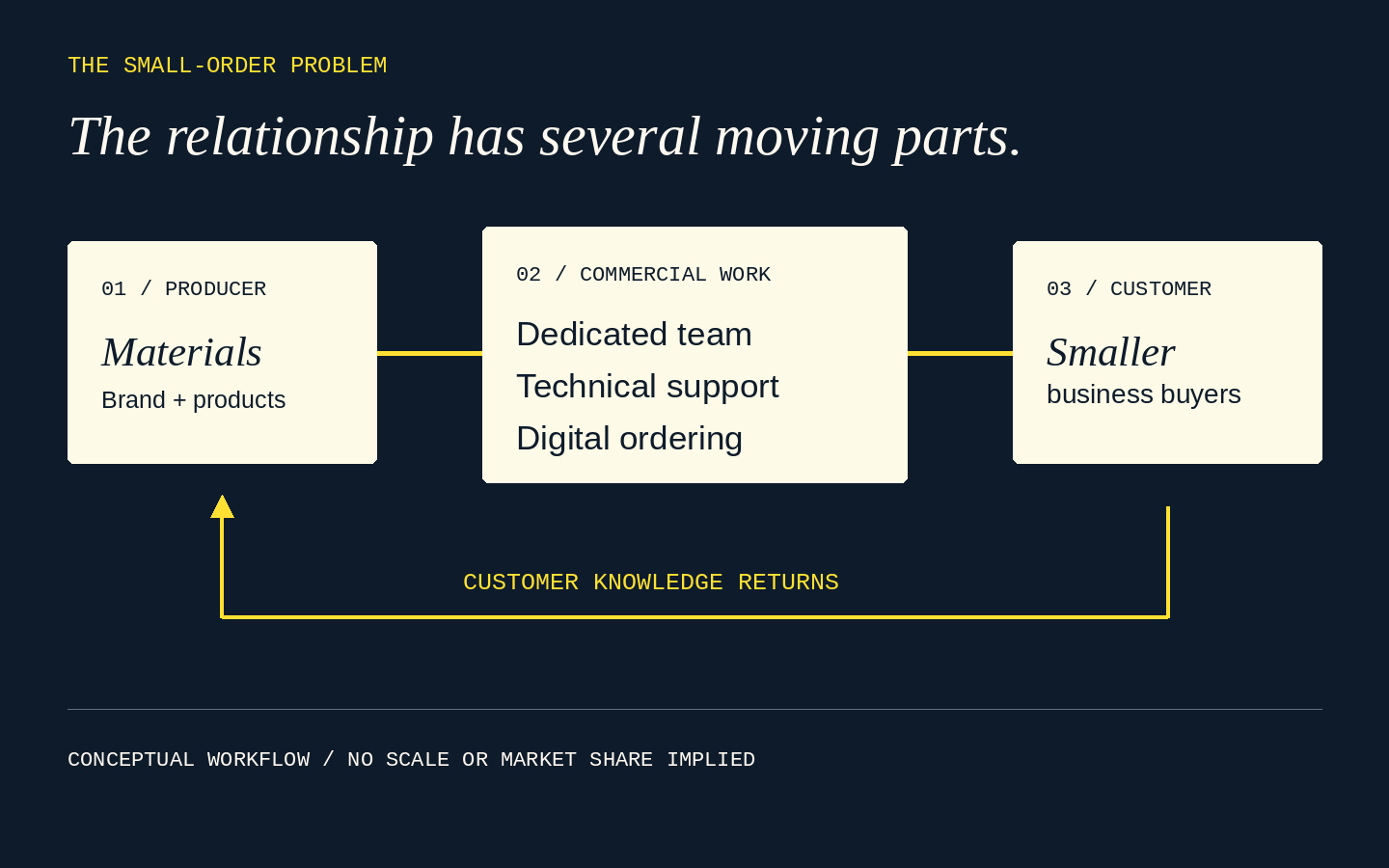
Technical support
Digital ordering
↩ Customer knowledge returns
The information travels back
By May 2005, the Chevron Phillips relationship had extended to packaged reference fuels in the United States. ChemPoint’s assignment included marketing, technical sales, customer service and fulfillment. Bulk orders would remain with the producer’s usual sales operation. The distinction was explicit, and it gave the outsourced partner a defined piece of the business to run.
That division makes the business easier to picture. The bulk customer and the package customer buy from the same product family, but reach it through different commercial arrangements. One group remains with the producer’s normal sales operation; another gets the combined marketing and service assignment. Organizing the boundary is part of the work. It determines who answers, who follows up and where the customer information goes. The elegance of the idea lies in how closely it attends to a rather ordinary piece of business: the next order.
Reference fuels are used to check fuel performance. The transaction therefore involved more than putting an available substance in front of an available buyer. Technical purpose mattered. So did the information produced by the relationship. Steigers described ChemPoint as supplying “solid and highly usable data.” That modest phrase deserves a place beside the products: the customer’s experience could tell the supplier something useful.
In February 2007, Chevron Phillips named ChemPoint a source for selected reference-fuel products across 60 countries in Europe, Africa and the Middle East. Steigers was now identified as ChemPoint’s president. A model concerned with fragmented demand had acquired a wider geography. The work involved reaching customers spread across borders while continuing to provide technical support and service.
Territory covered by the announced Chevron Phillips reference-fuels appointment in Europe, Africa and the Middle East.
An incubator, four founders, a new company
Xenon arc began in September 2010. Its founding executive team brought together Steigers, Honnas, Edward Lux and Chris Jardine, with experience across manufacturing, distribution, technology and consulting. There is a pleasingly practical balance in that list. A company working between producers and customers would need to understand several businesses at once.
In December, it announced $15 million in initial financing from Weston Presidio. The team was working from incubator space in Bellevue and finalizing a lease for its first headquarters. The intended uses were concrete: bring the initial offering to market, recruit people and expand the client roster internationally. Even a digitally enabled business needed somewhere to put the desks.
Sean Honey, Josh McDowell and David Ferguson were to join the board in connection with the investment. The new venture also participated in Microsoft’s BizSpark program. Steigers’s next chapter thus began with a mixture of industrial experience, software development and outside capital. Xenon arc’s proposed work was to make customer-facing business processes more effective for industrial producers.
The customer keeps the producer’s name
Xenon arc developed dedicated commercial teams and technology configured for individual manufacturers. Those teams operated under private-label branding. The producer could extend its reach into small and midsized accounts through a service organized around its own identity, with customer information flowing back into the relationship.
This is where the commercial mechanics become interesting. A manufacturer wants customers to recognize its products and understand their uses. A smaller buyer wants a workable route to purchasing and support. Xenon arc’s arrangement put people and digital processes into that space between the two. The company’s own name could stay out of the customer-facing spotlight while its staff did the work.
Its current offering continues to describe product and application expertise, inside and field sales, digital customer experiences and the management of accounts outside a producer’s strategic core. Those services make the underlying problem tangible. Someone must answer the question, understand the application and see the order through. Software has plenty to do; so do people.
The balance sheet meets the warehouse
In September 2013, Xenon arc secured a $9 million asset-based lending facility from First Capital. It was a working-capital revolver backed by accounts receivable and inventory. Steigers, then the company’s president, said the arrangement could expand its existing facility and support further growth.
The collateral supplies a small corrective to the airy language that often surrounds technology businesses. Inventory and unpaid customer invoices are tangible demands on a company’s resources. A business helping industrial products reach their users needs a way to finance the activity. Growth has a physical and financial workload, however elegant the customer interface may look.
Colonna’s recollection places a different kind of investment in that same year. In his account, Steigers and Honnas backed him when he was beginning in sales. He also credited Lukasz Maltanski with mentoring him. It is one employee’s memory, with named people and a specific starting point. That makes it more revealing than a general declaration about valuing talent.
“Chad Steigers and Adeline Honnas bet on me.”
Stefano Colonna, recalling his first sales experience in 2013
A founder changes seats
In June 2019, Steigers moved from chief executive into a strategic advisory role, and Paul Warburg succeeded him. Warburg had joined as chief financial officer and become president and a board member in 2016. The succession followed an established colleague’s progression through the business.
Steigers’s announced interests beyond the CEO role included digitization and improving routes to market and manufacturing operations. Reflecting on Xenon arc, he singled out “its differentiated corporate culture.” The phrase sits neatly beside Colonna’s later recollection of being given an opportunity.
Alyssa Cunnington offered another view in a July 2025 farewell after nearly 14 years at Xenon arc. She thanked Steigers and the founding team for bringing the original idea into existence and inviting her in early. Her account connected the company’s development with the people who had worked on it from its beginnings.
Steigers’s career can be followed through named products, territories, financing arrangements and a leadership handover. These memories add the colleagues. Together, they give his story its proportions: chemical engineering, years spent organizing the smaller sale, and a company built to give that sale sustained attention. Even the little order needs somebody willing to take it seriously.
Follow the working trail
- Chad Steigers on LinkedIn
- Xenon arc: website and approach
- Washington State University: 1982 graduation record
- 2003: the Dow UCON agreement
- 2003: Dow expands the partnership
- 2004: the BASF appointment
- 2004: Chevron Phillips packaged solvents
- 2005: reference fuels and customer data
- 2007: the 60-country appointment
- 2010: Xenon arc’s founding financing
- 2013: working-capital facility
- 2019: the leadership handover
- Alyssa Cunnington’s recollection
- Stefano Colonna’s recollection