The safe was supposed to survive the fire. That was, after all, rather the point of a fireproof safe. But when Network Computing Architects finally reached the documents inside, they had become ash. There is a useful company story here, although it begins with an object that performed considerably worse than its name suggested.
- NCA connects business networks, phone systems and security - and handles the work of making them cooperate.
- Its customer cases make the proposition tangible: shorter backups, shared customer information and fewer callbacks.
- ISSQUARED acquired NCA in 2019, adding its carrier services and regional relationships.
The safe had a deadline
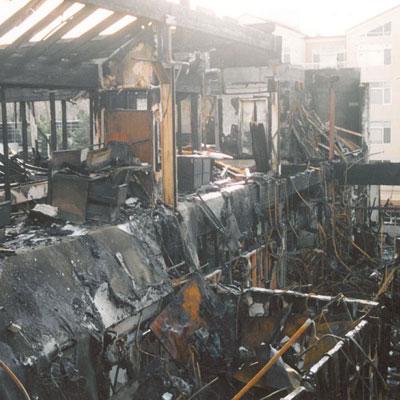
On December 17, 2001, a fire destroyed the Main Street building housing NCA and several other Bellevue businesses. The building had passed an inspection the previous week. It nevertheless lacked sprinklers and a fire alarm under the standards to which it had been built. The local history of the blaze describes the uncomfortable distance between meeting a standard and surviving a particular event.
NCA's data had been backed up through its other offices. The documents in the safe faced a different calculation: its protection was rated for a limited period, while the fire took days to extinguish completely. “By the time we got into [the safe], everything was ash,” CEO Tom Gobeille recalled in his account of the disaster. He also said every employee returned after relocation and rebuilding, and no customer was lost.
The recovery had a less photogenic obstacle. NCA's controller was on maternity leave; the other employees could not take over the finances. Gobeille called CFO Selections, which assembled outside financial help. In the reported recovery story, that intervention freed him to concentrate on customers and employees.
A reader can copy the question this raises: who performs the essential work when the usual person, building or machine is unavailable? Draw the answer before buying another protective device. A diagram of servers will miss the sole employee who knows how to pay the bills.
The customer who could not wait for Tuesday
For a compact demonstration of NCA's business, consider Shoreline Communications. In 2003, the phone-system developer bought StoneFly storage through NCA. Its existing backups could begin on Friday evening and still be running on Tuesday afternoon, interfering with engineers' work. Storage capacity was becoming a constraint, too.
The historical customer case records a roughly $30,000 IP storage-area-network solution with 2.2 terabytes of capacity. Alternatives under consideration cost $80,000-$100,000 for 750 gigabytes. Those are period-specific configurations, rather than interchangeable systems or a price list for today.
Shoreline's team migrated less critical servers first, followed by file and print services for 85 users. The case reports a 75 percent reduction in the backup window. NCA was the reseller; StoneFly supplied the platform, and Shoreline's own team did the migration work described. Keeping those roles distinct makes the example more useful.
The lesson is to test the bottleneck against the workload. A larger purchase alone might leave the same awkward backup routine intact. A staged move also gives the customer a chance to learn before putting the busiest systems at risk.
The seafood business and the callback
Aqua Star's difficulty was easier to hear. A salesperson needed inventory information, but could not retrieve it while speaking to the customer. The conversation ended, queries followed, and somebody called back. Each office had its own phone system and customer information. Buying customer-management software had not, by itself, made the information convenient to use.
NCA chief architect Wayne Bayley proposed common Cisco communications infrastructure. A demonstration arranged by CTO Don Flynn showed CIO Hugh Holman a portal resembling the desktop he had sketched for his salespeople. Shared telephony and integrated inventory and customer data let staff answer more questions during the call. Cisco's 2008 case study reports order processing falling from days to minutes.
This is a particularly good way to judge an integrator. Ask it to name the handoff it will remove. The change might involve switches, wireless access, telephone software and a portal; the customer experiences it as an answer that arrives sooner.
Selling the work between the boxes
NCA occupies the middle of the business technology market: between equipment and software manufacturers and the organizations trying to use their products. Its listed specialties include carrier and IP services, managed services, information security, unified communications, network installation, training and virtual chief information security officer services. The range gives it several ways into the same customer's operational problems.
The model combines technology resale and implementation with consulting and continuing services. An internal IT department can be an alternative, a collaborator or the buyer. A regional managed service provider or specialist security consultancy may compete for part of the same brief. The sensible comparison concerns who understands the particular environment and who remains responsible after installation.
“Be an extension of the vendor's sales force and their technical engineers.”Tom Gobeille, on choosing and working with vendor partners
That description of partnership makes NCA's expertise fairly concrete: understand the product well enough to represent it to the customer. In a separate account of RSA's direction, Gobeille pointed to four engineers certified in enVision security information and event management. The investment was in people able to deliver systems around compliance and risk.
By 2017, NCA's Digital Shadows partnership extended that reasoning to data leakage and digital risk beyond the customer's perimeter. The company was moving toward a broader view of business risk. That explains the change more precisely than a fashionable new product category would.
There was also a formal assurance mechanism. NCA achieved ISO 27001 certification in December 2007. Its 2019 acquisition announcement reported the 2013 version, with a scope covering client confidential information in its Professional Services Practice. A buyer should read that scope carefully: the boundaries tell you what the certification actually addresses.
A telephone system moves into the cloud
In March 2016, NCA selected GENBAND's Nuvia platform for UCFlex, its cloud communications offering. Voice, video, messaging and collaboration came together with multi-site management. The announcement also highlighted support for legacy Nortel IP phones, an appealing detail for organizations hoping to preserve existing equipment.
The distinction matters to an IT manager staring at a cupboard of perfectly serviceable handsets. Migration can involve retaining useful investments while changing how the service is delivered. Compatibility and support need checking against the actual devices and requirements; a historical announcement is no substitute for that assessment.
ISSQUARED acquired NCA in 2019. The deal announcement connected NCA's networking, security and carrier expertise with the parent's cloud and software offerings, including ORSUS. The combined business was described as serving more than 1,000 customers. Financial terms were undisclosed. In 2024, ISSQUARED again identified NCA as an earlier acquisition when it added CCT Technologies.
The photograph with the quietest subject
One customer-adjacent episode takes the story out of the office. In 2011, NCA donated networking equipment to Project Medishare for the CT imaging network at Hospital Bernard Mevs in Port-au-Prince, Haiti. The organization valued the goods at $20,000-$25,000.

The donation account gives a useful picture of infrastructure's place in the world: the clinical equipment depends on another layer of equipment, which rarely attracts the same attention. NCA's contribution supplied part of that supporting layer.
What the buyer should borrow
Three habits recur in these examples. Map dependencies, including people and paper. Define the business task before selecting the hardware. Move in stages when a change could interrupt work. These are editorial lessons from particular cases, rather than a promise that every NCA engagement produces the same result.
The approach makes sense when a business has systems that need to cooperate and a reason to pay for expertise between them. A company with simple requirements and sufficient internal skills may need a narrower supplier relationship. Integration also needs clear ownership: somebody must maintain the connections after the project team leaves. The fireproof safe is an excellent reminder to inspect the conditions attached to any comforting noun.