At AgWorks, an agricultural software company, the future arrived with a fairly awkward requirement: the old program had to come along. Its customers handled fertilizer and crop-protection operations. The software supported millions of transactions. Moving from the desktop to the cloud could not mean asking everyone to forget how the business worked.
- Mobilize.Net translated legacy application and database code for newer platforms.
- Its customers wanted to preserve business logic while escaping aging technology.
- In 2023, GAP bought the application business; Snowflake bought the remaining data business.
The farm software that needed to leave the office
AgWorks had 137,000 lines of Visual Basic 6 code and customers at more than 450 locations across 27 states, according to the published case study. It needed an Azure-ready application that could serve people beyond a desktop. That is a particular kind of software problem. The existing system is valuable enough that replacing it becomes frightening.
Mobilize.Net offered automated migration and a fixed-price engagement with a guaranteed delivery date. The case study says it met that date. In a 2016 announcement, AgWorks CEO Greg Duhachek said the technology halved costs. The exact project fee remains outside that comparison; the useful number is a customer’s reported saving, rather than a universal price promise.
For a technology buyer, this changes the question. Instead of asking how quickly a team can create a new application, ask how much existing behavior the team would have to rediscover. An obscure exception in agricultural software may be there because somebody once lost money without it.
The translator’s inheritance
Mobilize.Net launched in June 2012 with technology licensed from ArtinSoft. Tom Button, its president and CEO, had led Microsoft’s developer-tools division. The founding executive team included former Microsoft business-development director DeeDee Walsh, ArtinSoft executive Roberto Leiton and ArtinSoft founder Carlos Araya as chief scientist. This was a new company with considerable inherited experience.
Its expertise was source-code analysis and transformation. Visual Basic Upgrade Companion, or VBUC, moved VB6 applications toward .NET. WebMAP addressed the more disruptive trip from desktop software into web architecture. Those are related jobs, but a browser introduces a physical separation between interface and server that a desktop programmer cannot simply wish away.
WebMAP generated application code and supplied supporting components to manage the transition. Its documentation describes messaging, state tracking and desktop compatibility services. The practical promise was to carry established behavior into an architecture developers could then extend. Teams could add features after migration, rather than specify every old feature again before starting.
- 01AssessInventory code
- 02TranslatePreserve behavior
- 03RepairResolve exceptions
- 04TestVerify the result
Even the interface involved choices about what to build. Mobilize.Net used Progress’s Kendo UI components to reproduce complex desktop interfaces in browsers. Progress’s customer account attributes a 90% reduction in core-product development time and nearly $500,000 in labor savings to that decision. Those figures describe Mobilize.Net’s own development effort, not every customer migration.
A database has a memory, too
The same difficulty appears inside a database. Records are only part of what must move. Stored procedures, scripts and platform-specific instructions contain behavior that also needs a destination. A migration that transports the tables but abandons those instructions leaves developers with another translation project.
SnowConvert applied Mobilize.Net’s approach to that problem. Its 2020 Teradata assessment beta counted code and objects, estimated conversion coverage and identified instructions it could not convert. Oracle and SQL Server support followed. By January 2023, Snowflake said SnowConvert had converted more than 1.5 billion lines of code. That measures processing scale, rather than proving that every resulting system was production-ready.
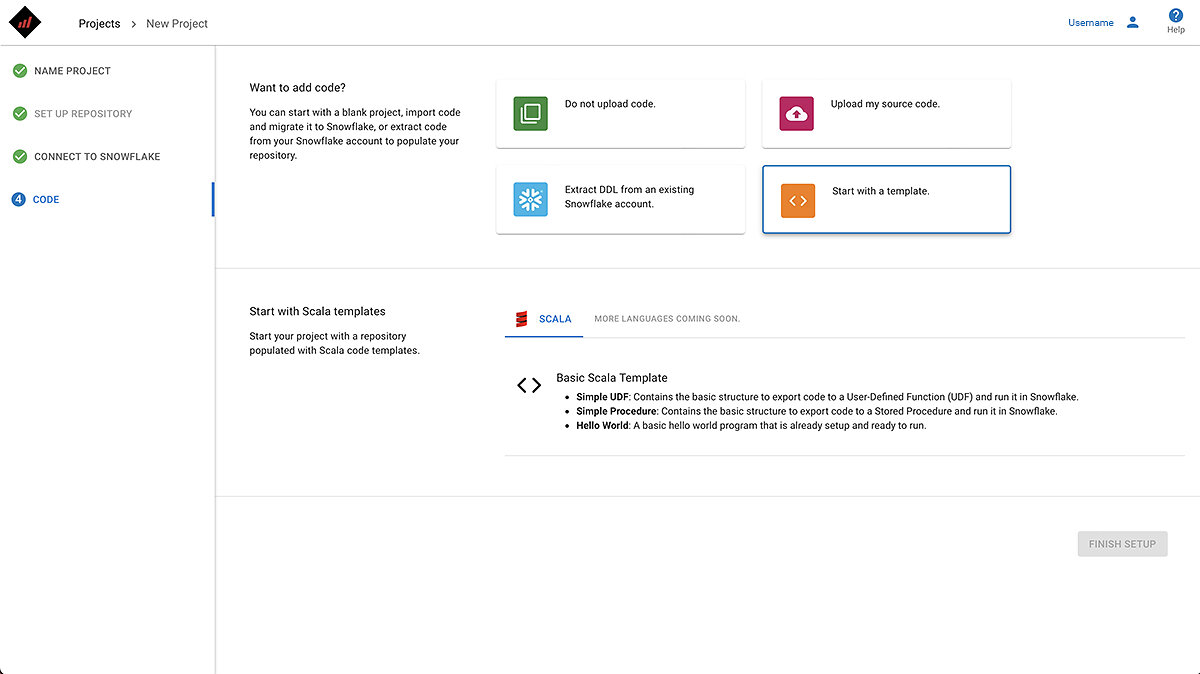
BlackDiamond Studio, announced in June 2022, extended the relationship beyond moving code. It brought together Snowflake-oriented VS Code extensions, Git integration, test generation and development tools for several languages. A limited free preview introduced the product. The commercial logic was easy to follow: after helping developers arrive on Snowflake, give them somewhere useful to work.
One engine, two destinations
Then the company itself was separated. GAP acquired the application migration business, including WebMAP, VBUC and the Mobilize.Net brand. Snowflake completed its acquisition of the remaining company on February 10, 2023, taking the data products and associated engineering teams.
“These business units grew from a common technical foundation, but now serve very different customers and market needs.”
Tom Button · February 2023
The distinction explains the outcome better than a single acquisition headline. An application owner needs a modernization partner. A data-platform company has a direct interest in removing obstacles that keep workloads elsewhere. The same translation expertise had become useful to two different businesses.
Application codeWebMAP + VBUC→ GAP
Data workloadsSnowConvert + BlackDiamond Studio→ Snowflake
Snowflake’s fiscal 2024 annual report records $76.3 million in cash consideration for Mountain US Corporation, formerly Mobilize.Net Corporation. An earlier filing described approximately $67 million net of acquired cash. Neither figure prices GAP’s separate transaction. For customers, the immediate consequence was that the two product families now belonged to different owners.
The useful part is the repair list
Mobilize.Net sold licenses and specialist engineering work. WebMAP documentation describes trials and licenses governed by time or code volume. Buying the tool still required a team capable of understanding the output. Its own product walkthrough explicitly leaves room for fixes, compilation and debugging after automated conversion.
The starting conditions matter just as much. The documented WinForms converter required accessible, compiling C# source and its dependencies; that edition excluded VB.NET projects and required COM references to be replaced with interop libraries. Missing build inputs could stop progress before translation even began. Broader product-family claims never erase an individual converter’s requirements.
There is a useful purchasing habit here: assess a representative application, inspect the exceptions and budget for verification. If the business wants fundamentally different behavior, preserving the existing logic may offer less value. Mobilize.Net’s particular insight was that plenty of businesses wanted a new destination for software whose accumulated knowledge they still needed.