An early Buildout employee made a serious mistake in front of a customer. Vishu Ramanathan remembered the decision that followed. He could get angry. He could also consider what that anger would teach everyone else. The office had cold brew, but even a very good beverage had limited powers of reconciliation. If people learned to conceal their mistakes, the company would have purchased a rather expensive silence.
Ramanathan, Buildout’s co-founder and former CEO, had arrived at a practical definition of culture: what happens when something goes wrong. The same question runs through his career as a software developer. When a customer struggles, do you explain the customer’s shortcomings, or reconsider what you built? His answer helped turn a small Chicago operation into a business serving commercial real estate brokerages across North America.
The keyboard shortcut came before the brokerage
There is a useful glimpse of Ramanathan before the conference panels and investment announcements. In November 2009, he introduced thinklinkr, a collaborative online outliner, to a forum of people who cared deeply about outlining. This was an audience with opinions about columns. They were willing to share them.
Users questioned missing features, browser compatibility and the feedback process itself. Ramanathan answered the complaints in detail, acknowledged the omissions and explained the compromises behind an early release. He called himself “a keyboard shortcut kind of person”. A request to move items up and down the outline became a development priority; later that month, he returned to say the shortcut had shipped.
The exchange makes a modest but revealing introduction. Here was a programmer prepared to have the product discussed in public, including its awkward bits. The customer’s objection could become the next thing he worked on. Nobody needed a conference badge to join the conversation.
His technical background included a decade at Business Logic, later known as NextCapital, and independent development work involving finance, logistics and trade regulation. He had worked with complicated business problems before commercial property became his focus. His education also included the University of Illinois Urbana-Champaign, which he attended from 1993 to 1997.
A hundred dollars buys a better question
With fellow developer Jason Tillery, Ramanathan found a particularly instructive job in Chicago: doing a broker’s marketing for $100 a month. The pair prepared brochures, filled out emails and maintained the website themselves. They learned the process before automating it. A brokerage had supplied both a customer and a curriculum.
Look at the ordinary mechanics of that work. A property needs facts, photographs and a persuasive presentation. Those ingredients must appear in several places, with the brokerage’s identity intact. A brochure, an email and a listing page may describe the same building, but somebody has to make them agree. Every new output offers another opportunity for repetition.
Buildout’s answer developed around that repetition. Put the property information into a system, then use it to generate branded materials, websites and campaigns. The software eventually reached into listing distribution and lead collection. The ambition was grounded in a specific working day: give brokers more room for relationships, and let marketers spend more time deciding how to market.
documentsProperty
websiteEmail
campaigns
The founders had chosen a task they could perform, inspect and improve. That gave them something more useful than an abstract opinion about an industry: familiarity with the work someone was already paying to have done.
The broker was paying attention
Commercial real estate acquired a convenient reputation for resisting technology. Ramanathan repeatedly questioned it. A broker whose income depends on getting business done has a reason to examine useful tools. Developers, meanwhile, have a reason to blame a reluctant market when their software goes unused. His arguments put more responsibility back on the people making the tools.
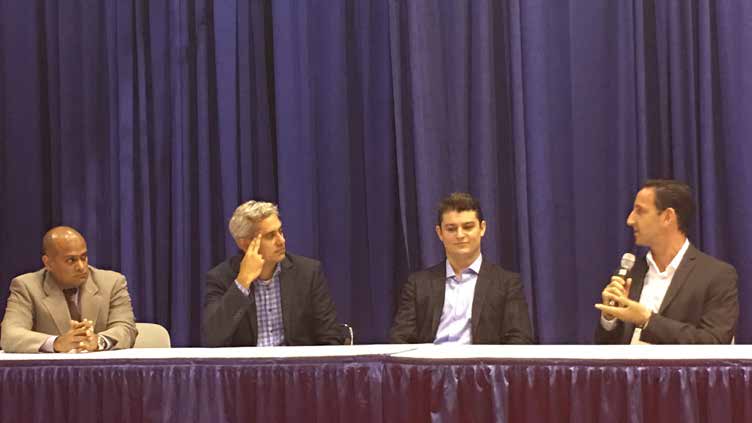
At the CBC Global Conference, where he appeared with ClientLook’s Michael Griffin and Ten-X’s Dan Colachicco on a panel moderated by Michael Beckerman, his advice to aspiring industry technologists was direct: work with brokers and take their problems seriously. A plausible idea still has to survive the customer’s working day.
His public thinking also extended beyond documents. Speaking at Propmodo Live in New York, he considered how connected buildings, ridesharing and artificial intelligence might change the business of property. One office example was delightfully unglamorous: getting the temperature changed required a work order after the manual thermostat control disappeared. An intelligent building could still make its occupants fill something out.
He treated automation as a way to return attention to the human work of business. Software might take over administrative tasks; trust and relationships would remain consequential. That emphasis helps explain why he could discuss emerging technology without treating the broker as an obsolete accessory.
The one percent worth building
Ramanathan had another argument about where a developer’s attention belonged. In 2016, he described his startup’s technology as overwhelmingly open source, with a small portion of custom development. He put the proportions at 99 percent and 1 percent. The point was allocation: existing software handled foundations so the team could concentrate on the part specific to its customers.
It is an unusually economical description of technical ambition. Operating systems, databases and web infrastructure had already absorbed enormous effort from other developers. Rebuilding them would consume time that could go toward a brokerage’s particular problem. Distinction could live in the last, narrow piece of the system.
“the 1 percent that makes us different”
Vishu Ramanathan, on open source, 2016
As commercial real estate software multiplied, he became attentive to the gaps between products. In an interview accompanying the 2018 DNA of CRE reports, he distinguished moving information between applications from creating an experience that actually felt coherent. Data could travel while the person using it still had to negotiate an obstacle course.
He also recognized the structure of the customer’s business. A brokerage could choose software, but independent brokers still needed reasons to use it. Adoption depended on usefulness at more than one level. A purchase decision at the top of a company would not automatically produce a habit everywhere else.
A growing company, a familiar classroom
Ramanathan’s interest in the people around the software had an earlier home. He graduated from Near North Montessori in 1989 and later returned to its community as a parent. In 2016, he described building a company in language that owed as much to a classroom as to an engineering department.
“I’m building a company and it’s a very social thing to do.”
Vishu Ramanathan, 2016
He wanted people to feel comfortable, participate, take initiative and enjoy their work. He connected those ambitions to his Montessori experience, and described revisiting its lessons as both a father and a boss. A school’s idea of developing the whole child had become relevant to the whole adult at work.
Growth made that ambition concrete. By September 2018, Buildout’s team had passed 75 people. The company had appeared on the Inc. 5000 in consecutive years, at No. 576 in 2017 and No. 658 in 2018. Ramanathan also received the 2017 Real Estate Tech Award for Most Influential Real Estate Tech Thought Leader. Recognition arrived alongside a much less ceremonial task: keeping a larger group able to work together.
His explanation for choosing Susquehanna Growth Equity as an investment partner centered on the relationship, including its industry perspective and willingness to help grow the business. The investor mattered for what it could bring after the money arrived. That is consistent with a founder who kept describing companies as groups of people attempting difficult work.
Capital milestones during Ramanathan’s leadership.
The company moves on. So does the lesson.
In July 2020, Buildout announced an investment partnership with The Riverside Company. It reported more than 37,000 active users across North America. Ramanathan’s stated ambition was to make Buildout a trusted name in brokerage software, with new resources supporting its products and growth. The early marketing job had widened into a much larger responsibility.
Ramanathan and Tillery subsequently stepped down from their leadership roles following that investment. By 2022, Tillery had returned, and employees were discussing the challenge of maintaining honesty through transitions. Senior platform designer Alex Griffin remembered the founders’ informal approach as something that had encouraged people to speak plainly from the beginning.
That recollection gives the early customer mistake a longer shadow. Permission to speak up has to survive changes in staff, scale and leadership. It can become part of a company’s memory, but memory still needs practice. The work of making an organization candid continues after the people who first shaped it leave their posts.
In a 2021 leadership forum, Ramanathan supplied a joke suited to someone still recalibrating his own judgment: “I’ve grown my emotional intelligence from a 6…up to a 3.” Learning had enlarged his understanding of how much remained. For a developer who once returned to an outlining forum with a requested shortcut, it was a recognizable form of progress: hear something, revise the assessment, keep working.