A commercial real estate listing has a peculiar ability to multiply itself. The address goes into a broker’s notes, then a CRM, then a proposal, then an offering memorandum, then a property website, then several marketplaces, then a deal sheet, then an invoice. The building stays put. Its data gets a world tour.
Buildout built a business around stopping that tour. The Chicago software company wants one property record to travel through an entire brokerage: find the owner, nurture the relationship, win the listing, create the marketing, syndicate it, track the transaction, calculate the split and pay the broker. In March 2026, the company launched a unified CRM and declared that circuit complete.
This is less a story about adding another clever app than about removing the humans who have been forced to behave like integrations. Buildout says more than 50,000 brokers now use its products. The customer list shown on its site ranges from Coldwell Banker Commercial and NAI Global to Newmark, Lee & Associates, SVN and smaller shops. The same system must make sense to a rainmaker chasing an owner, a marketer polishing a brochure and a finance lead reconciling commissions.
First, the consumer ideas failed
Buildout’s origin is useful because it contains no garage mythology. Co-founders Vishu Ramanathan and Jason Tillery were software developers doing consulting work and trying to invent consumer products on the side. The consumer ideas kept failing. The business projects kept paying. Their response was gloriously practical: find a B2B problem people would reliably pay to remove.
They talked to people in bars and cafes about what made work annoying. Commercial real estate stood out. It was a giant, relationship-heavy industry running important processes with less capable software than the founders had seen in finance and logistics. They did not immediately build a dashboard. They made the emails, brochures, proposals, offering memorandums and listing pages themselves.
“Innovation comes from doing work.”Vishu Ramanathan, co-founder
That sentence is the Buildout playbook in miniature. Service work showed the founders where the repetition lived. Then software turned repetition into a product. Launched in 2010, the original platform let a brokerage enter listing information once and push it into brand-consistent documents, email campaigns, websites and third-party portals. The early promise was not intelligence. It was relief.
The product widened at the seams
Marketing automation solved one ugly stretch of the deal. It also exposed the awkward joins on either side. Before a brochure exists, a broker has to identify an owner, understand a property and manage a relationship. After the listing goes live, somebody has to capture leads, report activity, shepherd the transaction, issue invoices and calculate commissions. Every handoff was another chance to retype a number or lose the latest version.
The founders’ narrow wedge became a platform plan after two outside capital events. Susquehanna Growth Equity invested $8 million in 2017, when Buildout had roughly 30 employees and planned to more than double the team. The Riverside Company made an undisclosed private-equity investment in July 2020 and backed an acquisition run. Neither Buildout nor its investors published the purchase prices.
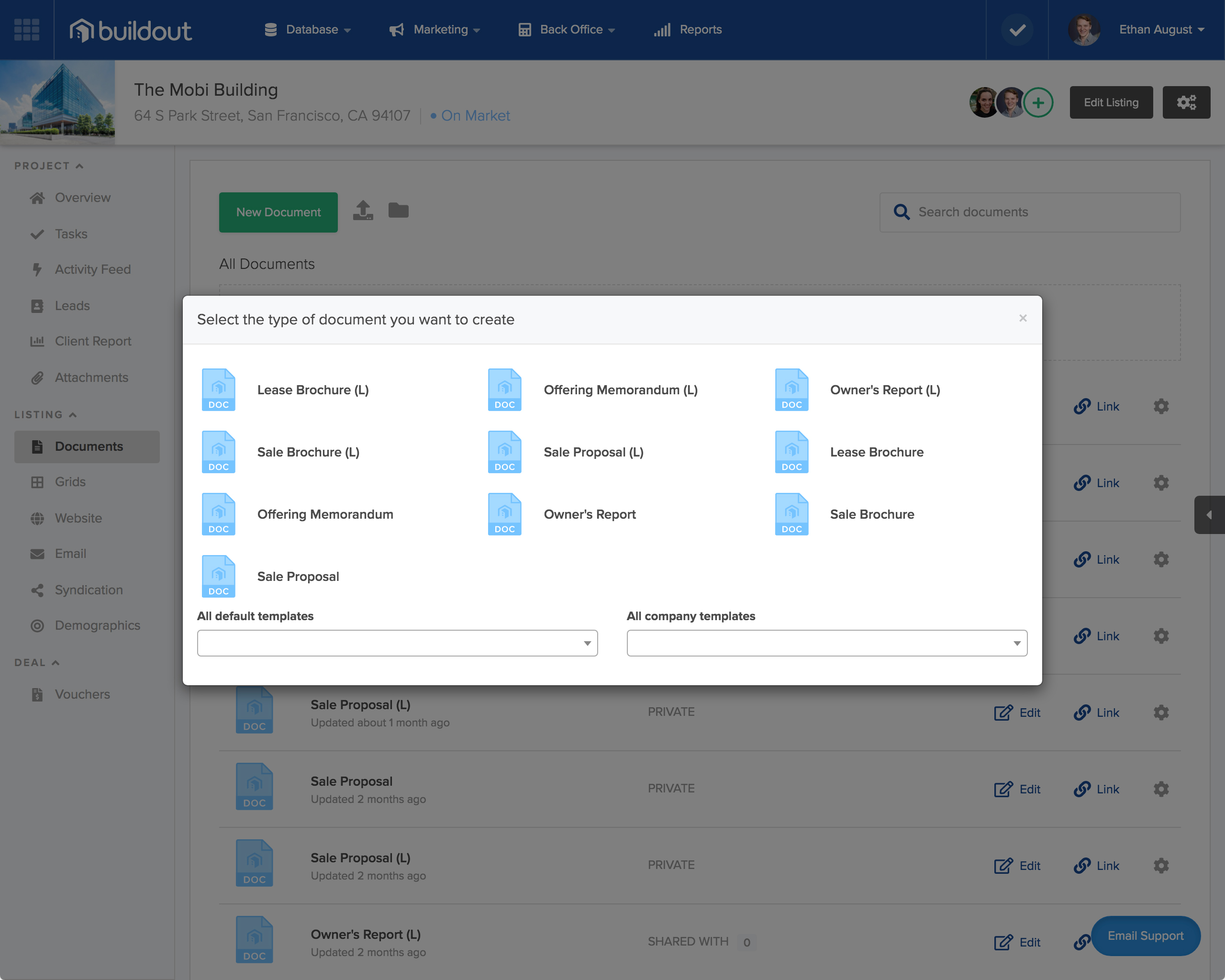
- RethinkA Salesforce-based CRM purpose-built for CRE dealmaking.
- AptoBroker CRM, pipeline and deal-management software.
- ProspectNowOwner and property records plus predictive sale and refinance signals.
- Oval Room GroupPhotography, video, aerials, renderings, plans and virtual tours.
The shopping list is almost suspiciously literal. CRM, data, transaction workflow, cameras. Each deal filled a missing square in the brokerage workflow. But buying the squares did not instantly connect them. Buildout initially told customers that acquired products would remain separate while integrations developed. That distinction matters. A collection of logins is not an operating system, even when one company owns all the passwords.
2025 was integration. 2026 was the reveal
By 2025, the acquired pieces were beginning to behave like one product. Rethink+ put Buildout’s proprietary property intelligence inside CRM workflows. Showcase+ synchronized listing changes across marketing materials, websites and syndication partners. Buildout added AI for ingesting source documents, structuring property data, generating descriptions and outreach, and producing first drafts of proposals.
Then came the new Buildout CRM in March 2026. CEO Helen Calvin framed it around a customer complaint: the real pain was not a shortage of software but “overlap and disconnect.” The broker and administrator had become the glue. The new CRM sits on Buildout Suite’s shared data layer, joining contacts, properties, comps, outreach and pipeline to Showcase marketing and Manage & Close back-office operations.
Company-reported figures changed from “users” in 2016 to “brokers” in later years, so this is a directional growth picture, not a like-for-like audited series.
The difference from a general CRM is the shape of the data. Buildout knows that a contact can be tied to a property, ownership record, comp, listing, proposal and commission. Its AI pitch is similarly grounded in tasks rather than a chat window: ingest documents, identify likely-to-sell owners, populate fields, make materials, write an email, advance a stage. The technology matters only if fewer people have to copy an address.
Distribution makes that shared record more valuable. Buildout’s syndication network includes CommercialEdge sites such as 42Floors and PropertyShark, plus Catylist, TenantBase, Spacelist, OfficeSpace.com, theBrokerList, Brevitas, RI Marketplace and Apex Commercial Exchange. The network is not a claim that every buyer lives in one marketplace. It is an admission that they do not. A broker can update the listing at the source instead of hunting down a changed asking price across a small zoo of portals. The same logic applies to reporting: web activity and campaign response can return to the listing record rather than disappearing into separate inboxes.
The price of deleting the duplicate work
Buildout now publishes a meaningful starting number: $125 per user per month. Brokerages can begin with marketing, CRM or another workflow and expand on the shared platform. Showcase is listed at $199 per broker per month plus a $275 monthly brokerage fee; Showcase+ is $249 per broker plus that fee. Bundles, upgrades and deployments of more than 100 users go through sales.
The visible bill
Seats, a monthly brokerage platform charge, optional bundles, enterprise configuration and paid visual-media work.
The invisible bill
Duplicate entry, stale versions, manual portal updates, commission spreadsheets and expensive people doing clerical handoffs.
The calculation is easiest for brokerages with repeated listing volume, a real marketing function and enough transactions to make handoffs costly. Front Street Commercial said its marketer had been spending at least 40 hours a week creating brochures, websites and revisions before streamlining the process. A Colliers Chicago team described replacing spreadsheet-and-email choreography and getting properties onto multiple portals in under 24 hours.
Competitors still surround every layer. Salesforce and HubSpot can be adapted into CRMs. AscendixRE, ClientLook and RealNex speak more of the industry’s language. CoStar and Reonomy sell intelligence; Crexi and LoopNet sell exposure; Canva makes attractive pages; spreadsheets remain undefeated on procurement speed. Buildout’s defense is not that each individual feature is impossible to reproduce. It is that stitching those choices together creates the very administrative work the platform is meant to erase. A rival can win one screen while Buildout argues about the cost of the full day.
A solo industrial broker, Daniel Cruz of eXp Commercial, offers the other end of the market. Buildout’s templates let him present work that looked like it came from a larger marketing department without hiring one. This is the clever part of vertical SaaS: the same automation can remove bureaucracy at a national firm and simulate resources for a one-person shop.
A platform for brokerages, not every property business
Buildout’s focus is also its boundary. It is built around brokerage, not property management, construction, facilities operations or institutional investment management. A firm that only needs a lightweight contact list, runs few listings, already has deeply customized Salesforce workflows, or treats accounting as the center of its operation may not recover the switching and subscription costs. Predictive owner signals still require a broker’s judgment, and generated marketing still needs facts checked by a human.
The integration argument weakens if a team buys only one module and keeps every surrounding handoff intact. It strengthens as more roles share the same record. That creates the ordinary platform tension: the more useful the connected workflow becomes, the more consequential migration, permissions, training and vendor dependence become. Buildout’s answer is modular adoption. Customers can start with one problem instead of replacing the whole stack on a Monday morning.
What another vertical founder can copy
Do the work before naming the category. Start with a repeated deliverable somebody already pays for. Preserve the customer’s brand rather than forcing yours onto their output. Follow the data upstream and downstream until the next broken handoff becomes obvious. Buy capability only when integration can make the combined workflow better. And treat artificial intelligence as labor removed, not decoration added.
Buildout did not win commercial real estate by predicting that every broker would become a software enthusiast. Its published vision says technology should empower brokers, not replace or bog them down. That is a useful constraint. The broker keeps the relationship. The machine remembers which version of the rent roll belongs in the brochure.