A real estate lead begins life with optimism and immediately enters administrative weather. It arrives from a listing portal or an ad, lands in a database, gets routed to an agent, waits for a call, triggers an email, becomes a showing, becomes a contract and, if nothing breaks, becomes a commission calculation. Each handoff is a chance for the customer to disappear or the staff to type the same facts again. Inside Real Estate built its company around that unglamorous chain.
The private software firm, founded in 2008 and now based in Murray, Utah, sells the machinery behind residential brokerages. Its BoldTrail platform covers lead generation, IDX websites, customer relationship management, automated marketing, recruiting, transaction files, commission accounting and performance reporting. The buyers are agents and teams, but the consequential contracts are with brokerages and franchise systems that need hundreds or thousands of people to use the same plumbing without looking like the same company.
That last part matters. BoldTrail can wear a brokerage's colors, connect proprietary tools and leave the brokerage brand in front of the consumer. Inside Real Estate presents itself as the technology partner, not the business waiting to replace the agent. In a sector where portals and brokerages routinely eye one another's customers, restraint is a sales feature.
The product is the handoff
BoldTrail makes more sense as a route than as a feature list. A consumer searches a branded website. The CRM records behavior and scores the contact. Campaigns decide who gets a text or email. Lead rules decide which agent gets the opportunity. A transaction record carries the customer into the back office. Accounting calculates the split, fees and commission. Recruiting and performance dashboards feed what happened back to management.
One record, five rooms
The company is not unique because it offers a CRM. Follow Up Boss, Lofty, CINC, Sierra Interactive and others compete for some of that work, while Lone Wolf and MoxiWorks cover broad brokerage needs. BoldTrail's distinction is the width of its attempt: connect the agent's first contact with a prospect to the broker's last accounting entry, then sell optional services through a marketplace. The platform becomes valuable when data crosses those boundaries without staff carrying it by spreadsheet.
This is enterprise software disguised as sales software. The agent sees reminders and property alerts. The broker sees permissions, lead assignment, brand control and unit economics. The finance team sees commission rules. The recruiter sees production patterns. One database serves several people who do not naturally agree on what software should do.
“Speed.”RE/MAX, on why it chose kvCORE over continuing to build comparable agent tools itself
A rollup with a user interface
Inside Real Estate reached this breadth by buying. kvCORE, launched in 2017, was the breakout product. It passed 30,000 users within roughly a year, and the company said its overall platform reached 150,000 users in 2018. Private equity firm Lovell Minnick Partners bought a majority stake in 2019. The price was not disclosed, but the strategic intent was plain: accelerate growth and make acquisitions.
The shopping list became the product map. dashCMA added pricing presentations. AmpStats strengthened recruiting intelligence. BoomTown, acquired in January 2023, brought a respected rival CRM, a large customer base and Brokermint's transaction and back-office tools. The combined company had about 700 employees. In 2024, BoldTrail became the umbrella over kvCORE, BoomTown, btPRO, Brokermint and the newer modules.
Rollups often fail first at the seams. Sales decks promise a suite while customers discover separate credentials, duplicate records and support teams that pass tickets between one another. Inside Real Estate's real test is not whether it can own many products. It is whether a lead, deal and dollar can move through them as one workflow. BoldTrail is an answer still being delivered, not a completed merger ceremony.
The customer who stopped building
RE/MAX supplies the cleanest case study because it tried the obvious alternative. The franchise had acquired booj and developed its own CRM and websites. In 2022 it announced that those products would sunset and that affiliates in company-owned regions in the United States and Canada would move to technology powered by kvCORE. The company also planned a roughly 17 percent workforce reduction, concentrated in technology, while reinvesting much of the savings elsewhere.
What changed its mind? Maintenance velocity. RE/MAX said a specialist focused entirely on real estate software could deliver a mature, continuously updated product faster. It kept strategic technology in-house - including its main consumer site and proprietary integrations - while outsourcing the sprawling agent workbench. In 2024, it expanded the relationship into BoldTrail's back office.
This is the economic argument for Inside Real Estate. A brokerage can build, but building creates a permanent product organization. Every MLS change, mobile release, deliverability problem, privacy rule and new communication channel joins the backlog. Buying transfers that treadmill to a vendor whose cost is spread across hundreds of thousands of users.
Current BoldTrail pricing is not public and varies by seats, modules, branding, implementation and add-ons. A public 2018 enterprise contract showed tiered kvCORE pricing around $7 to $10 per agent per month for several thousand agents. That is useful history, not a current quote. The 2019 majority investment, 2023 BoomTown deal and 2025 ListAssist acquisition were all announced without prices.
Quote-based pricing fits the customer range, but it also makes comparison harder. A buyer must price the entire operating change: subscription, migration, campaign rebuilding, MLS connections, training, optional lead generation and the staff time needed to enforce adoption. “Included for agents” can still be expensive at the franchise level. The honest denominator is not seats purchased. It is weekly active users and closed transactions touched by the system.
Five months from deal to feature
The most persuasive evidence that this acquisition machine can produce more than a bundle arrived in 2025. Inside Real Estate acquired ListAssist, a small company with natural-language and computer-vision models for property search, in March. By August, it had launched HomeSearch AI across BoldTrail, combining the acquired search technology with BoomTown's alert experience and Inside Real Estate's automation.
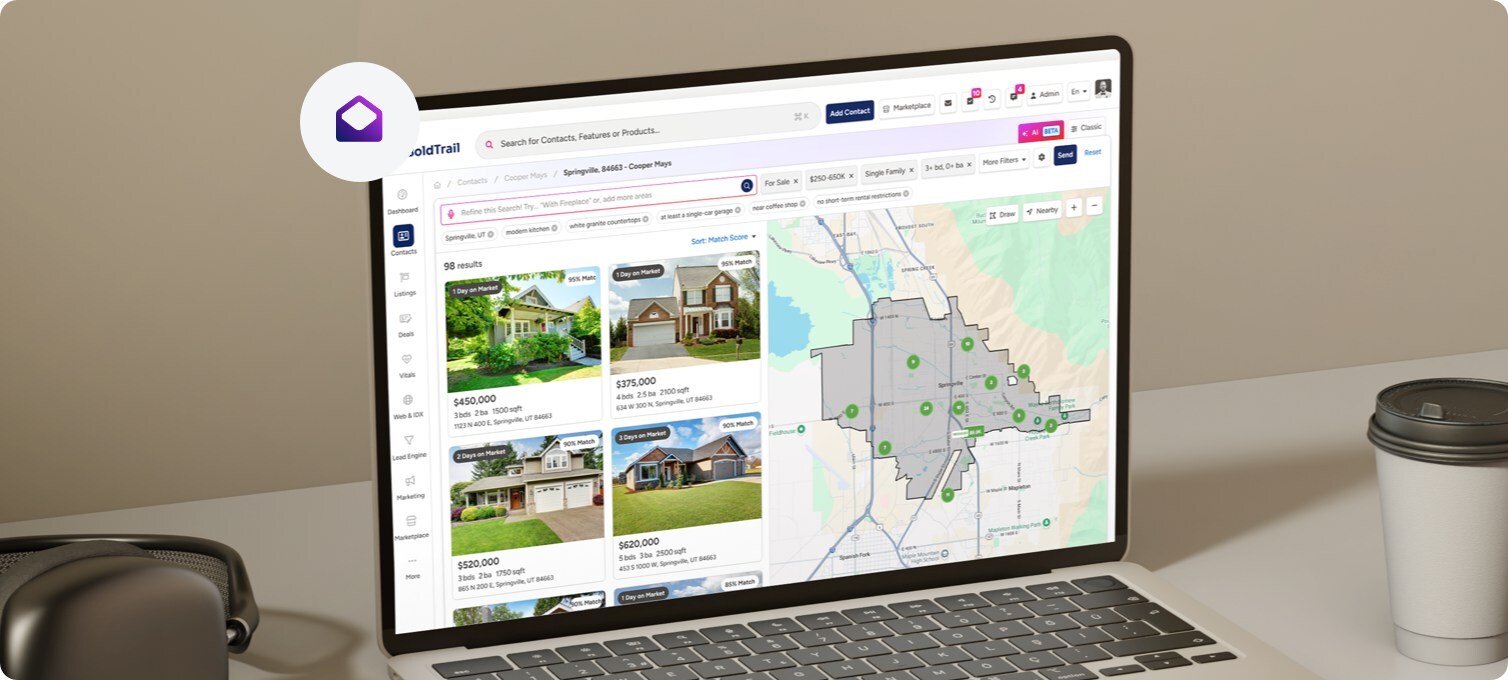
For consumers, the change is simple: search more like a person speaks and less like a database form. For agents, the strategic feature is reengagement. Old contacts can receive more specific property suggestions, and their behavior returns to the CRM as a reason to call. The company is using AI to make an existing database more active, not merely to add a chatbot to the corner of a screen.
The five-month interval is the copyable part, with conditions. It worked because Inside Real Estate already controlled the customer surface, property data flows, alert system and distribution. A buyer without those assets would spend months negotiating access before integrating a model. Acquisition speed comes from prepared interfaces and a clear insertion point, not executive impatience.
Now the software wants permission
In 2026 the company pushed beyond recommendation into action. ComplianceAI, built with SetWave, performs a first pass over transaction files for missing documents, signatures and inconsistent information while leaving final decisions with supervising brokers. BackOffice MCP is designed to give authorized assistants a controlled route into brokerage data and workflows. The pitch is an agent asking an assistant to open a transaction, prepare documents, flag trouble and move work toward signature inside the system already in use.
Streams Studio widens the ambition. It is presented as an open, MCP-native workflow layer that can connect a brokerage's wider stack, even when the customer does not use every BoldTrail module. That is a notable change in posture. The suite vendor is acknowledging that the customer's software will remain plural.
The first thing likely to fail is not model intelligence. It is authority. Real estate files mix consumer data, licensed activity, state-specific forms, money and deadlines. An assistant that can act needs the same permissions, audit trail and limits as a careful employee. A dazzling demo is less important than knowing who approved an action, which record it touched and how to reverse it.
The next brokerage platform will be judged by what its AI is forbidden to do.YesPress analysis
What to copy - and when to walk away
Inside Real Estate's playbook is useful beyond property software. Start with one frequent, expensive workflow. Expand into adjacent handoffs where customers already lose time or data. Acquire capabilities only when they can improve the shared workflow. Keep the customer's identity in front. Make migration and adoption part of the product, because unused automation is just a recurring invoice.
It works when
A brokerage has enough agents and transactions to justify integration, names an internal owner, cleans its data, standardizes lead rules and trains managers to inspect adoption.
It breaks when
A small team needs only a light CRM, leaders refuse process changes, agents keep private spreadsheets, custom tools cannot connect or the suite's breadth becomes its learning curve.
The competitive risk is the same as the product advantage. A broad platform can remove handoffs, but it can also create dependence on one vendor and make best-of-breed tools harder to adopt. The marketplace, developer hub and newer open-AI posture reduce that tension only if integrations are deep, data remains portable and customers can control permissions. “One platform” should describe the experience, not the exit barrier.
Inside Real Estate fits between the consumer portals that attract home shoppers and the brokerage systems that close and account for their deals. It does not need to become Zillow to matter. It needs to make sure the person who arrived from Zillow does not vanish between a lead alert and a commission check. For seventeen years, the company has kept following that person through the building. BoldTrail is what happened when it bought most of the rooms.