The revealing number at Kale Realty is $400. A Chicago agent can negotiate a sale, collect a commission, and pay that fixed amount to the brokerage. On a bigger sale, the fee stays put. After $6,000 in annual sales transaction fees, it stops. For an agent accustomed to handing over a percentage, that changes the question: what, exactly, should a brokerage get paid for?
- The offer: capped sales fees, with coaching and technology included.
- The audience: Chicago-area agents building their own client relationships.
- The catch: fixed bills continue when closings do not.
Kale serves two groups at once. Buyers, sellers, renters and investors come through its agents. Those agents, meanwhile, choose Kale for the infrastructure behind their businesses. The brokerage’s proposition depends on making that second relationship useful enough to keep.
First, a uniform. Then, a business of one.
The family story begins well before the commission pitch. Sol Kale established Kale Uniforms in 1951 and invested in Chicago property. The uniforms even reached the movies: Backdraft and The Blues Brothers appear in the company’s family history. This was a business with a neighborhood attached.
In 2007, his grandson Nick Kale Patterson left Coldwell Banker and opened the present brokerage on Roosevelt Road, beside the uniform business. Its agent roster contained one name: his. The distinction matters. Kale’s family real estate roots reach back to 1951; the brokerage described on its current website opened in 2007.

Chicago Agent Magazine reported agent number 200 in 2013. By 2017, more than 400 professionals had outgrown the Roosevelt office, prompting a move to Lincoln Park. Kale marked its 750th agent in November 2023. Today its site describes a community of more than 700, with an office in Logan Square.
The percentage gets a price tag
“100% commission” has a satisfying ring. It still needs footnotes. Kale publishes a $400 fee per closed sales side, capped at $6,000 annually, plus $54 a month and $249 a year for errors and omissions insurance. At fifteen sales sides, the transaction cap is reached. Monthly and insurance charges continue.
Your year, in fixed fees.
Illustration using August 2026 published terms: min(sides × $400, $6,000) + $648 + $249. Excludes rentals, association and MLS dues, licensing, marketing and other business expenses.
Consider a hypothetical $10,000 commission. A 20% brokerage share would cost $2,000. Kale’s sales fee would be $400 before its cap, with recurring charges accounted for separately. This illustrates the mechanism, rather than predicting an agent’s savings: actual splits, commissions and services vary. A larger commission widens the difference because the flat sales fee does not rise with it.
Rental work has different economics: Kale publishes an 80/20 split plus a $15 transaction fee. An agent whose practice is mostly leasing therefore needs a different calculation. A quiet sales year also deserves attention. Even with zero sales, twelve monthly payments and annual E&O total $897.
The sale does not find itself
Kale’s alternative to percentage pricing includes tools people recognize: a RealGeeks website with MLS search, a connected customer database, email campaigns, marketing templates, digital paperwork and signatures. Kaley AI answers agent questions with a route to human help. These are practical components of the agent’s working day, bundled into the published monthly fee.
The bundle has a boundary. Kale explicitly says it does not provide a regular stream of internet leads. It passes along some inquiries and points to paid lead partners, but teaches agents to generate their own business. Someone expecting a brokerage to supply a full calendar of appointments should examine that sentence closely.
“We took the money we would’ve paid a broker and put it into marketing ourselves.”
Suli Gazafer · Kale agent, company-published testimonial
Gazafer’s account captures the appeal for an agent whose referrals already come from personal relationships. Keeping more income creates a choice about where to spend it. His testimonial is a useful example of that choice, rather than evidence that every agent will achieve the same result.
What happened in week seven?
The more interesting test comes after the software login. In May 2025, Risa Weiss became vice president of agent development, with responsibilities including transaction coaches and production coaching. That puts attention on the awkward stretch between attending a class and handling a client’s actual problem.
Kale’s TRACK+ program, built around The Locker Room’s coaching, makes that work countable. Its August 2026 report describes five agents over twelve weeks: 1,283 conversations, 100 buyer and listing appointments, and nine closings worth approximately $2.44 million in property volume. These are company-reported results from a small cohort, without a comparison group. Property volume is not income.
Company-reported activity totals; not a tracked conversion funnel or a forecast.
The report also records a wobble. Weekly contacts had ranged from 109 to 192 through week six. In week seven, they fell to 50. By week eleven, the group held twelve listing appointments. The sequence supports a modest lesson: an activity plan needs a way to notice when activity stops. It does not establish that coaching caused the recovery.
A little structure around the freedom
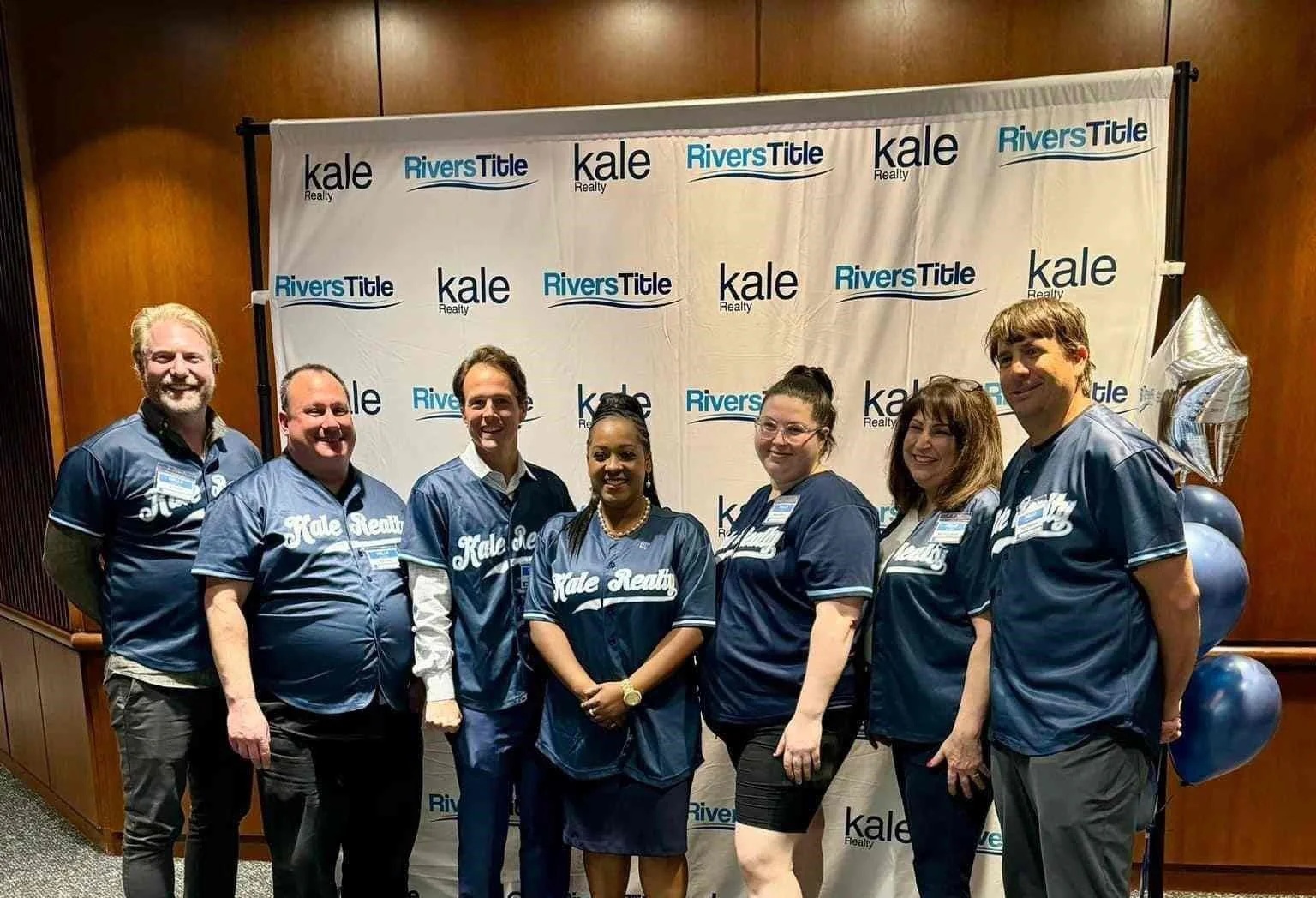
The culture supplies another kind of contact. Quarterly summits mix learning and recognition. At the February 2025 gathering, agents arrived by limousine for breakfast and a keynote, followed by awards for producers, mentors and referral leaders. Kale ranked fourth among midsized employers in the 2024 Chicago Tribune Top Workplaces coverage. Its leadership page also lists Janet, the company dog.
For an agent considering Kale, the useful exercise is simple: price a slow year and a busy year, identify which services actually get used, and ask who helps when a transaction turns difficult. Then borrow the coaching habit: record conversations, appointments and follow-up each week. Independence is easier to manage when the work leaves a trail.