Vikas Kamran once admitted that enthusiasm could make him stay too long with an idea. The returns disappointed; the investment continued. For someone building a business around helping other people make decisions, it was an appropriately inconvenient lesson. Every promising idea, apparently, ought to come with a reasonably accessible brake.
His career has given that lesson several places to work. There was Accenture, then Revel, the consulting firm he co-founded and led, then the larger world of Infogain. Now he is president of Gradial, a Seattle company applying AI agents to enterprise marketing. The technology has changed considerably. His public argument about unnecessary complexity has proved rather more durable.
That makes his story more interesting than a procession of job titles. A founder can dislike bureaucracy while running a small firm. The harder test comes with growth, new partners, an acquisition and responsibility for selling software to organizations with elaborate habits of their own. Kamran has kept returning to the question of how people actually get things done.
A firm with less ceremony
Before Revel, Kamran worked at Accenture in Seattle and New York, serving large enterprises. He knew the consulting business from inside it. Revel offered him a chance to work on the model itself: the arrangements around the advice, the layers between the people with a problem and the people able to help.
In the late 2000s, the pitch was unusually suited to a nervous economy. Companies wanted spending reduced and results made visible. Revel helped one business save $1.7 million over four years through a different bill-payment structure. Its client work also included shortening delivery cycles for software businesses. An operational improvement has the social disadvantage of being difficult to photograph, but the finance department can generally recognize one.
The firm grew quickly. Inc. placed Revel at No. 48 on its 2008 list and No. 34 in 2009. Those rankings establish a period of rapid expansion; they also make an awkwardly useful backdrop to Kamran’s preference for fewer bureaucratic layers. Growth supplies customers and colleagues. It supplies fresh opportunities to create the very procedures a founder once found exasperating.
Kamran called the early approach PURE Consulting. Its premise was to put capable people closer to opportunity. The practical appeal is easy to understand: a client buying help would rather spend its attention on the problem than on navigating the organization supplying it. Preserving that simplicity as a business expands is a more demanding occupation than naming it.
The office was moving. So was the idea.
By 2016, Revel was changing how it presented itself. The refreshed brand placed empathy and human-centered design near the center of the business. Work with brand strategy firm Stoke and design partner Turnstyle gave the company a new visual language, including a vivid palette and distinctive dithered imagery. A consulting firm was taking the experience of encountering the consulting firm seriously.
The redesign accompanied an organizational argument: communities of professionals could come together around problems. Design thinking would help them understand opportunities before settling on solutions. A website could express that idea; the company still had to practice it. The distinction between announcing a philosophy and arranging a working day around it is where much corporate ambition meets its first queue.
Kamran’s tenth-anniversary essay put the change in a physical setting. Revel was preparing to leave Kirkland for new headquarters in Belltown’s historic Seville Building. He described spaces intended for interactive, human-centered experiences, alongside renewed attention to San Francisco and the Bay Area. The move supplied a street-level expression of a business trying to make collaboration part of its identity.
In February 2017, he connected that direction to a strategic partnership with Adobe. He credited colleagues Laszlo Kismarton, working on technology platforms and partnerships, and Nicole Ponzio, leading the experience design community. His account also described eight new client companies added during the preceding year. The achievements had names and assignments attached to them, which gives an abstract phrase like innovation a welcome office address.
Three questions before the grand announcement
Kamran’s explanation of digital transformation in 2017 began with changes in the economics of technology. Cloud services had made infrastructure and application delivery more accessible. Companies still faced the business problem of staying relevant to customers. Easier access to technology had left plenty of difficult decisions intact.
His three tests were “desirability, viability and feasibility.” The words impose a useful discipline on a room full of enthusiasm. Wanting an idea to work does not settle whether an organization can support it, deliver it or sustain the change. Human readiness belongs in the calculation alongside the technology.
Desirability
Is there a reason to want it?
Viability
Can the organization sustain it?
Feasibility
Can it be put into practice?
An editorial shorthand for the framework he described in 2017. Three questions, no invented score.
He also placed employees inside the customer-experience argument. How people are treated within an organization affects how they approach the people outside it. The point carries consequences for a consultant: a better interface may require changes well beyond the interface. A customer can encounter an organization’s internal arrangements without ever seeing its organizational chart.
The acquisition put engineering beside design
In October 2019, Infogain acquired Revel. The initial arrangement kept Revel operating as an independent organization, with Kamran remaining CEO and its leadership team in place. Revel had more than 200 employees. A business built around advice and experience design was joining a larger platform and product engineering company.
The combination addressed a familiar gap between conceiving an experience and making it work. Design brings a view of what people need; engineering supplies the means of delivering it reliably. Joining those capabilities made the proposition broader. It also made coordination part of the product being offered to clients.
At the time of the deal, Kamran spoke about digital experiences that would feel useful to customers without intruding on them. Trust belonged in the relationship. It was a revealing concern for a business working with personalization and data: the ability to do something technically leaves open the question of whether a customer welcomes it.
His responsibilities subsequently extended into Infogain’s digital leadership. A February 2023 announcement identified him as Corporate Vice President, Digital, as Garrick Schmitt arrived to lead Revel’s experience transformation work. Schmitt’s background spanned user experience, product and digital marketing. The direction remained a meeting of disciplines rather than a single specialty acquiring a more elaborate title.
Later, Kamran publicly marked the close of his tenure and described a next chapter with the local generative AI startup community. He thanked colleagues, mentors and partners. A long stretch building one business had led into a larger company; the next move would bring him closer to a younger software company.
A new seat, a familiar problem
Gradial announced Kamran as president in August 2025. He had already been an early advisor, helping shape the platform’s vision and architecture. The operating role put go-to-market strategy, customer alignment and the product roadmap on his agenda. Advice was becoming a daily responsibility for the business.
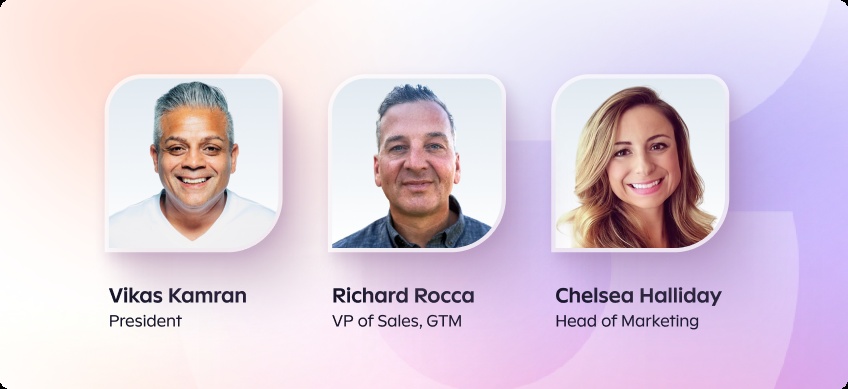
Richard Rocca, arriving from Adobe, joined as vice president of sales; Chelsea Halliday, previously at Vercel, became head of marketing. CEO Doug Tallmadge was bringing in experience across enterprise selling, marketing and operations. Kamran’s move was part of a leadership expansion around a product already aimed at the working routines of marketing teams.
Those routines provide a concrete setting for AI. A campaign passes through content, systems, approvals and publishing. Gradial describes agents operating within existing tools to coordinate and execute tasks. The proposition puts the everyday mechanics of marketing near the center of the software discussion. Buying another tool is easy to announce. Making an existing workflow less cumbersome gives customers something more useful to judge.
For Kamran, the connection to his earlier career is an editorial reading of a repeated concern: the distance between intention and execution. At Revel, he challenged layers in consulting. At Gradial, his responsibilities concern bringing software into enterprise work. The settings differ, but both require close attention to the people expected to use what is being sold.
Customers should have a reason to stay
In a public exchange about enterprise software, Kamran endorsed an open approach and argued that product value should keep customers. That position makes retention a continuing obligation. A customer who can leave supplies a useful audience for claims about convenience.
He has also found a smaller image for his agenda: a sculpture outside the Seattle Art Museum, passed on the way to a Gradial sales kickoff. It prompted a reflection on reducing friction in products, pricing and service.
“Our job is to create freedom.”
Vikas Kamran, on the people using Gradial
For an enterprise executive, freedom eventually meets a calendar, a budget and a piece of unfinished work. That is a fair place to test the phrase. Kamran’s career has brought him repeatedly to that meeting: a growing consultancy, a redesigned organization, a larger engineering business, an AI company. Each brings its own opportunities for complication. Each gives him another place to put his argument to work.
Follow the work
PROFILES, COMPANIES & FURTHER READING