VICE Media once sold a wonderfully expensive idea: that one company could own the attention of young people everywhere. It would find the story in a basement show, a war zone or a cloud of dubious smoke, then carry that voice through magazines, websites, YouTube, HBO, a cable network, films, ads and events. Investors bought the pitch. By 2017, after TPG put in $450 million, the reported valuation reached $5.7 billion.
Six years later, VICE filed for Chapter 11. A group led by lender Fortress Investment Group acquired it in a transaction reported at $350 million. The collapse became shorthand for the digital-media bust, but that summary is a little too neat. VICE made work that audiences remembered and won serious awards for it. The problem was that cultural power, borrowed distribution and a large fixed-cost organization were being counted as if they were the same kind of asset. They were not.
The product was a point of view
The company began in Montreal in 1994 as Voice of Montreal, a free alternative magazine. Shane Smith, Suroosh Alvi and Gavin McInnes turned it into VICE, then took it to New York. Its editorial trick was not complicated, which made it hard to imitate: send curious people into places that television treated as remote, speak in the audience's language, keep the camera close and leave the institutional tie at home.
That method traveled. VBS.tv made internet documentary video before every publisher decided it needed a video strategy. The HBO series put Smith and correspondents in front of mass audiences. VICE News reported from conflict zones and under-covered communities; its work accumulated Peabodys and Emmys, and a collaboration on This American Life's "The Out Crowd" shared the inaugural Pulitzer Prize for Audio Reporting. Food became Munchies. Music became Noisey. The voice itself became inventory.
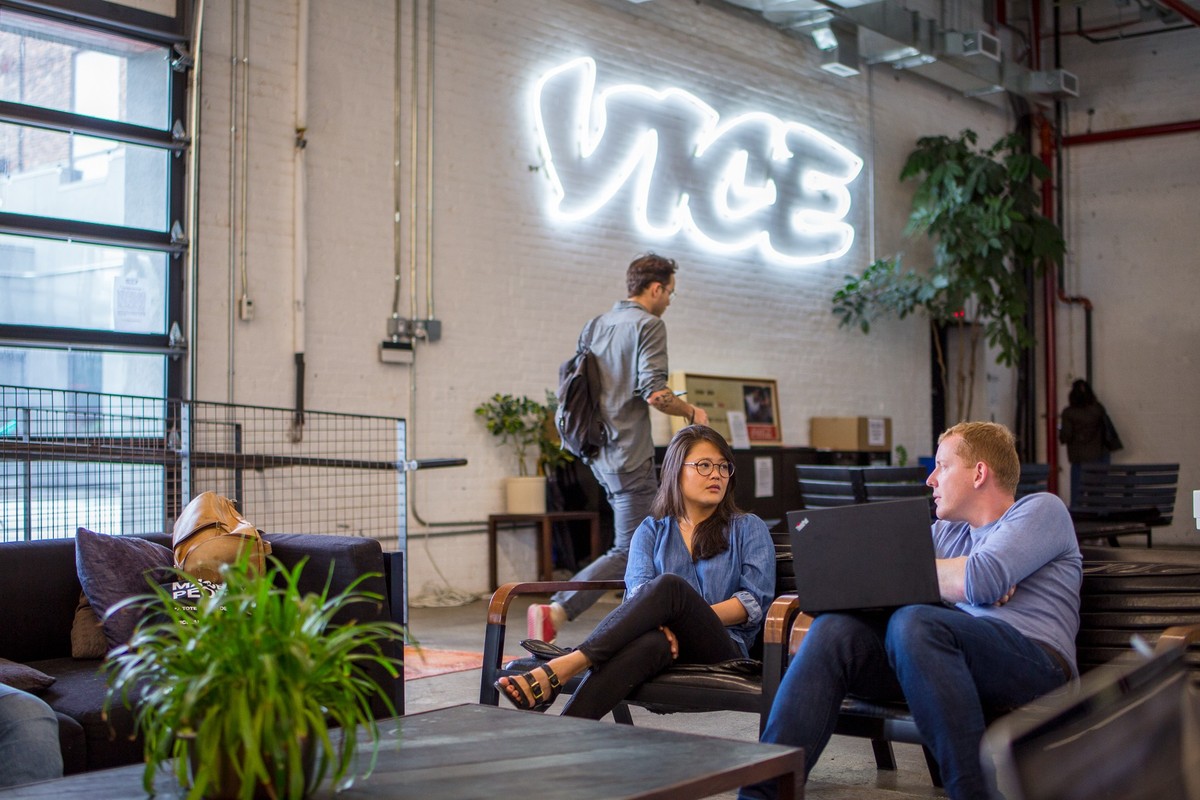
Advertisers wanted access to that inventory without sounding like advertisers. Virtue, VICE's creative agency, turned cultural fluency into a service: insight, strategy, design, production, talent and live experiences. Its client list has included Google, Nike, Samsung and LVMH. This was one of VICE's smarter translations. The newsroom developed a tone; the agency sold companies help navigating the audience that understood it.
VICE's durable asset was not a homepage. It was a voice that could survive a change of container.
What failed first: the math
The first visible crack was not bankruptcy. It was the growing distance between the story investors heard and the money the business produced. VICE expanded through costly offices, international editions, acquisitions, a large newsroom and television. VICELAND launched in 2016 by replacing A+E's H2 channel, a striking wager on linear cable just as younger viewers were learning to live without it. In 2017, VICE cut digital staff while emphasizing video. Revenue targets were missed. The cultural brand was still loud; the income statement had started mumbling.
Empire model
- Own the publishing operation
- Hire for global scale
- Distribute everywhere
- Monetize attention later
Portfolio model
- Start with buyers and partners
- Co-finance selected IP
- License brands and rights
- Keep fixed costs narrower
Then came a failure more serious than a missed forecast. Reporting in late 2017 described sexual harassment, settlements and a boys-club workplace. Smith and Alvi acknowledged that the company had failed to create a safe and inclusive environment. The scandal damaged trust inside the organization and punctured the myth that a youthful company was naturally a progressive one. Nancy Dubuc replaced Smith as CEO in 2018 and was asked to professionalize both the business and the culture.
The turnaround met worsening economics. HBO ended its relationship with VICE in 2019, removing an important customer and a prestigious distribution window. VICE raised $250 million in debt that year from a group including Fortress, Soros Fund Management and Monroe Capital. It also acquired Refinery29 in stock, adding scale while the digital ad market became more difficult. The pandemic, repeated layoffs, executive churn and a failed sale process followed. Debt did what debt does: it turned a long strategic argument into a date on the calendar.
Peak meets reckoning
TPG invests at a $5.7 billion valuation; workplace misconduct reporting exposes a governance crisis.
A major window closes
HBO ends the partnership and VICE raises $250 million in debt while attempting a turnaround.
Creditors take the keys
Chapter 11 produces new ownership led by Fortress and wipes away the old valuation.
The portfolio rebuild
Digital returns by joint venture, the studio gets new capital and VICE adds production assets and partners.
The second act starts with a buyer
After bankruptcy, CEO Bruce Dixon said it was no longer cost-effective to distribute digital content the old way. Several hundred positions were eliminated in 2024 and publishing on VICE.com stopped. Three months later, the website and brands including Munchies, Motherboard and Noisey returned through a joint venture with Savage Ventures, which committed tens of millions of dollars. The clever part was structural: VICE retained brand control while a partner handled daily digital operations.
The remaining company looks less like a magazine empire than a rack of interoperable production businesses. VICE Studios develops and makes scripted and unscripted television and film, including Gangs of London, Bama Rush and the Dark Side franchise. VICE TV remains a cable joint venture with A+E. VICE Sports programs series and podcasts. VICE News, with Smith back as editor-in-chief, centers on documentaries and video podcasts rather than a giant daily newsroom. Virtue and the commercial-production group sell ideas and execution to brands.
The new VICE loop
+ recognizable IP
or news production
or joint venture
Adam Stotsky, an NBCUniversal and Dick Clark Productions veteran, became CEO in June 2025. The choice underlined the shift from digital publishing to entertainment operations. VICE also acquired Cuba Pictures and London Alley, signed ITV Studios as its exclusive global distribution partner, and raised a $75 million credit facility from Western Alliance Bank. Executive chair Michael Lang said the financing was intended to help jump-start roughly $500 million of projects over three to five years.
That money answers the question, "What changed their mind?" Before bankruptcy, outside networks and streamers often funded projects, which limited VICE's control over distribution. The new capital lets the studio co-finance selected work and keep more leverage over rights. VICE has moved from paying to reach an audience every day toward investing where a buyer exists and an asset can keep earning.
What a smaller company can steal
Keep the taste. Rent the pipes.
- Build a voice specific enough to travel across formats.
- Turn reporting and ideas into reusable IP, not disposable posts.
- Choose partners when infrastructure is expensive and undifferentiated.
- Start expensive projects with a buyer, sponsor or rights plan.
- Treat culture and governance as operating systems, not office decoration.
The most copyable VICE move is not gonzo reporting or provocative headlines. It is the conversion chain. A distinctive observation can become an article, a documentary, a television format, a podcast episode, a brand campaign or a licensed library title. Small publishers can do this without pretending to be conglomerates: develop one repeatable franchise, learn which customer pays for it, retain the rights that matter and partner for the rest.
The least copyable move is financing scale with the assumption that attention will become margin later. VICE raised roughly $1.6 billion in investment and debt over its history. Much of that money purchased reach, headcount and optionality. Optionality is lovely until interest, rent and payroll become specific.
Where the new model can still break
A leaner VICE is not a safe VICE. Studio production is hit-driven. Streaming buyers have become more selective. Cable distribution is in structural decline. Agency budgets follow the economic cycle, and branded work can compromise the editorial credibility that made the company useful to brands in the first place. Co-financing also adds risk: keeping more upside means supplying capital before success is known.
The strategy will not work if VICE's name becomes merely nostalgic, if partners capture the customer relationship, or if management again expands fixed costs ahead of contracted demand. It also fails if the company treats governance as a solved problem. A rebellious voice can be an editorial advantage; rebellion against basic management is only expensive.
Still, the post-bankruptcy design is coherent. VICE no longer needs to prove it owns youth culture. It needs to make programs buyers want, campaigns clients will fund and franchises audiences choose. That is a less glamorous ambition than building the next global media empire. It may also be the first VICE pitch in years that starts with the invoice.