A fiber connector can look clean and still fail inspection. That is an awkward starting point for an industry selling speed: before the network can carry anything useful, somebody must examine the end of a cable. VIAVI Solutions makes the equipment for that examination. It also makes instruments that hunt radio interference, software that reconstructs network trouble, and pigments that change a banknote's color when you tilt it. Follow the light, and this apparently peculiar collection of businesses begins to make sense.
- Tests networks from physical fiber to application traffic.
- Sells to carriers, equipment makers, enterprises and defense customers.
- Supplies security pigments used on currencies in more than 100 nations.
The expensive problem at the end of a cable
Consider VIAVI's instruction to technicians: Inspect Before You Connect.
The procedure is wonderfully unglamorous. Inspect the connector. If it is dirty, clean it. Inspect again. Connect only after it passes. A quick reference for tower construction explicitly tells technicians to repeat cleaning and testing until the end-face passes. The first failure in this workflow can be the interface itself, before anyone gets to blame the software.
OneAdvisor 800 gathers several investigative jobs into a portable instrument. Depending on configuration, it checks fiber and cable connectivity, measures wireless coverage, locates interference and validates Ethernet transport. For a tower contractor, the appeal is practical: fewer separate instruments and a common testing workflow. For an operator, it is evidence that an installation meets its requirements before the job is accepted.
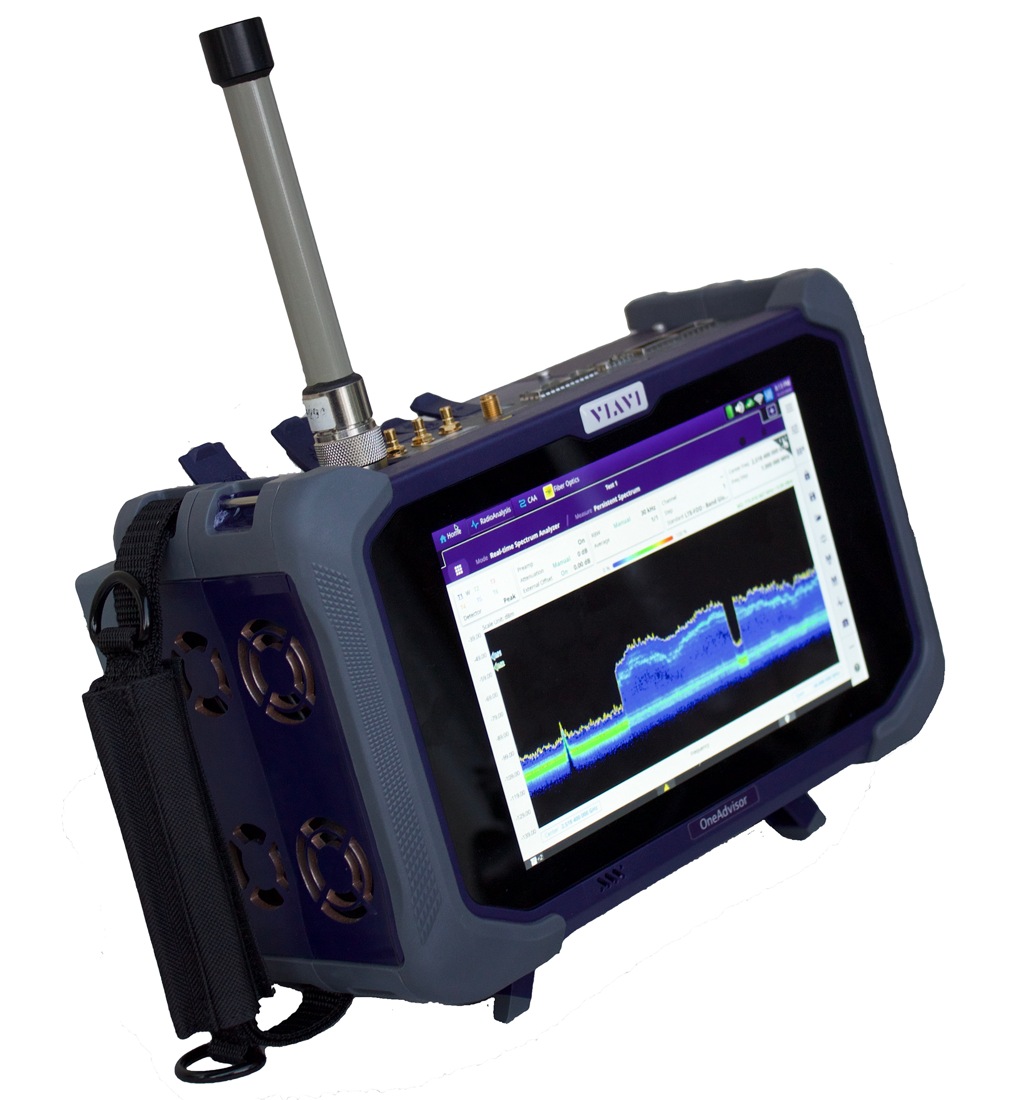
That distinction matters. VIAVI occupies the testing and assurance layer of telecommunications. A carrier buys equipment to build a network; it buys test equipment to find out whether the network behaves as intended. Cloud operators, component manufacturers, enterprise IT teams and government laboratories face versions of the same problem, at different scales and with different consequences.
Rewind the network
The enterprise version often begins with a complaint: something was slow earlier. Reproducing an intermittent problem can be harder than fixing it. VIAVI's Observer GigaStor captures and retains network conversations so investigators can return to the period around an incident. Observer Apex uses packet-derived information for end-user experience scoring. The product is selling a useful form of memory.
In the lab, the question changes again. How will equipment behave under load, with difficult traffic or under attack? TestCenter addresses performance and protocol validation; CyberFlood addresses application and security testing. VIAVI's combined portfolio links physical-layer checks with higher-layer validation. Its competitive argument is that engineers can investigate across those layers using a broader set of related tools.
“Inspect Before You Connect.”
VIAVI's fiber inspection instruction
Keysight is a major alternative in communications testing; EXFO competes in fiber testing and assurance, while enterprise monitoring buyers also evaluate specialists such as NETSCOUT. The sensible comparison starts with the actual job: interfaces, supported protocols, capture requirements and workflow. A broad catalog alone cannot tell a buyer which instrument belongs in the van or the lab.
The banknote is the other clue
Now tilt a banknote. VIAVI's Optical Security and Performance Products business manufactures optically variable pigments, including magnetic pigments that create apparent depth and motion. Its security pigments protect currencies in more than 100 nations. For currency and other security documents, the company's color-shifting pigments and taggants are available as ink exclusively through SICPA.

This is a different buyer and a different manufacturing problem. The shared expertise is controlling light. Thin-film optical coatings also serve sensing and other optical applications. VIAVI therefore combines an instrument-and-software business with a materials business. Calling it simply a telecom supplier misses a substantial part of what it knows how to manufacture.
Connect only after a pass. Repeat when necessary.
The deal that took the long way round
VIAVI's corporate history also rewards a second look. It traces its heritage to Wandel & Goltermann in 1923. The present name arrived in 2015, when JDSU spun off its communications and commercial optical products business as Lumentum. Network testing, service enablement and optical security remained together as VIAVI. This was a separation of established businesses, rather than a garage startup.
In 2024, VIAVI tried to buy Spirent. Keysight offered more, and Spirent's board switched its recommendation. That original route failed. Then competition concerns created another opening: the U.S. Justice Department required divestitures in high-speed Ethernet testing, network security testing and radio-frequency channel emulation. VIAVI became the buyer of those businesses.
The acquisition closed in October 2025. VIAVI announced $425 million in cash consideration, subject to customary adjustments. Its subsequent filing reported $399.3 million paid at closing, subject to final working-capital adjustments. Those are differently qualified figures. The filing also recorded approximately $20.6 million in acquisition-related costs. Buying expertise has a bill beyond the headline price.
Buy the capability. Keep the discipline.
Another purchase widened the company's reach: Inertial Labs, acquired in January 2025, brought orientation, positioning and navigation technology. The announced agreement specified $150 million initially and up to $175 million in contingent consideration over four years. By October 2026, the business was launching INS-NV, a programmable navigation development platform combining inertial sensing with NVIDIA computing.
The commercial model spans instruments, software and associated support, alongside manufactured optical products. Customer needs persist after delivery: equipment requires calibration, software changes and networks expand. Internally, VIAVI describes a learning-oriented culture; its employee report says leadership development had reached over 79% of managers in fiscal 2024. That is a concrete program behind the recruiting language.
There is a transferable habit here: turn an intermittent complaint into something observable, then test against a defined requirement. Its limits are equally practical. A lab scenario is useful only insofar as it represents the conditions that matter; a packet investigation needs the relevant traffic captured. The tool must fit the failure. VIAVI's appeal is the range of ways it lets engineers look closely enough to choose.