A video service provider had a problem that arrived 140,000 times a day: failed attempts to access its applications. That figure appears in a Cisco account of a Vitria deployment. Each failed attempt was a small disappointment for someone trying to watch something. Together, they posed a diagnostic puzzle. Which part of the machinery deserved the blame?
- Vitria connects operational signals to the services customers experience.
- VIA AIOps diagnoses incidents and can run approved fixes.
- Its sweet spot is complex operations spanning networks, applications and teams.
The intervention was specific. VIA AIOps correlated application failures with network elements, identified the cause, triaged incidents and sent them to the appropriate team. Cisco’s 2021 brief reports a 28% reduction in the failure rate. The revealing detail is the connection between the application and the network. The complaint and the cause lived in different places.
The clue nobody owned
That separation is Vitria Technology’s territory. AIOps means applying artificial intelligence to IT operations. Vitria’s version concentrates on service assurance: keeping the experience delivered to a customer working across all the equipment and software behind it. Telecom operators, cable companies, streaming services, banks and healthcare organizations appear in its industry coverage.
Consider the organizational problem. An application team sees failed sessions. A network team sees congestion. Another team has just changed a configuration. Each has evidence, and each has a perfectly reasonable place to begin investigating. The reader can recognize the trouble without understanding a single networking protocol: everybody has part of the story. Nobody necessarily has the sequence.
An old obsession with connections
Vitria dates to 1994, when JoMei Chang and Dale Skeen founded the company. Their backgrounds include real-time messaging and distributed computing. Chang remains CEO; Skeen remains CTO. According to Vitria’s account, Chang took the company private in 2007 to pursue operational intelligence, then directed that work toward telecom AIOps in 2020.


The older product makes that continuity tangible. BusinessWare combines application integration, business process management and business-to-business integration. It handles processes such as order fulfillment, insurance claims and financial transactions across systems and organizations. A customer can model a process, connect its applications and coordinate both software interactions and human work.
VIA addresses the operational consequence of those connections. Once a service depends on many systems, its failure cannot always be understood inside any single one. Vitria’s expertise lies in bringing information across those boundaries. Its contemporary AI pitch has an unusually long integration history underneath it.
Give the machine a map
In April 2026, Vitria introduced its Self-Evolving Knowledge Plane. The term is grander than the underlying idea: give diagnostic software an updated account of how the environment fits together. Telemetry, topology, configuration records and past incidents feed a knowledge layer that represents relationships and operational context.
“Autonomous operations require more than data - they require understanding.”Dale Skeen · April 2026
Vitria’s announcement describes an operator deployment where degraded radio-network experience was traced to resource constraints in a virtualized transport router. The visible problem was at one layer; the constraint was at another. The system triggered remediation. This example explains the appeal more neatly than a catalogue of AI features: knowing which things depend on which other things changes where you look.
- 01Service symptom
- 02Dependency map
- 03Probable cause
- 04Approved action
VIA supports fault, performance and change analysis, with controls over which actions run automatically and which require approval. Vitria positions that combination against alternatives including BigPanda, Dell AIOps and Splunk ITSI. Its argument emphasizes service dependencies, network scale and an explanation that an operator can inspect. Buyers should test that distinction against their own incidents.
That network emphasis matters. In a published conversation about VIA 3.0, Cisco’s Marc Austin distinguishes public service-provider operations from conventional data-center operations, pointing to their complexity and scale. Vitria’s Chris Menier describes the release around openness: getting data into VIA, fitting existing workflows and defining actions. The ambition depends on joining the tools operators already use.
The market is also changing its vocabulary. In September 2026, Vitria announced its inclusion as a Sample Vendor for Event Intelligence Solutions in eight Gartner Hype Cycle reports. That is a research listing, rather than an endorsement. It places the company’s current pitch at the intersection of observability, incident intelligence and automation, where buyers are asking what useful decision follows the collection of data.
The economics of an avoided visit
The commercial model follows enterprise software rather than an individual app purchase. Vitria sells through direct engagement and partners. Cisco offers VIA through its purchasing channel alongside Crosswork network automation. Partners can resell the software and provide services. The practical buying conversation therefore includes integration, implementation and ongoing operations.
The bank was adding digital services and needed to detect infrastructure changes affecting them. Cisco’s brief reports $1 million saved in the first year by replacing manual, reactive tasks with automated, proactive workflows, alongside a 70% reduction in mean time to repair. Those are reported outcomes from one case. They are not a purchase price or a forecast for another bank.
Deployment also takes work. Vitria’s results page describes production launches in 90 days at a large US internet provider and 120 days at a Fortune 200 mobile operator. These examples suggest a project with data connections and operational decisions to settle. The cost equation includes that effort as well as the software.
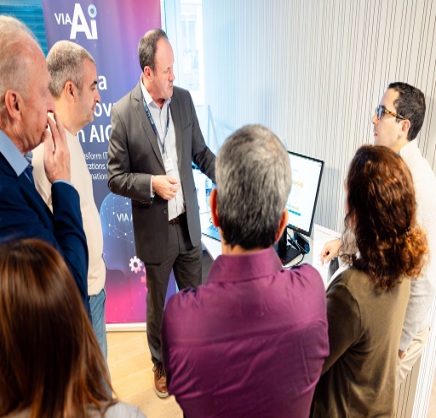
There is a useful discipline in the company’s own hiring descriptions, too. Solution architects are asked to build business cases, conduct proofs of concept and translate operational problems into measurable outcomes. That is a sensible way to evaluate this category. An attractive demonstration needs a second act in which the buyer’s real data and real escalation paths enter the picture.
A smaller first step
The copyable lesson is an inference from those deployments: choose one customer-visible service problem, connect its relevant signals, measure the present response and authorize a narrow fix. That gives a team something concrete to inspect. Did diagnosis improve? Did restoration become faster? Did fewer customers need to call?
This approach needs usable telemetry, a credible dependency model and access to the systems that execute a response. Missing relationships can misdirect diagnosis; a correct diagnosis without permission to act still waits for a person. For a simple environment, the integration effort may outweigh the benefit. Vitria makes its clearest case where the costly delay lies between teams and technology layers. The customer, meanwhile, is still waiting for the video to start.