Consider the small catastrophe of a missing word. A witness says “not.” A transcript loses it. The sentence still looks perfectly respectable. It just means the opposite. This is the territory Verbit chose: conversations where a plausible approximation can be an expensive mistake, and where the written record has work to do long after everyone stops talking.
- AI captions and transcripts, trained around particular industries.
- Human review when the finished record needs extra care.
- A business squeezed by cheaper automatic transcription.
- A new bet on helping people use the words immediately.
Founded in Tel Aviv in 2017 by Tom Livne, Eric Shellef and Kobi Ben Tzvi, Verbit began with lawyers’ frustration over slow, costly, inaccurate transcripts. Its early answer paired speech recognition with human correction. The machine supplied a draft; people repaired it. There was an appealing bargain here: automate the repetitive work without asking customers to accept every machine mistake.
The price of a minute
Then came the buying. In May 2021, Verbit acquired VITAC, a captioning provider with 35 years of experience. For an AI company, that meant acquiring something no model download includes: broadcast relationships, professional judgment and knowledge of delivery systems. Software might produce the words. A broadcaster still needs them on screen, on time, in the right format.
That November, Verbit announced a $250 million Series E at a $2 billion valuation. Read the arithmetic carefully: $150 million was primary investment, and $100 million was secondary transactions. The headline was bigger than the new money entering the business. The financing supported further product development and acquisitions. Scale was the plan.
$150mPrimary investment
$100mSecondary transactions
The awkward part was that the product itself kept getting cheaper to make. By June 2024, CTech was reporting falling revenues under pressure from AI tools. Verbit had undergone successive layoffs, and Yair Amsterdam replaced Livne as CEO. Automation, which had helped sell the original business, was also making a plain transcript harder to defend as a premium purchase.
In a July 2026 retrospective, Livne described ChatGPT’s arrival in November 2022 as his turning point. His account of the board dispute is his own. The commercial question is easier to grasp: if customers can get an acceptable draft elsewhere cheaply, what will they still pay you to do?
Catch it before the witness leaves
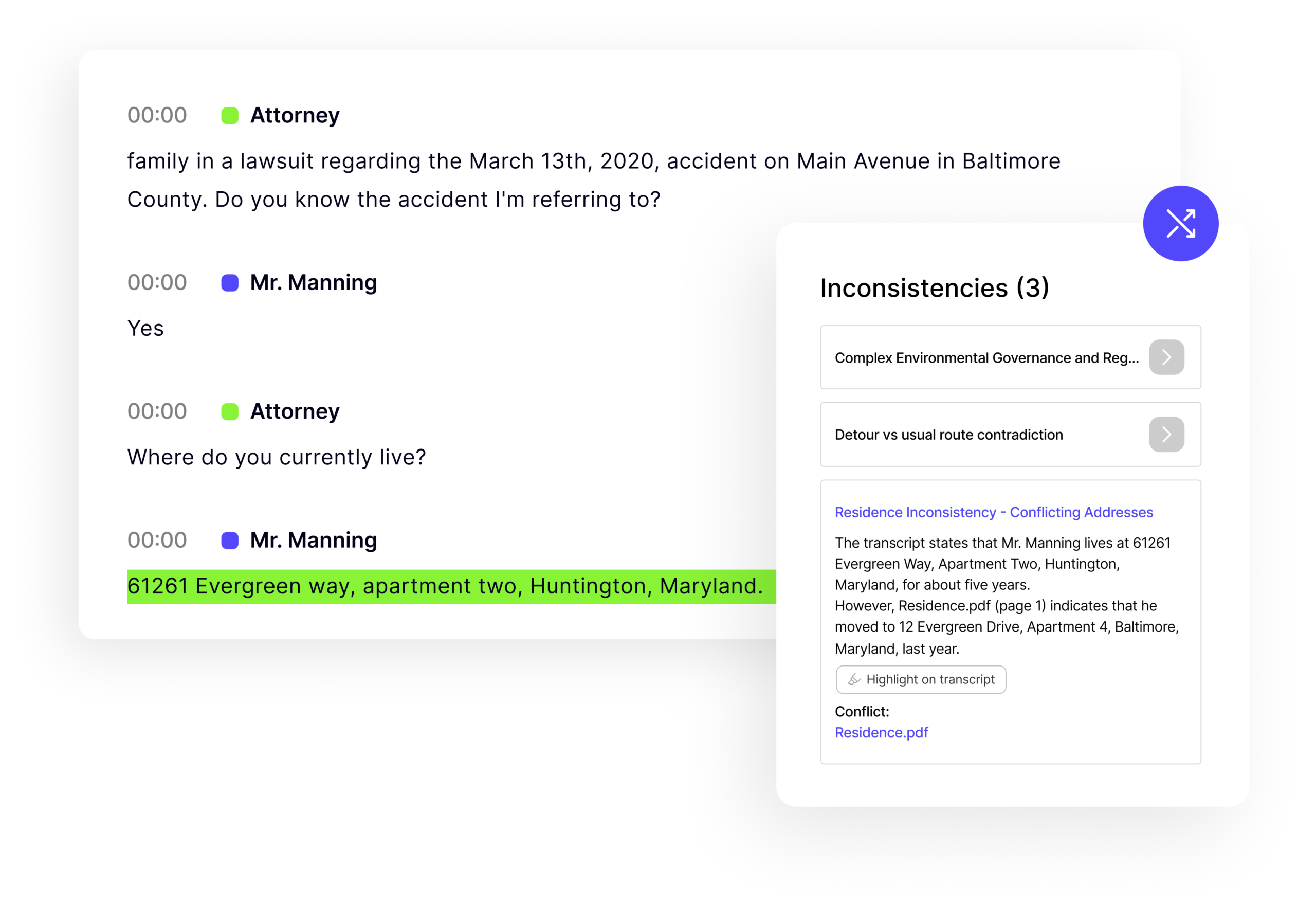
Amsterdam’s answer was to move toward technology-based transcription and applications that produce business insights. Legal Visor, launched in March 2025, makes that change tangible. It compares testimony with case materials and flags possible inconsistencies while a proceeding is underway. It also offers search and summaries. The intended purchase is time to ask a better follow-up.
There is a useful detail in the launch demonstration reported by LawSites: the second-chair attorney. The lawyer asking questions may be too occupied to watch another panel. A colleague can monitor the software and pass along a discrepancy. The product’s usefulness depends on the choreography of the room as much as the cleverness of the model.
Fisher Phillips and Smith, Gambrell & Russell helped develop Legal Visor as design partners. That is a practical way to build: put the tool beside the people who will use it, then discover what interrupts them. An impressive alert has little value if it arrives after the opportunity to question a witness has passed.
- 01 / CaptureSpeech becomes a draft.
- 02 / ContextTerms, speakers and documents matter.
- 03 / ReviewA person checks what matters.
- 04 / ActAsk, publish, search or share.
Behind these tools sits Captivate, Verbit’s proprietary recognition engine, introduced in 2024. It uses domain training and custom vocabulary. The proposition is sensible: a courtroom, a lecture and a television programme have different linguistic habits. Whether that produces enough improvement for a particular buyer is something to test with that buyer’s audio.
The caption is only half the job
Verbit’s customers also include universities, media businesses and corporate teams. Legal Capture handles recording, live editing and the path to reviewed legal finals. Campus Complete bundles campus media accessibility services. Translation, dubbing and audio description extend the offering beyond a page of text. These customers buy access, usable records and less work between recording and delivery.
In July 2026, Captivate Post Plus added professional quality control to automated media captioning. Its details are gloriously unglamorous: caption placement, offscreen speaker identification and sound labels. A file can spell the dialogue correctly and still obscure something on screen or fail to tell a viewer who spoke. The human job survives in those finishing decisions.
“Whenever we have something that is time sensitive, that is when we especially turn to Verbit.”
Marsha Naegeli · NAEGELI Deposition & Trial
Customer testimonial published by Verbit
Buy the workflow, test the result
Verbit sells software and services, with subscription offerings and tailored enterprise plans. Buyers book demos and specify their needs. Integrations with platforms including Zoom, Teams, Canvas and Panopto matter because a transcript stranded outside the customer’s daily tools creates another chore. The cost to compare is the whole job: generation, correction, formatting, review and delivery.
Its competition includes Rev and 3Play Media, which also combine AI with human expertise. Verbit’s distinction rests on its industry-trained engine, acquired captioning operations and live legal analysis. “AI plus humans” alone is no longer much of a dividing line.
The copyable lesson is to follow the customer’s next action. Test difficult names, overlapping speakers and representative recordings. Check the language support and the final output. Keep human judgment over legal flags and consequential records. A cheap draft can be enough for informal notes; a deposition team or broadcaster may need considerably more. Verbit’s next chapter depends on making that difference worth paying for.