In 2017, Van Andel Institute put $10 million into microscopes and the construction needed to house them. Consider the peculiar economics of that purchase. The machines would produce pictures of molecules. A useful drug might follow, eventually. First came the ability to see a biological problem clearly enough to ask a better question.
- VAI studies the machinery behind cancer, Parkinson’s and metabolic disease.
- Shared laboratory tools and clinical partnerships connect discovery with testing.
- Its education work runs from children’s science programs to a research doctorate.
That sequence explains much about this nonprofit in Grand Rapids. Biomedical discovery involves long stretches when the valuable thing is a sharper explanation. VAI’s distinctive proposition is to assemble people, equipment and collaborators around those explanations, then find ways to test what they might mean for human health.
01 A building for unanswered questions
Jay and Betty Van Andel founded the institute in 1996, envisioning an independent home for biomedical research and science education. Betty had been a teacher. The pairing of laboratory research with education was there from the beginning. Their son David now leads VAI as chairman and CEO; Jonathan D. Licht is its president and chief scientific officer.
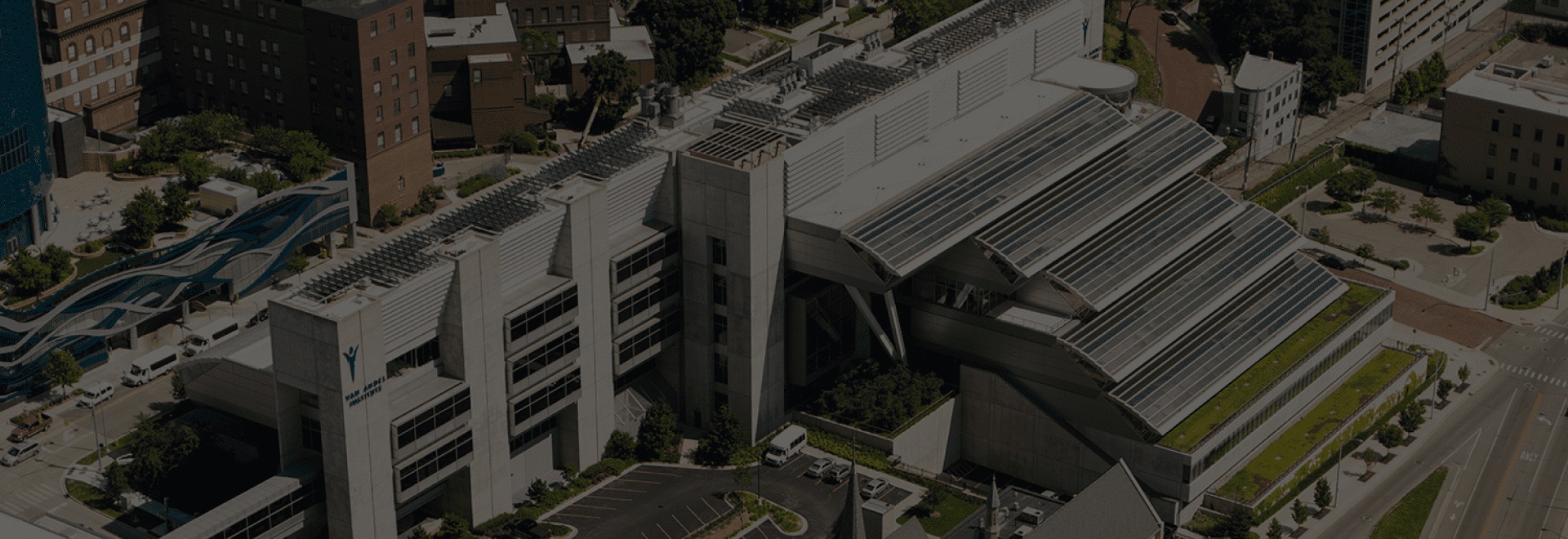
Rafael Viñoly’s building steps into a steep hill on Grand Rapids’ Medical Mile. Its two phases were completed in 2000 and 2009. Glass admits daylight; the second phase earned LEED Platinum certification. A 33,000-gallon tank catches rainwater. Even a place devoted to microscopic events has to solve ordinary problems of water, light and space.
02 The instructions beneath the instructions
One of VAI’s central interests is epigenetics: the mechanisms that regulate gene activity without changing the DNA sequence. A cell’s instructions need context. Which genes should be active? Which should stay quiet? When those controls malfunction, the consequences can include cancer. Researchers investigate the controls themselves, hoping to identify opportunities for treatment.
That work sits beside neurodegenerative science, metabolism, cell biology and structural biology. Their overlap matters. The shape of a protein can help explain its behavior; cellular metabolism can influence disease; gene regulation can connect questions that initially belong to different specialties. Sharing a building and scientific resources gives those conversations somewhere practical to go.
“We are an institute with and without walls.”
Peter A. Jones, on VAI’s collaborative approach
03 The expensive part can be shared
The 2017 microscopy investment illustrates the model. Cryo-electron microscopy lets scientists examine molecular structures in fine detail. Buying the instrument is only a beginning: people need technical expertise, computing and help interpreting what they see. VAI’s core facilities gather those capabilities so individual laboratories can draw on shared resources.
External academic and commercial researchers can use its cryo-EM services. Other cores offer genomics, optical imaging, flow cytometry, mass spectrometry and computational support. Requests, equipment scheduling and pricing run through CrossLab. For a scientist with a defined project, VAI can be a working resource rather than a distant name on a research paper.
There is a quieter form of sharing, too. The Bioinformatics and Biostatistics Core publishes workflows, applications and teaching materials on GitHub. The Shen laboratory’s BISCUIT toolkit analyzes DNA methylation sequencing data. A researcher elsewhere can inspect those methods and reuse the code. The collaboration can begin before anybody books a flight to Michigan.
Cryo-EM equipment + related construction
Financially, VAI belongs to the world of philanthropy, endowment support and research grants, with paid services and education offerings among its activities. It occupies a different position from a biotechnology company developing a proprietary drug portfolio. Comparable independent institutes and university laboratories compete for scientific talent and funding; clinical organizations supply another essential piece: testing ideas with patients.
04 When the attractive idea disappoints
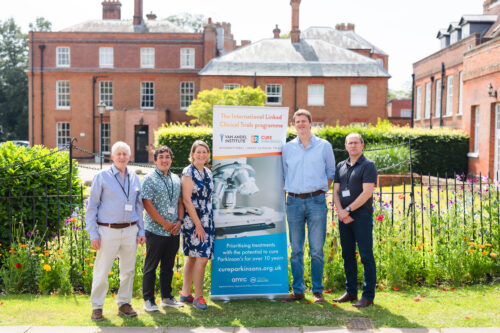
VAI’s partnership with Cure Parkinson’s supports International Linked Clinical Trials, which prioritizes potential treatments, including drugs developed for other conditions. Repurposing offers an appealing head start because researchers already know something about a medicine. Evidence from one disease, however, cannot establish benefit in another.
Exenatide made that distinction uncomfortable. The diabetes drug had generated hope for Parkinson’s. But a University College London-led phase 3 study involving 194 participants over 96 weeks found no evidence that it slowed progression or reduced symptoms. VAI and Cure Parkinson’s had funded accompanying studies of brain imaging and wearable movement measurement.
VAI’s February 2025 account discussed a possible delivery problem: analysis suggested only small amounts of exenatide reached the relevant brain area. That possibility sharpened the questions about related drugs; it did not overturn the negative trial. The useful habit here is separating enthusiasm for a mechanism from evidence that a particular treatment works.
05 Keep the evidence moving
In December 2025, VAI and Cure Parkinson’s renewed their agreement for three years, each pledging $750,000 annually. Together, the base commitments amount to $1.5 million a year. The broader program had launched 47 trials; VAI funding had supported 10. Those numbers describe a collaborative effort, with responsibility and resources spread among organizations.
In cancer, the VAI-Stand Up To Cancer Epigenetics Dream Team provides a similar bridge. Its 109-person EVITA trial examined oral vitamin C in certain blood disorders. September 2026 results included an exploratory survival signal, but no significant difference in abnormal blood-cell growth rates. A larger phase 3 trial must confirm the finding. Interesting biology still owes the patient convincing evidence.
06 Curiosity needs somewhere to start
The institute also trains the people who will ask the next questions. Its Graduate School offers a Ph.D. in molecular and cellular biology through problem-based learning and laboratory research. Its K-12 arm provides student programs, field trips, teaching resources and professional development. Teachers and families have an immediate way into an organization whose medical ambitions take much longer.
Those audiences need different doors. A teacher can explore classroom resources. A prospective doctoral student can examine admissions and faculty research. A laboratory can request a service. A donor can support the work through giving or community fundraising. Each route connects a broad mission to something a person can actually do.
For other organizations, the transferable idea is straightforward: pool expensive capabilities, connect specialists and preserve the ability to revise an assumption. The conditions matter. Equipment requires staff and maintenance. Collaborations require clinical partners. Discovery requires patient funding. VAI’s model gives those requirements an institutional home, while leaving the answer to the experiment.