There was a word in the clinical-trial summary that adults in a pharmaceutical company had no trouble with: placebo. It is an ordinary word if you spend your days around trials. Then Health Literacy Media showed the summary to the people it was actually for - children with type 1 diabetes and their parents. Some children did not know the word. They did not know how to say it, either. So HLM added a pronunciation key.
Another phrase fared worse. “Mixed meal tolerance test,” the formal name for a trial endpoint, did not survive the interviews. HLM replaced it with “liquid meal” and an explanation of what happened. The changes came from a modest round of virtual testing: four parents read the summary with their children; one child also joined an interview. Tiny sample, precise job. The revised document was translated into six languages, reviewed locally, and in 2026 won the Grand ClearMark for plain-language communication.
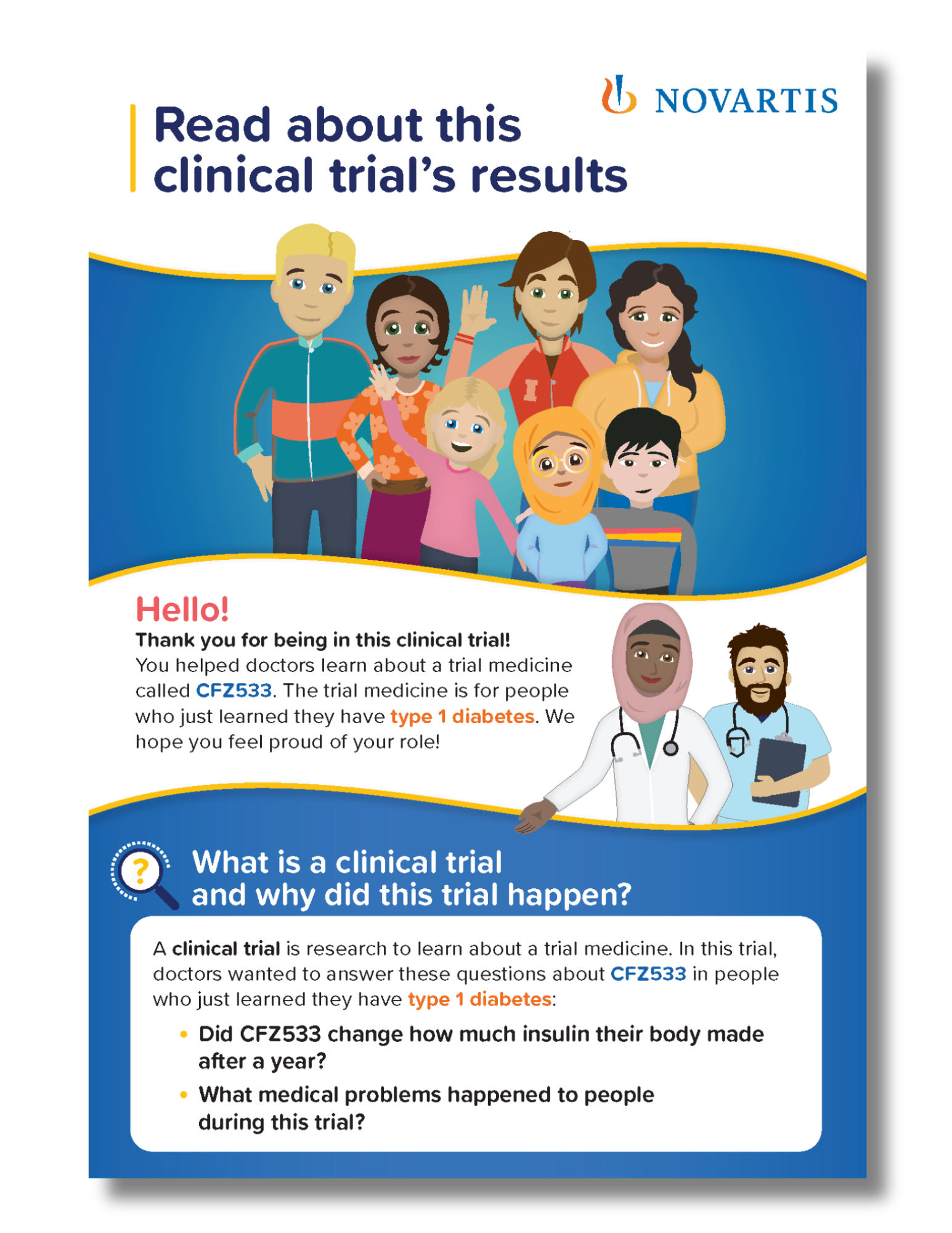
That story contains the entire operating system of Health Literacy Media, a St. Louis nonprofit with the habits of a research shop and the output of a creative studio. Understand the science. Write and design the thing. Put it in front of the intended audience. Let the audience embarrass the draft. Revise.
Health information is not clear because the author approves it. It is clear when the audience can use it.The HLM proposition, in one sentence
The draft is only a hypothesis
Most communication agencies can shorten a sentence. A medical-writing team can preserve scientific detail. A design studio can make a page inviting. HLM sits in the narrow seam between all three, then adds a fourth discipline: it recruits people, conducts interviews, surveys, and focus groups, helps with institutional-review-board submissions, and turns the failures into a recommendation report.
Science, risk, rules, audience
Words, pictures, formats
Interviews, surveys, groups
Evidence back into the work
The company calls this health literacy, but that term can sound remedial, as though the patient is the broken part. HLM’s practice points the burden in the other direction. A consent form, website, video, or discharge instruction is a product. If people cannot use it, the product has failed. The fix may be common words and short sentences; it may also be a diagram, a bilingual site, a virtual coach, a better sequence of ideas, or a person available to help.

A Missouri name outgrown
HLM began in 2009 as Health Literacy Missouri, the result of years of work by St. Louis health leaders and the Missouri Foundation for Health. It moved quickly: provider training, a statewide summit, community initiatives, an online library containing more than 10,000 resources. The founding foundation supplied heavy grant support. That support made the organization possible, but it also created the first business problem.
In 2012, the board and staff began planning a multi-year exit from that dependence. Early experiments pointed to an answer. HLM’s social-media work had built an audience; a health-literacy documentary, made in four versions for four different audiences, won a Silver Telly and received a regional Emmy nomination. Video scripting and production could be a service. So could training, document revision, design, and testing. Mission became expertise; expertise became something customers bought.
By 2016, “Missouri” had become misleading. The company said its clients stretched from Los Angeles to New York, Minnesota to Madrid. It kept the initials and changed the final word to Media. The rebrand was not cosmetic. It recorded what had changed the organization’s mind: the methods developed for one state traveled.
Reported in IRS-derived nonprofit filing data.
A real operating cost, and a roughly $300,000 shortfall that year.
Today the customer list is broad: pharmaceutical companies, hospitals, researchers, government agencies, universities, nonprofits, advocacy groups, and community organizations. They buy project work rather than a software subscription. HLM reviews or creates the material, designs the format, tests it, trains the professionals, or runs a program. Its public filing data suggest that earned and other income, rather than donations, supplies most revenue. This is a nonprofit, but not a charity-box business.
Two programs show the range
Clearly Communicating Clinical Trials, or C3T, follows a study from recruitment to results. HLM makes recruitment materials, consent documents, data-collection forms, study updates, and lay summaries. The point is not merely friendlier copy. Clear consent makes participation meaningful; clear forms can improve the information a study collects; understandable results acknowledge what participants contributed.
Explore Transplant & Living Donation tackles a different high-stakes decision. Built with transplant-education researcher Amy Waterman, it includes print and digital education, animated coaching, real-life donor stories, patient decision support, and training for dialysis providers. More than 4,000 providers have been educated through the programs, leading to better transplant education for more than 28,000 kidney patients.
The same transplant expertise now feeds a three-year national program funded by the federal Health Resources and Services Administration. Living donors can face travel bills, lost wages, and dependent-care costs. A federal reimbursement program helps eligible donors, yet many potential donors do not know it exists. HLM and its partners are building a multilingual campaign across a website, text, email, social media, live help, and peer mentors. It is a characteristic HLM assignment: the benefit already exists; the obstacle is understanding and navigation.
What the clever reader should steal
HLM’s method is portable. A clinic, research team, insurer, or public agency does not need an animated character on every project. It does need to stop treating readability as a score produced at the end. The audience belongs inside production.
A usable clarity loop
- Name one action the audience should be able to take.
- Write for their situation, not the organization chart.
- Pair words with visuals only when the visual does explanatory work.
- Test with people who resemble the real users, including those likely to face the greatest barriers.
- Record exactly where they hesitate, misread, or give up - then revise and test again.
There are limits. Plain language cannot rescue inaccurate science, a service people cannot afford, or a system designed to deny access. A focus group cannot stand in for individualized medical advice. Translation without local review can produce correct words that feel foreign. And a tiny test is useful only when the question is narrow; it cannot prove that an entire population will behave the same way.
General agencies
Strong at campaigns and production, but may lack clinical, regulatory, and health-literacy depth.
HLM's seam
Research rigor, health education, audience testing, plain-language writing, and design in one team.
In-house teams
Close to the science and institution, but often too close to notice what an unfamiliar reader cannot decode.
This is also where HLM’s advantage can disappear. If the client will not let users challenge the draft, if legal review treats every technical term as sacred, or if production begins after all meaningful decisions have been made, HLM becomes just another pair of editing hands. Its process works best when the organization is willing to discover that its first answer was wrong.
The word placebo was not wrong. “Mixed meal tolerance test” was not wrong. Wrongness was never the interesting question. The question was whether a teenager living with diabetes could move through the page without being made to feel that the science belonged to someone else. Health Literacy Media’s business is the small, consequential distance between those two standards.