The interesting number in Trustmark’s 2024 results was a loss: $182.8 million. That was the price, before taxes, of selling a portfolio of investment securities. For a bank, voluntarily making a number that ugly appear in the accounts requires an explanation. Trustmark’s was unusually concrete. The securities it sold yielded an average of 1.36%. The securities it bought yielded 4.85%. The bank was paying to escape yesterday’s economics.
There is a useful question hiding in that trade. When does keeping something become more expensive than letting it go? For this Mississippi institution, answering it meant selling a business that had worked rather well.
- Trustmark combines household banking, commercial lending and wealth services across six states.
- Its 2024 insurance sale created room for a costly securities reset.
- Its local-service proposition comes with a serious fair-lending chapter.
The expensive part was standing still
In April 2024, Trustmark announced a $345 million agreement to sell Fisher Brown Bottrell Insurance to Marsh McLennan Agency. The business had grown from one Jackson office to ten across three states. The announced price represented about 5.9 times its 2023 revenue. A valuable operation had attracted a valuable offer.
The completed sale produced a $228.3 million pre-tax gain. In the same quarter, Trustmark sold $1.561 billion of securities and bought $1.378 billion of replacements. The securities loss was $137.1 million after taxes. The insurance gain was $171.2 million after taxes. These were separate transactions, but together they gave the bank room to absorb the reset.
What had stopped working was the return on the old portfolio. In a higher-rate environment, low-yield assets become awkward companions to deposits that cost more to retain. Trustmark publicly pointed to strong insurance brokerage valuations and the opportunity to improve earnings. The decision joined those two facts. It did not require the insurance business to be broken.
A regional bank with several front doors
Trustmark’s family tree starts with Jackson Bank in 1889, passes through mergers, and acquires the Trustmark name in 1985. Another change came in August 2025: a Mississippi state charter replaced its national charter, and Trustmark National Bank became Trustmark Bank.
Today it occupies the middle ground between a neighborhood institution and a national network. Its offices span Alabama, Florida, Georgia, Mississippi, Tennessee and Texas. At the end of 2025, it operated 160 full-service branches and seven limited-service branches. That gives a customer physical places to go, alongside the familiar conveniences of an app.
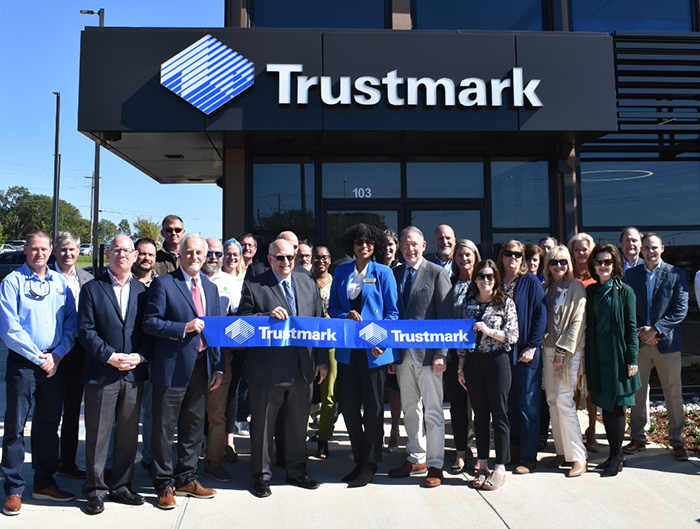
The small detail that explains the model is myTeller. An interactive teller machine connects customers to a live teller by video. The bank extends human service through a machine, an arrangement that makes sense for someone who wants help without arranging the day around lobby hours.
From a paycheck to a payroll
For households, the entry point is ordinary: checking, savings, a credit card, perhaps a mortgage. myTrustmark handles mobile check deposits, bill payments, transfers and spending tools. Its usefulness is the removal of errands. A deposited check no longer automatically means a trip across town.
The price depends on behavior. Simple Checking requires $50 to open and charges $10 monthly unless a waiver condition is met: 15 debit transactions, $100 in direct deposits, or a $1,500 average daily balance per statement cycle. Other charges can apply. For someone choosing an account, that small print is more useful than a slogan.
For a business owner, the problem changes. Money arrives unevenly, suppliers expect payment, and someone needs to know what is available. Trustmark offers commercial credit, cash management, account reporting, ACH payments and wire transfers. The service connects borrowing with the less glamorous work of moving and monitoring money.

Wealth services add trust administration, investment management and retirement planning. Securities and investment advisory services involve the disclosed Raymond James entities. A customer choosing among these services needs to understand who provides each one and its terms.
The business model follows those jobs: earn interest on loans and securities, pay for funding, and collect fees for services. Regional rivals, national banks, credit unions and online providers compete for different pieces. Trustmark’s pitch is the combination of those pieces with an accessible banking relationship. That proposition matters most when a customer’s needs span several services.
Delivering it also takes people. Trustmark advertises internships, an IT co-op and a Development Associate Program. These are concrete investments behind its stated emphasis on employee development. They also reveal a practical requirement of the model: people must understand both the banking system and the customer across the desk.

The neighborhoods in the footnote
A local relationship deserves scrutiny about who receives it. In 2021, federal authorities reached a settlement with Trustmark over allegations that it had avoided predominantly Black and Hispanic neighborhoods in Memphis between 2014 and 2018. The complaint addressed branch locations, loan officers, marketing and fair-lending controls.
The agreement required a $3.85 million loan subsidy fund, $400,000 for community partnerships and at least $200,000 annually for outreach and related initiatives. Civil penalties totaled $5 million. The Justice Department said the bank cooperated with the investigation. These obligations belong in any assessment of its community banking promise.
“People you trust. Advice that works.”
Trustmark’s brand line
The part worth copying
Trustmark offers a practical management lesson: value an asset against its alternatives. A business can be profitable and still be worth selling. An investment can keep paying interest and still impose a substantial opportunity cost. Writing down that comparison is something a much smaller company can copy.
The conditions matter. Trustmark had a buyer, a valuable insurance operation and capacity to absorb losses. Without those, the same maneuver could weaken a bank. Nor does a higher replacement yield guarantee better results once funding costs and credit losses enter the calculation.
The subsequent numbers are encouraging, with qualifications. Trustmark Corporation reported $224.1 million in 2025 net income. Second-quarter 2026 profit was $63.5 million; its operating figure, excluding non-routine items, was $56.7 million. Those are different measures. The next earnings release is scheduled for October 27. The bank’s experiment in paying to move on now has results to keep testing.