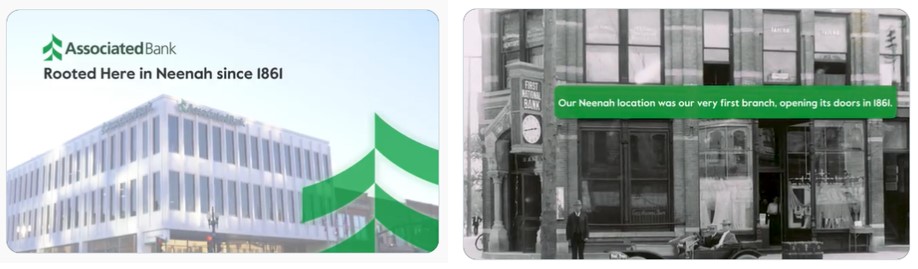
In Neenah, Wisconsin, a bank keeps leather-bound ledgers from the nineteenth century. They are handwritten, which makes them charming. They are also an early version of the same calculation occupying its executives today: whose money comes in, whose money goes out, and what remains between the two.
The ledgers belong to the family tree of Associated Bank. Its oldest predecessor dates to 1861. The interesting part of this story, however, is recent. In December 2024, its parent announced a decision that sounds peculiar outside banking: sell assets, accept a substantial loss, and make the business better equipped to grow.
- The business: everyday accounts, commercial lending and wealth services, anchored in the Midwest.
- The reset: replace low-yield assets and reduce expensive borrowing, accepting an immediate earnings hit.
- The next test: turn a larger footprint into deeper customer relationships.
A tree with three trunks
Associated emerged in 1970 when three northeast Wisconsin banks joined forces: Kellogg Citizens, Manitowoc Savings and First National Bank of Neenah. Its evergreen emblem arrived in 1992. The symbol has an unusually literal backstory. Pine lumber helped build the region’s economy, and the predecessor banks financed lumber businesses.
The First Financial merger in 1997 added another layer. This is a company assembled from local institutions, carrying their customers and accumulated habits into a larger organization. A branch can retain a town’s banking history while the balance sheet behind its counter becomes something much bigger.
The customer has more than one problem
For a household, Associated provides checking, savings, mortgages and home-equity borrowing. Its digital service handles tasks such as moving money and managing cards. For a business, the conversation widens: financing inventory, buying property, collecting payments and making payroll. Treasury management addresses the daily movement of cash that continues long after a loan closes.
Private wealth adds investment management, financial planning, private banking and trust services. A customer selling a business might need several of those at once. That overlap explains the strategy. A mortgage-only customer gives the bank one relationship. A business owner who also keeps operating deposits and needs succession planning gives it several ways to remain useful.
Associated occupies the regional middle ground between neighborhood lenders and national institutions such as U.S. Bank, BMO and JPMorgan Chase. Its proposition combines nearby bankers with a broader commercial and wealth toolkit. Whether that combination matters depends on the customer: a complex borrowing problem rewards expertise; a straightforward savings account may turn on price and convenience.
The expensive arithmetic of starting again
A bank earns much of its money from the gap between income on loans and securities and the cost of funding them. Fees from accounts, cards, wealth management and other services add another stream. Old assets paying modest yields can become awkward companions to more expensive funding.
Associated’s December 2024 announcement made that mismatch visible. It sold approximately $1.3 billion of securities yielding 1.87%, planned roughly $1.5 billion of reinvestment at 5.08%, and agreed to sell about $700 million of mortgages yielding approximately 2.99%. Proceeds would also help repay Federal Home Loan Bank advances costing about 5.90%.
The rationale was explicit: remove low-yield assets and create capacity for relationship lending. The company’s proxy discussion of 2023 had already described a shift away from its previous operating model. What had become less useful was the economics of parts of the portfolio. The public record supports that explanation without requiring a dramatic conversion scene in the boardroom.
The cost was substantial. Full-year reporting identified a $130 million mortgage-sale loss, a $148 million investment-sale loss and a $14 million borrowing-prepayment loss, alongside other adjustments. The parent posted a $164 million fourth-quarter loss. Shareholders also absorbed dilution from a separate equity offering. Changing direction required capital as well as conviction.
An app still needs a balance sheet
The reset accompanied a less theatrical investment: better banking software. Associated launched a modernized digital platform in September 2022. By early 2025, management reported approximately $35 million invested in digital since 2022, alongside card controls, account-opening improvements and financial wellness tools. It reported digital sales up 42% in 2024 compared with 2021.
There was a physical trade-off. Earlier investor materials described branch consolidation, staffing reductions in selected functions and back-office closures as helping fund digital investment. The practical lesson is specific: finance improvements by deciding which existing costs no longer earn their place. A prettier app alone cannot repair unfavorable funding economics.
“2025 was a pivotal year for Associated Bank.”
Andy Harmening, president and CEO, January 2026
The parent’s 2025 net income available to common equity reached a company-record $463 million, versus $112 million in 2024. That comparison includes the previous year’s restructuring charges, so the jump exaggerates the underlying acceleration. A cleaner operating clue: annual net interest margin rose from 2.78% to 3.03%.
Now make the bigger bank feel close
Expansion supplies the next experiment. Associated completed its American National acquisition on April 1, 2026. Announced the previous December at approximately $604 million in stock, the deal extended its reach in markets including Omaha and the Twin Cities. By October, management said the conversion was complete.
The October 22 results put parent-company assets at $51 billion, with more than 200 banking locations across six states. Third-quarter earnings available to common equity were $144 million. But nonaccrual loans also rose from the previous quarter. Acquisitions enlarge the business; they do not suspend credit risk.
For customers, the useful question remains delightfully unglamorous: can this bank solve the next problem? For operators, the transferable idea is to inspect inherited economics before adding more products. The approach depends on capital, customers who stay and loans that perform. Without those, accepting losses today may simply leave less room tomorrow.
Follow the money
Explore the bank, its products and its ongoing news.