MAMMOTH BIOSCIENCES RAISES $465M+ TO BUILD NEXT-GEN CRISPR CURES NANOCAS: FIRST ULTRACOMPACT EXTRAHEPATIC GENE EDITOR ANNOUNCED JAN 2025 BAYER COLLABORATION VALUED AT OVER $1 BILLION REGENERON PARTNERSHIP FOR IN VIVO GENE EDITING TREVOR MARTIN - FORBES 30 UNDER 30 - FORTUNE 40 UNDER 40 DETECTR BOOST: FIRST CRISPR COVID TEST WITH FDA EMERGENCY USE AUTHORIZATION 30% GENE EDITING EFFICIENCY IN PRIMATE SKELETAL MUSCLE - ASGCT 2025 MAMMOTH BIOSCIENCES RAISES $465M+ TO BUILD NEXT-GEN CRISPR CURES NANOCAS: FIRST ULTRACOMPACT EXTRAHEPATIC GENE EDITOR ANNOUNCED JAN 2025 BAYER COLLABORATION VALUED AT OVER $1 BILLION REGENERON PARTNERSHIP FOR IN VIVO GENE EDITING TREVOR MARTIN - FORBES 30 UNDER 30 - FORTUNE 40 UNDER 40 DETECTR BOOST: FIRST CRISPR COVID TEST WITH FDA EMERGENCY USE AUTHORIZATION 30% GENE EDITING EFFICIENCY IN PRIMATE SKELETAL MUSCLE - ASGCT 2025
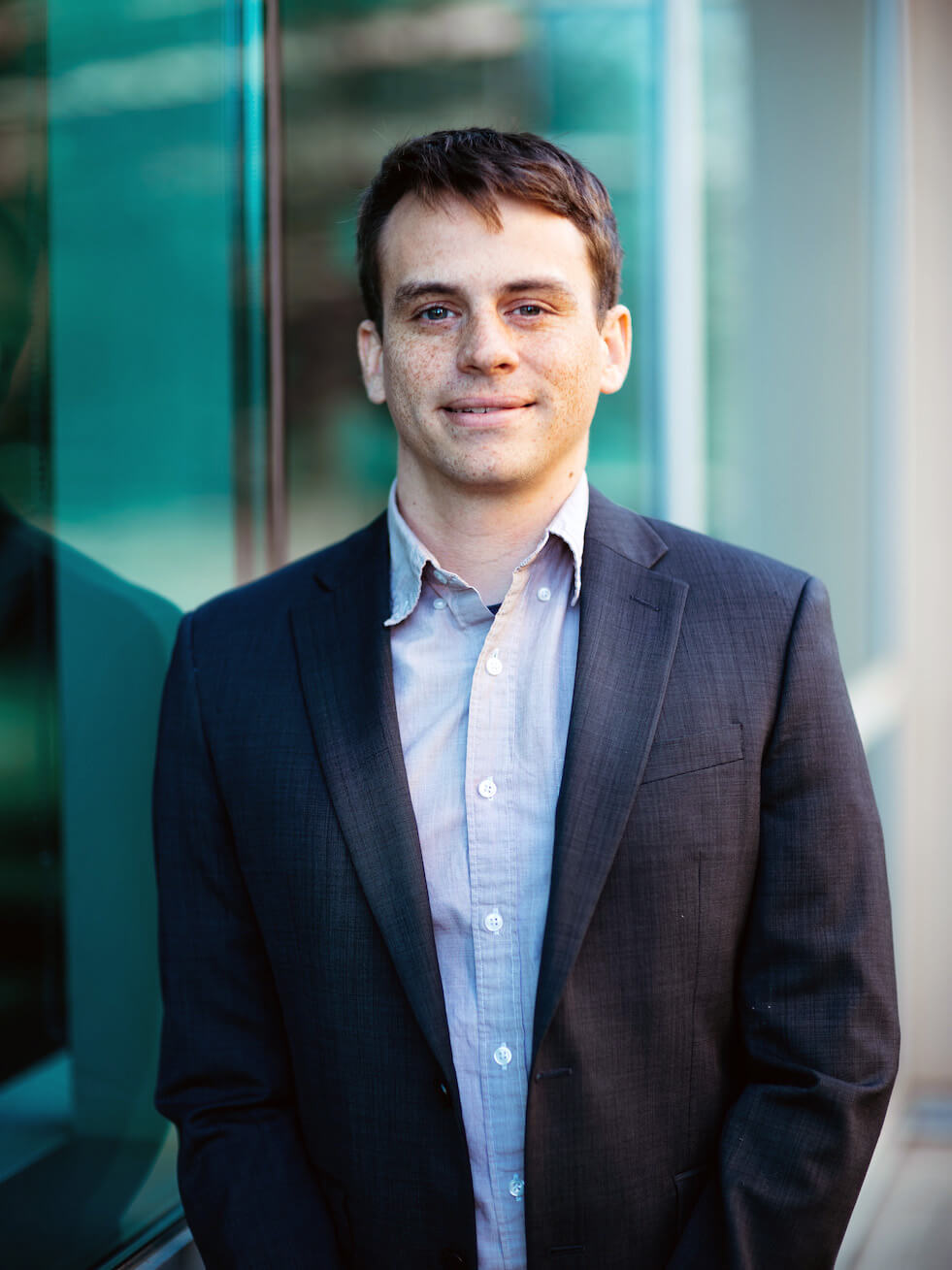
Trevor Martin, Co-Founder and CEO of Mammoth Biosciences
Profile / Biotechnology / CRISPR

Trevor
Martin

The kid from Atlanta who cold-emailed a Nobel laureate - and rewrote what CRISPR can do.

Co-Founder & CEO Mammoth Biosciences CRISPR Therapeutics Gene Editing Forbes 30U30
$465M+ Total Raised
$1B+ Bayer Deal
210 Employees
2017 Mammoth Founded
30% NanoCas Muscle Editing Efficiency
1st CRISPR COVID Test FDA EUA
1/3 Size of Standard Cas9

Nature's Search Engine,
Not Just a Pair of Scissors

When Trevor Martin was finishing his PhD at Stanford, he sent a cold email to Jennifer Doudna. Not a warm intro through a professor, not a conference handshake - a cold email. That email connected him with two of Doudna's graduate students, Janice Chen and Lucas Harrington, and in 2017, the four of them launched Mammoth Biosciences with a bet that most of the biotechnology world had not yet made: that the CRISPR universe was far larger than anyone had catalogued.

Martin grew up near Atlanta, and his earliest instinct was not toward biology at all - it was physics and chemistry that drew him in. Princeton's Integrated Science Program changed the frame. Designed by David Botstein, the program fused biology with computation, statistics, and chemistry into a single discipline. Martin discovered that the interesting country lay at the borders between fields, not in their centers. He won top honors at Princeton for his molecular biology thesis, then moved straight to Stanford for a PhD under Hunter Fraser (Biology) and Susan Holmes (Statistics), where he built statistical tools to map how gene expression variation shapes human disease.

That combination - deep quantitative fluency inside a biology PhD - turned out to be an unusual credential for a biotech CEO. Most biotech founders arrived from medicine or from chemistry. Martin arrived from the overlap, which gave Mammoth its founding premise: that CRISPR systems are not just molecular scissors but a vast library of biological search tools waiting in microbes across every ecosystem on earth, and that the company with the best map of that library would win.

"We think about CRISPR as this kind of search engine rather than just a pair of scissors."
- Trevor Martin, Co-Founder and CEO, Mammoth Biosciences

The early years of Mammoth moved fast. The company initially built a CRISPR diagnostics platform, and when COVID-19 arrived, that platform became suddenly, urgently relevant. In 2021, the FDA granted Emergency Use Authorization for DETECTR BOOST, the first CRISPR-based high-throughput COVID-19 test - a landmark that validated both the technology and the team's ability to navigate regulatory terrain at speed.

But the bigger bet was always therapeutics. Mammoth's core intellectual contribution is the discovery and engineering of ultracompact CRISPR systems - proteins one-third the size of the standard Cas9 that everyone else was working with. That size difference is not aesthetic. It determines what can fit inside an adeno-associated viral (AAV) vector, the delivery vehicle used to get gene editors into cells inside the body. Standard CRISPR tools fill an AAV to capacity. Mammoth's ultracompact systems leave room for the cargo - the editing machinery itself - and can reach tissues that standard CRISPR cannot.

In January 2025, Mammoth announced NanoCas - described as the first efficient ultracompact extrahepatic gene editor - with in vivo editing efficiencies of up to 30% in the skeletal muscle of cynomolgus macaques. Skeletal muscle has been one of gene therapy's persistent hard targets. NanoCas reached it. The company then presented preclinical data at the American Society of Gene and Cell Therapy (ASGCT) annual meeting in New Orleans in May 2025, with a lead program designated MB-111.

The company's partnership list tells its own story of validation: a Bayer strategic collaboration potentially valued at over one billion dollars, a Regeneron collaboration for in vivo gene editing, and an NIH contract. Tim Cook is among Mammoth's individual investors. Total capital raised has passed $465 million, including over $100 million in non-dilutive funding. The company employs more than 200 people.

Martin's management philosophy reflects his training as much as his background. He talks about the CEO job as three things: setting strategic direction, recruiting great people, and managing capital. He is deliberate about hiring for what he calls "culture-add over culture-fit" - the person who changes your organization rather than just fitting into it. His literary touchstones are Emerson and Whitman, which tells you something about the self-reliance and expansiveness that he carries into the work. He still uses "y'all." He credits NPR for the absence of a Southern accent.

"Let others say 'no' to you - you don't have to say no to yourself."
- Trevor Martin

What he is building, in his own framing, is something on the scale of Genentech - a company that does not just develop one drug but creates a platform that generates cures across multiple disease categories. The CRISPR landscape is crowded and fast-moving, with Editas, CRISPR Therapeutics, and Intellia among the established players. Mammoth's edge is the breadth of its CRISPR system library and the size advantage its ultracompact tools provide. Whether NanoCas or a successor becomes the gene therapy vector of the 2030s, this is the company that found the tools smallest enough to try.
Why Smaller is Everything in Gene Therapy

The Size Advantage: Mammoth's CRISPR Systems vs. Standard Cas9

AAV vectors are the delivery trucks of gene therapy. They have a fixed cargo capacity. Standard CRISPR tools (SpCas9) fill that truck. Mammoth's ultracompact systems leave room for the editor - and can reach tissues the truck couldn't reach before.

Standard SpCas9

Protein Size (relative)
AAV Packaging Room
Tissue Access

~1,368 amino acids. Barely fits in AAV with guide RNA. Primarily limited to liver delivery at scale.

Mammoth NanoCas (Ultracompact)

Protein Size (relative)
AAV Packaging Room
Tissue Access

~1/3 the size of Cas9. Single AAV delivery. Reaches skeletal muscle, eye, lung - tissues standard CRISPR cannot efficiently target. 30% editing efficiency in NHP muscle demonstrated.

The Long Game

2007-2011 Princeton University - Integrated Science Program (Biology). Awards top honors for molecular biology senior thesis. Discovers computational biology at the intersection of math and life sciences.
2011-2017 Stanford PhD in Biology under Hunter Fraser and Susan Holmes. NSF fellowship. Develops novel statistical tools for understanding how DNA sequence variation shapes gene expression and disease. Bio-X Bowes Fellow.
2017 Co-founds Mammoth Biosciences with Jennifer Doudna, Janice Chen, and Lucas Harrington. Seeds the founding thesis: map and engineer CRISPR's full natural diversity.
2020 Mammoth raises $45M Series C. DETECTR COVID-19 diagnostic platform launches. Partners with GSK on decentralized CRISPR diagnostic tools.
2021 FDA Emergency Use Authorization for DETECTR BOOST - the first CRISPR-based high-throughput COVID test. $195M Series D. Forbes 30U30, Fortune 40U40, EY Entrepreneur of the Year.
2023 Bayer strategic collaboration announced, potentially worth over $1 billion. Mammoth gains major pharma validation for its ultracompact CRISPR therapeutics platform.
2024 $100M Series E closed. Regeneron collaboration announced for in vivo gene editing. Martin presents at JP Morgan Healthcare Conference on AI-driven CRISPR discovery.
2025 NanoCas announced - first efficient ultracompact extrahepatic gene editor. 30% editing efficiency in non-human primate skeletal muscle. Preclinical data on MB-111 presented at ASGCT 2025.

In His Own Words

"There are no textbooks for how to do your project - the main point being that no one has done it before."

"It takes a team to make a difference. I believe that empathy, the ability to listen to others and recruit good people is the core."

"It's more about the people you work with than timing. If you work with a team you really respect and feel prepared to go on a long journey with, timing becomes secondary."

"I could be a really good biologist and a really good statistician... going across fields can be unique in general."

Milestones That Moved the Field

🏆

First CRISPR COVID Test - FDA EUA

DETECTR BOOST became the first CRISPR-based high-throughput COVID-19 diagnostic to receive FDA Emergency Use Authorization (2021).

🧬

NanoCas - First Extrahepatic Editor

First efficient ultracompact CRISPR system capable of extrahepatic in vivo editing via a single AAV vector. 30% efficiency in primate muscle (2025).

💰

$465M+ Raised

Built Mammoth Biosciences into one of biotech's best-capitalized CRISPR companies, including $100M+ in non-dilutive funding.

🤝

Bayer Partnership - $1B+ Value

Strategic collaboration granting Bayer access to Mammoth's ultracompact CRISPR systems for in vivo gene editing therapies.

🔬

Regeneron Collaboration

Partnership to pair Mammoth's ultracompact CRISPR systems with Regeneron's delivery technologies for next-generation gene therapies.

Forbes 30U30 + Fortune 40U40

Named to both Forbes 30 Under 30 (Healthcare) and Fortune's 40 Under 40 lists. EY Entrepreneur of the Year 2021.

Things Worth Knowing

01

He cold-emailed Jennifer Doudna during his Stanford PhD. That email led to co-founding Mammoth Biosciences. One email. One company. Over $465 million raised.

02

Tim Cook - yes, the Apple CEO - is among Mammoth Biosciences' individual investors. Martin's pitch was compelling enough to reach Cupertino.

03

He grew up near Atlanta disliking biology. Physics and chemistry were his things. Princeton's Integrated Science Program flipped that completely.

04

Despite years at Princeton and Stanford, Martin still uses "y'all." He credits listening to NPR for not developing a full Southern accent. The two facts coexist comfortably.

05

His literary heroes are Emerson and Whitman - self-reliance and the embrace of contradiction. Not the obvious reading list for a biotech CEO, but it maps to how he actually builds.

06

Mammoth's early investor James Currier of NFX was met at a chance encounter at a Stanford accelerator demo day. Martin didn't manufacture that meeting. He just showed up.

Trevor Martin in Conversation

In Conversation with Trevor Martin - Mammoth Biosciences

YouTube Interview

🎙

STANFORD eCORNER PODCAST

"Building Biotech to Last"

Listen Now

Building Biotech to Last - Stanford eCorner

Podcast Interview

Find Trevor Martin Online

Share This Profile