A purchase order is a small thing to build a theory of artificial intelligence around. It has quantities, suppliers, prices and somebody waiting for a signature. Yet on TransData's procurement page, the revealing detail comes at the end of the workflow. After the forecasting, supplier comparison and document preparation, a human buyer gets the final decision.
That last step helps explain this Austin technology services company's place in the AI market. TransData builds software and automation. It also supplies the people, support processes and operational discipline needed once the software meets an ordinary working day. The interesting question is how those parts fit together.
- Build the software, connect the systems, keep the operation running.
- AI agents share the workflow with reviewers and support teams.
- Buyers can engage engineering teams, focused delivery programs or managed operations.
A buyer still has to say yes
Consider the proposed procurement journey. TransData's AI Procurement Manager monitors inventory and sales orders, forecasts demand, checks supplier histories and prepares requests for quotations. It compares proposals and generates purchase orders. The buyer reviews the recommendation before execution. A familiar administrative chore becomes a sequence of distinct decisions.
The distinction matters because those decisions have different consequences. Finding a shortage is one task; committing money to a supplier is another. TransData's offering keeps approval visible inside the process. Its website identifies ERPNext as tested and operational. Other enterprise systems appear as customization possibilities, a reason for prospective customers to ask about their particular integration.
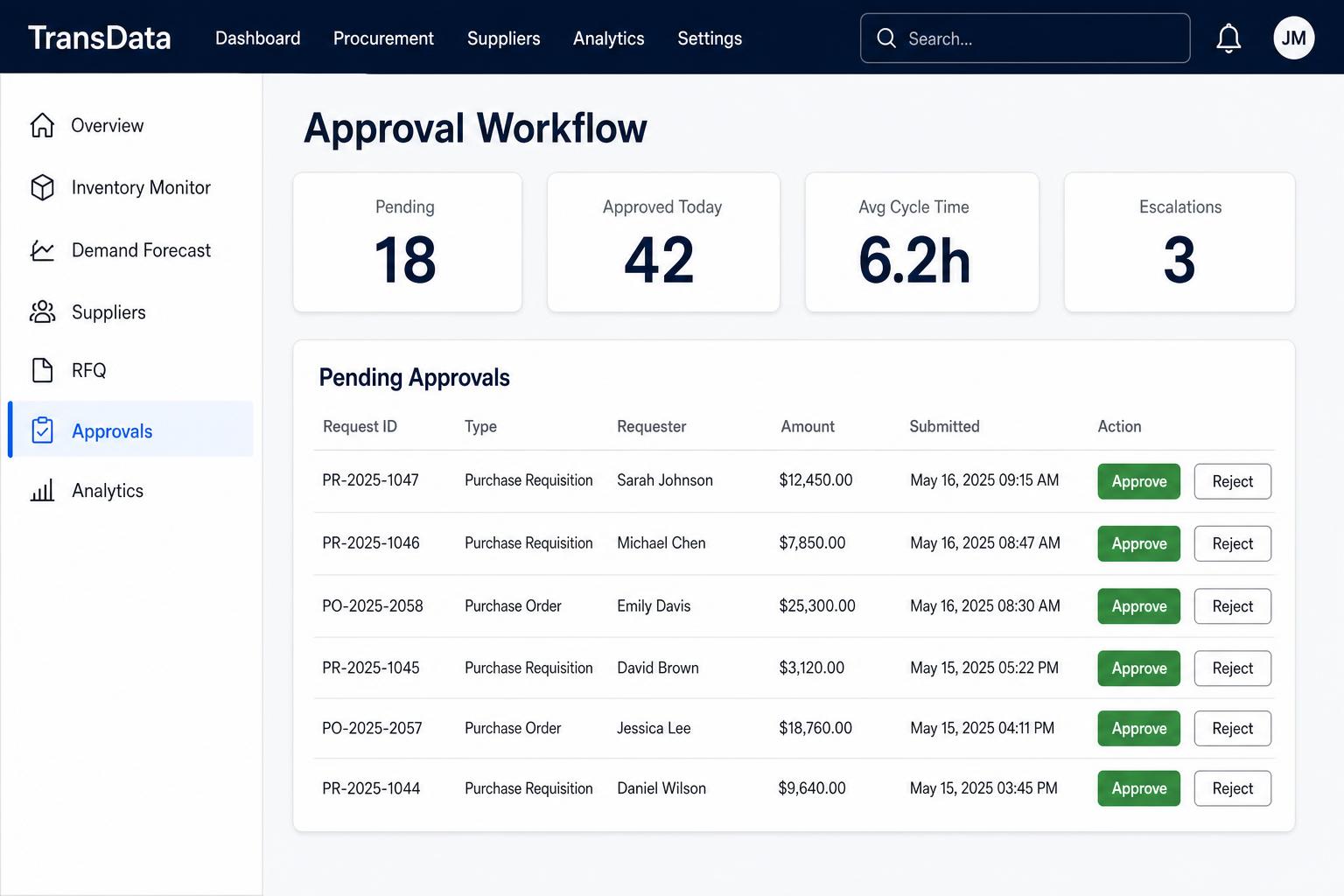
This is a useful window into a services company whose catalog otherwise threatens to become an alphabet soup. AI, RPA, MLOps, CRM: each abbreviation describes a tool or discipline. The purchase order supplies something easier to understand - a job that must actually get finished.
The company between the systems
TransData's current website dates the business to 2004 and describes an evolution from software engineering into six connected capabilities. These span product development, intelligent systems, data, automation, cloud transformation and managed delivery. Founder and CEO Mian Ali remains the public face of that proposition.
The customers it targets include software companies, midmarket enterprises, consulting firms and private equity portfolios. A product company might need developers inside its existing team. A consulting firm might need someone to implement its recommendations. An operating business might need customer records to move reliably between billing, support and its CRM.
TransData offers five engagement routes: embedded engineering teams, product acceleration, AI ForwardOps, data and AI modernization, and intelligent operations. These are ways of organizing delivery around a customer's problem. They also explain the business model: commissioned engineering and ongoing managed services, with scope and responsibilities agreed for the engagement.
“Technology is only valuable when it creates real business impact and lasting trust.”
Mian Ali, founder & CEO
Its core delivery presence spans Austin, Vilnius and Pakistan. The company describes additional regional coverage through partners. That distinction matters to a buyer arranging working hours, escalation and data handling. A dot on a coverage map does not automatically mean an owned office.
Two projects, two useful price tags
The clearest historical examples are smaller and more tangible than an enterprise AI manifesto. In a December 2021 Clutch interview, Farosh's e-commerce operations manager reported spending $50,000 with TransData. The work included a Laravel marketplace, design, mobile development and customer support. The engagement began around December 2017.
A Finnish event-management client separately reported roughly $70,000 for development between March 2015 and November 2018. The client supplied the design and algorithms; TransData developed the web and mobile software. When requirements changed during development, the roadmap had to be reconsidered.
That second customer praised delivery within budget but wanted faster adaptation to new technology. Their practical recommendation was weekly progress meetings. The lesson travels well: outsourcing still needs a customer who understands the work, watches progress and makes decisions.
The work a demo leaves out
AI ForwardOps addresses a more recent version of that coordination problem. TransData describes embedded teams that take AI through deployment, integration, operation and expansion. Its emphasis is on the surrounding machinery: evaluation, monitoring, permissions, change control and an identifiable operating owner.
In an October 2026 article, the company argues that promising pilots stall when their carefully prepared inputs meet live systems. That diagnosis is also a sales argument for its data engineering and operational services. The website's delivery examples are explicitly illustrative implementation patterns. They should be read as explanations of an approach, rather than measured customer results.
Operate → Measure → Improve → Repeat
The human work is specific. Annotation teams label training data and assemble evaluation datasets. Production reviewers handle exceptions and feed corrections back to engineers. SaaS support teams manage triage, troubleshooting, knowledge and escalation. TransData's opportunity lies in connecting those functions, so the handoff between a model and a person is part of the design.
Start with the exception queue
TransData sits where software engineering, systems integration and business process services overlap. A buyer could assemble separate specialists for each function, build the capability internally or choose another integrated provider. TransData's positioning is the connected delivery model. Its value depends on whether that connection makes ownership clearer for the customer.
The method is copyable. Pick a workflow. Separate predictable steps from judgment calls. Define what happens when information is missing. Give the reviewer context, authority and time. Measure the exceptions alongside completed tasks. These choices turn a vague automation ambition into work someone can supervise.
The conditions matter. Unreliable records can undermine supplier recommendations. Approval queues can become bottlenecks. A team without a decision-maker can struggle even with capable developers. The quiet promise in TransData's proposition is that someone will own those awkward details after launch. The purchase order is finished only when the next person can use it.