A refund is supposed to be a small act of repair. The customer gets their money back; the company gets on with business. At Highline Warren, the automotive aftermarket manufacturer and distributor, that small act had acquired a peculiar administrative life. A consumer receiving a refund for a BlueDevil product could require a vendor record and a check. Sometimes, according to the company’s case study, processing the refund cost more than the refund itself.
- Transcard connects outgoing and incoming payments with banks and accounting systems.
- Its buyers include businesses, financial institutions and fintechs.
- The useful trick: keep payment instructions, recipient choices and reconciliation together.
The refund that cost too much
Highline Warren adopted SMART Disburse. Approved requests moved to a weekly batch, payment statuses came back automatically, and consumers could choose a virtual prepaid card or a bank payment. The company estimated annual savings of $30,000-$50,000. That estimate belongs to this customer and this workflow. It nevertheless gives an unusually concrete answer to a slippery question: what does payment automation actually remove?
Annual savings reported in the Highline Warren case study, combining time and money.
The revealing detail is the vendor record. A business had been organizing a one-time consumer refund as though it were the beginning of a supplier relationship. Money movement inherited the assumptions of the accounting system. Transcard’s opportunity lives in that mismatch: the work companies do because their existing systems were designed for something slightly different.
It started at the fuel pump
Transcard’s own history begins in 2008 with a fuel-payments platform used by U.S. Xpress. Founder and former CEO Craig Fuller came from the transportation world. In July 2012, U.S. Bank acquired Transcard’s heavy-truck fuel card network, including its technology and acceptance network. The distinction matters: the purchase covered that operation; Transcard continued.
The original product already contained an interesting pairing. The bank’s subsequent offering combined corporate fuel spending with a prepaid account for a driver’s personal use. One card had to respect two different kinds of money. Transcard’s later expansion applied a related instinct to other industries: understand the separate jobs hidden inside an apparently simple payment.
The company describes the period after the sale as the beginning of a broader platform. Pay-in and pay-out capabilities followed, then account-to-account automation linking businesses, banks and enterprise resource planning systems. Today, Greg Bloh leads the company as CEO; Chris Fuller is president, and David Samples is CTO.
Four products, one unfinished job
SMART Suite is the umbrella. SMART Hub gives a finance team a place to manage payables and receivables. SMART Disburse handles outgoing funds. SMART Collect handles billing and incoming payments. SMART Exchange maintains the ongoing relationship with a supplier, including onboarding, validation and payment preferences. The distinction between a single payout and a continuing business relationship is built into the product family.
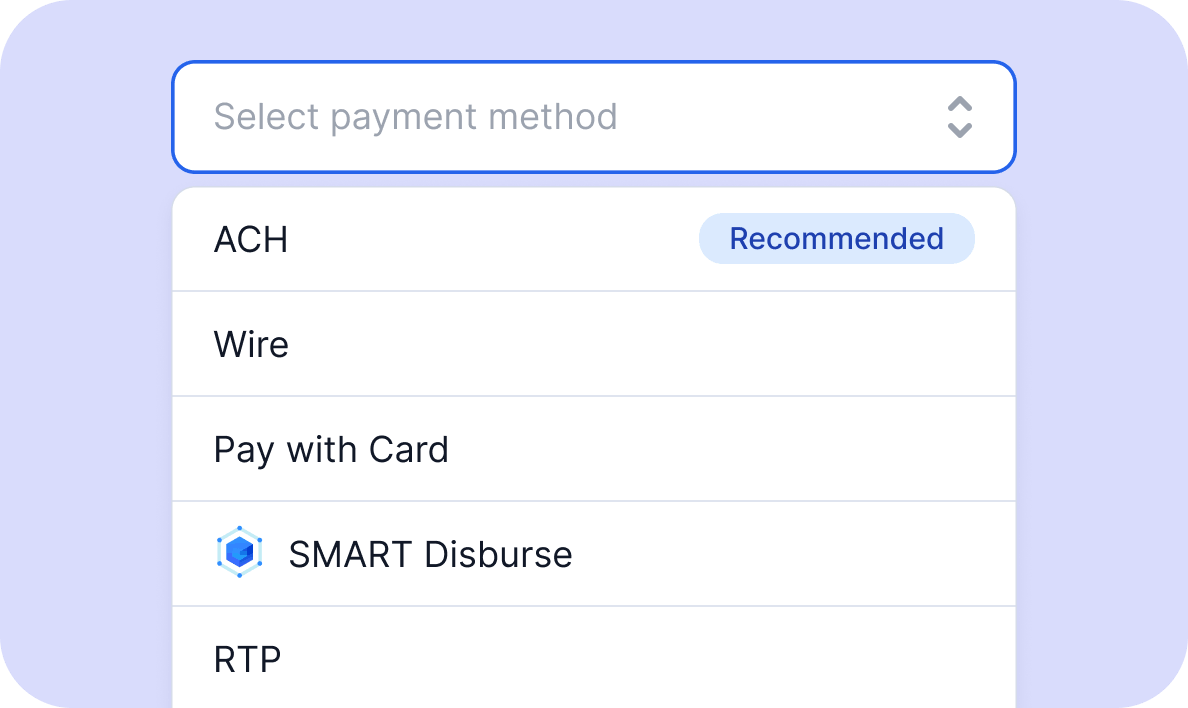
The intended customers include banks building payment services, fintechs embedding payouts, and finance departments in insurance, healthcare, property management and transportation. An insurer may need documents and signatures before releasing money. A property manager may need to return a deposit. Both need the payment to reach the right person and leave a usable accounting trail.
- 01Approve
- 02Choose
- 03Send
- 04Reconcile
Transcard sells B2B software and payment infrastructure through direct relationships and partners. Its positioning emphasizes existing bank accounts, multiple payment methods and connections to systems of record. Buyers can use prebuilt connectors, APIs or file integration. That makes the comparison with alternatives a workflow question: how much can the chosen combination of bank portal, ERP module and payment software carry from beginning to end?
For a buyer, the cost calculation should include integration, ongoing service and transaction charges, along with the staff time needed to handle exceptions. A faster payment can still be an expensive payment if someone has to repair its data afterward. The useful buying question is which manual steps disappear, which move to the recipient, and which remain with the finance team. A demonstration should follow one real transaction all the way back into the accounting record.
The invoice has a clock
Freight provides the next problem. A forwarder may have to pay a carrier before the shipper pays the forwarder. Freightos describes customer payment delays of 30-90 days after delivery. Making the outgoing transfer faster does little to close that interval. The missing ingredient is credit.
In October 2025, Transcard announced a partnership with OatFi to put financing into B2B payment workflows. The following month, Visa announced its freight collaboration with Transcard. By December, Freightos had announced point-of-booking payments and flexible financing for forwarders through WebCargo, supported by Visa, Transcard and OatFi. The practical idea is to offer payment terms at the moment a booking creates the need for cash.
International expansion adds different constraints. Transcard entered Canada in 2025 and partnered with Thredd on global issuance and virtual cards. Familiar screens still need local payment options, currencies and operating arrangements behind them. A platform’s international usefulness depends on those particulars.
Give the dashboard something to do
The company’s Virtual CFO extends the same argument into AI. In Microsoft’s November 2025 customer story, Samples describes a requirement for useful, actionable interactions. A warning about a cash shortfall becomes more useful when the system can propose the next step. These are the product’s ambitions and described capabilities, rather than an independently measured return.
“Every interaction must deliver real value, and it has to be actionable.”David Samples, CTO · Microsoft customer story, November 2025
The implementation lesson is pleasantly unglamorous. Pick one troublesome transaction. Count the handoffs, exceptions and manual entries. Establish who may approve an action, then check whether the resulting data actually reaches the ledger. An organization with inconsistent supplier records or an unsupported integration still has work to do. Credit requires approval; payment methods have costs; an AI recommendation needs permissions and dependable data.

That is the useful way to understand Transcard’s place in the market. Its proposition gathers the decisions and records surrounding a transfer into a connected process. The test is what happens afterward: whether the supplier knows, the customer can choose, and the accounting team can close the record without another little expedition through a spreadsheet.
Follow the money
Explore Transcard, the SMART Hub product, its blog and newsroom. Connect on LinkedIn, X, Instagram, Facebook or GitHub.
Watch: Transcard at QuickBooks Connect · The Future of Supply Chain · Transcard’s video channel.